
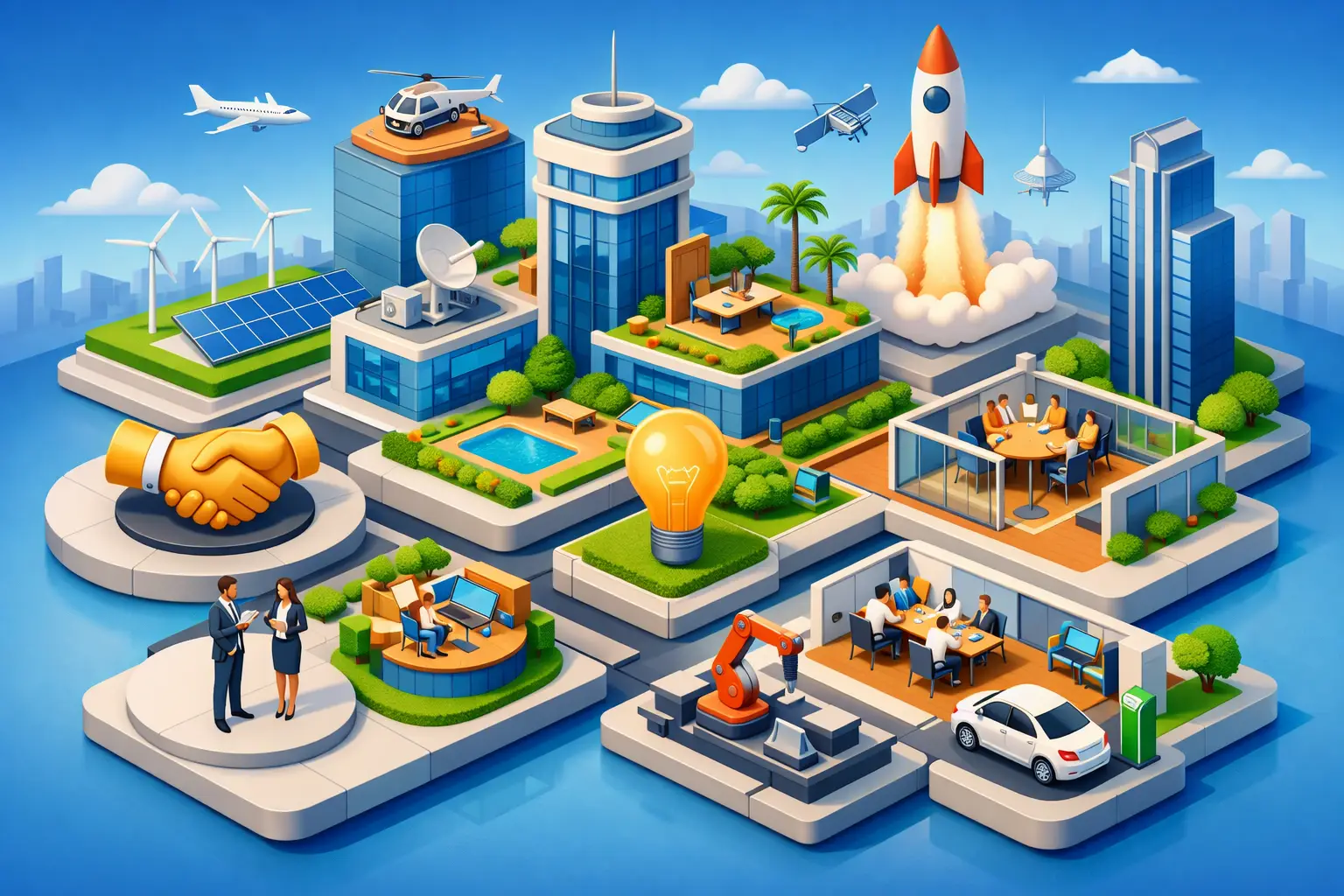
The companies that win the next industrial decade will not choose sites based on land alone. They will choose ecosystems that reduce time to production, protect margins, support talent, and keep expansion options open. That is the real answer to the question, what are 10 top reasons to set up innovation and production of technology products in Erisha Smart Manufacturing Hub? It is not one feature. It is the compounding value of infrastructure, policy alignment, sector depth, and operational readiness in one coordinated platform.
For advanced manufacturers, clean-tech operators, and technology product companies, location is now a strategic decision, not a real estate transaction. The right base can shorten launch cycles, improve supply-chain control, strengthen ESG positioning, and make future scaling far less expensive. Erisha was designed around that reality.
What are 10 top reasons to set up innovation and production of technology products in Erisha Smart Manufacturing Hub?
The strongest reason is simple: Erisha is built as a production ecosystem, not a generic industrial estate. For companies in EVs, hydrogen mobility, semiconductors, aerospace-adjacent manufacturing, renewable energy systems, and other advanced sectors, that distinction matters.
First, the infrastructure is purpose-built for technology production. Many industrial locations offer land and leave the tenant to solve everything else. Erisha takes a different position, with turnkey factories, modular industrial units, logistics facilities, and cleanroom-ready semiconductor spaces designed around modern manufacturing requirements. That lowers the friction between project approval and operational launch. For investors and operators, time saved at the start often becomes capital preserved later.
Second, the hub is structured for sector clustering rather than fragmented occupancy. Dedicated clusters for EVs, hydrogen mobility, eVTOL aircraft, and renewable energy production create proximity between manufacturers, component suppliers, engineering teams, and strategic collaborators. Clusters matter because innovation rarely happens in isolation. They reduce coordination costs, improve supplier responsiveness, and create stronger conditions for co-development. Companies evaluating industrial cluster performance may find useful context in this internal perspective on industrial cluster development example that works.
Third, Erisha supports both innovation and production in the same environment. That sounds obvious, but many locations separate R&D from manufacturing execution, creating delays between design, testing, validation, and scaled output. Erisha is built to close that gap. When product teams, pilot manufacturing, logistics planning, and commercial production can operate within one ecosystem, iteration becomes faster and less expensive. That is especially relevant for high-value technology products where process changes and quality control define competitiveness.
A lower-cost base without compromising strategic reach
Fourth, the operating-cost profile is a serious advantage. High-growth manufacturers do not just need prestige locations. They need cost structures that support long-term production economics. Ras Al Khaimah stands out for lower operating costs compared with many traditional industrial gateways, while still offering investor-friendly conditions and strong regional access. For boards evaluating total cost of occupancy, that combination can materially improve project viability.
Fifth, the logistics position strengthens regional and global market access. Advanced manufacturers depend on reliable inbound materials flow and outbound distribution routes. Erisha benefits from access to port infrastructure and connectivity across the GCC and beyond, giving occupiers a practical base for serving regional demand while maintaining export potential. A production site that reduces logistics complexity can improve working capital efficiency as much as it improves delivery speed.
Sixth, the regulatory environment in the UAE remains a major part of the investment case. Industrial operators need clarity, predictability, and structures that support capital deployment. The value here is not simply that the environment is investor-friendly. It is that regulatory alignment, industrial policy momentum, and economic diversification goals create a supportive backdrop for long-horizon manufacturing investment. For leadership teams comparing operating structures, the distinction explored in What’s Different in Erisha vs UAE Free Zones? can be useful.
Why advanced manufacturers need more than factory space
Seventh, Erisha is designed as a live-work-innovate environment, which directly affects workforce stability and productivity. This is one of the most underestimated advantages in industrial site selection. A factory can be built almost anywhere. A durable industrial community is harder to create. By integrating residential, healthcare, education, retail, hospitality, and R&D assets into the wider environment, the hub addresses a real operational issue: retaining skilled talent over time.
For advanced manufacturing businesses, labor is not interchangeable. Engineers, process specialists, quality teams, and technical operators stay longer in places that support daily life, family needs, and professional growth. The result is lower disruption, better continuity, and a more resilient operating model. That broader ecosystem logic is reflected in Why Hospitals and Colleges Belong in Erisha Hub.
Eighth, the ESG position is built into the platform rather than added as a marketing layer. Institutional investors, multinational partners, and major customers increasingly assess industrial locations through sustainability, compliance, and long-term resource efficiency. An ESG-compliant environment gives occupiers a stronger story with regulators, capital providers, and downstream buyers. It also supports future-proofing. Sites built around outdated environmental assumptions can become expensive to upgrade. Sites designed with sustainability in mind are better positioned for the compliance demands ahead.
This matters even more for companies in clean energy, electrified mobility, hydrogen systems, and next-generation transport technologies, where brand credibility and supply-chain integrity are under constant scrutiny. If your product claims a better future, your production base should support that claim.
The scale to start now and expand later
Ninth, scale matters, and Erisha is planned at a scale that supports long-term growth rather than short-term occupancy. Too many industrial tenants enter sites that work for phase one but fail at phase two or three. Expansion becomes constrained by neighboring uses, fragmented planning, or land limitations. Erisha was conceived as a large-scale mixed-use industrial project, which changes the growth equation. Companies can establish an initial footprint with greater confidence that future capacity, adjacent operations, and ecosystem services can evolve with demand.
That is particularly valuable for manufacturers entering the Middle East with a staged market strategy. They may begin with assembly, testing, or regional distribution, then move into deeper localization, supplier integration, and full-scale production. A scalable base protects that path. It also helps institutional partners and investors underwrite growth with fewer assumptions about relocation or operational fragmentation.
Tenth, the hub is aligned with future industries rather than legacy categories. This is not a site trying to retrofit itself to emerging sectors. It is being positioned around them. EVs, hydrogen mobility, semiconductors, eVTOL systems, renewable energy, health tech, and aerospace-related production all point in the same direction: higher-value manufacturing ecosystems with stronger technology intensity and longer strategic relevance.
That future-facing sector alignment creates practical value. It attracts more relevant tenants, deeper specialist services, and stronger partnership opportunities. A semiconductor operator has different needs from a conventional light manufacturer. An eVTOL components producer requires a different ecosystem from a generic warehousing tenant. Erisha is built around those distinctions. Companies considering specialized manufacturing environments can explore related context in Best Industrial Hubs for Semiconductors and Are eVTOL and Aircraft Parts Allowed in Erisha?.
The real strategic advantage is compounding, not isolated
Individually, each of these ten reasons is meaningful. Together, they create a more powerful result. Purpose-built infrastructure reduces setup friction. Cluster design increases collaboration. Integrated R&D and production improve speed. Lower costs support margins. Logistics connectivity expands reach. Regulatory clarity improves confidence. A live-work-innovate model strengthens talent retention. ESG readiness supports capital and customer expectations. Scalable planning protects growth. Sector alignment positions tenants inside the industries most likely to define the next economic cycle.
That combination is why Erisha stands apart from a standard industrial park. It is being shaped as economic infrastructure for companies that intend to build, export, innovate, and scale in the same place.
For decision-makers evaluating where to place advanced manufacturing capacity, the better question is not whether a site can host production. Many sites can. The better question is whether that site improves the economics, resilience, and strategic upside of production over the next decade. That is where Erisha makes its case.
If your business depends on speed to market, specialized facilities, investor confidence, workforce continuity, and access to high-growth regional demand, the location decision will influence far more than your factory footprint. It will influence how efficiently your entire industrial strategy performs.
