
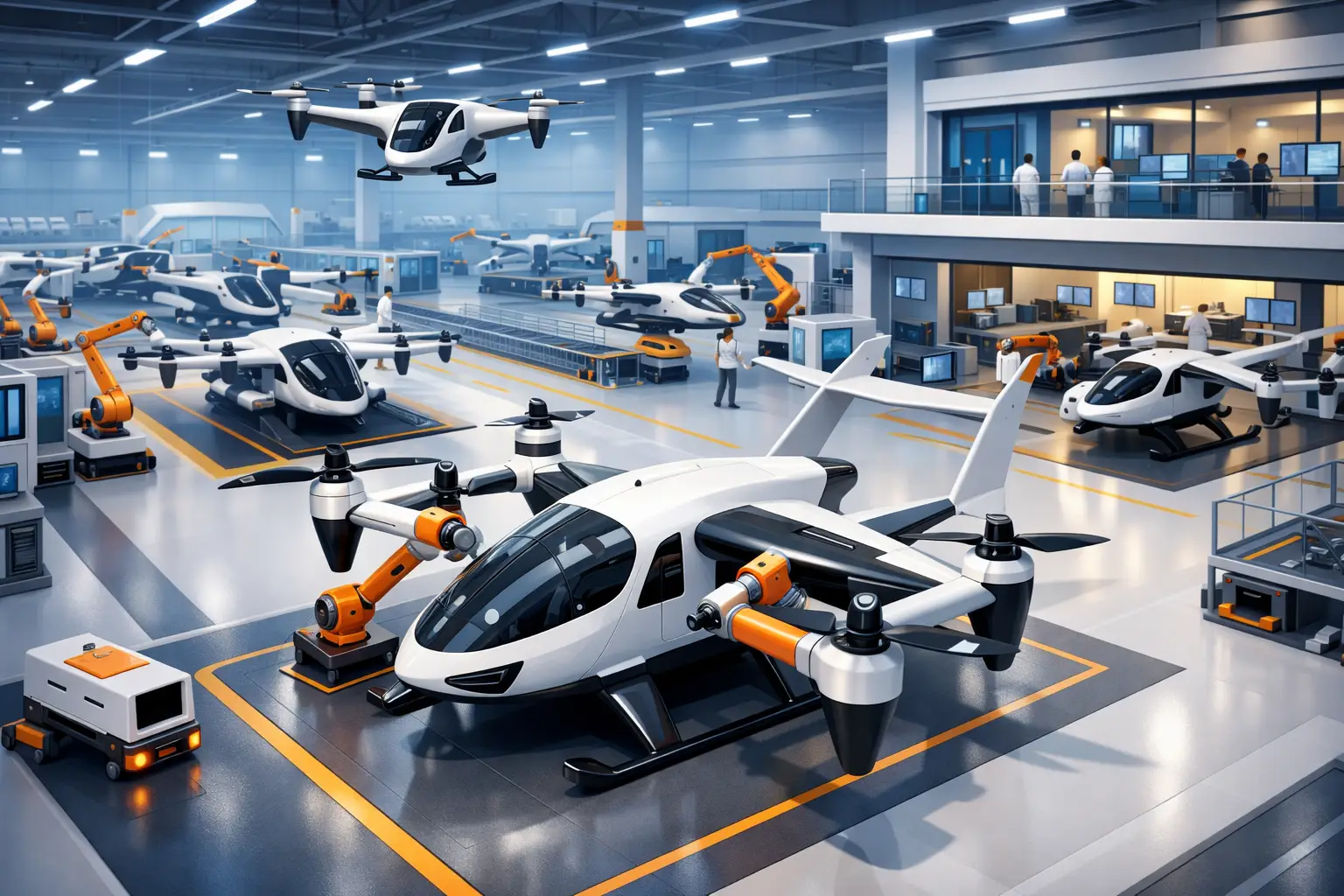
The companies positioned to lead the next aviation cycle will not be the ones with the boldest prototype footage. They will be the ones that can industrialize eVTOL production and connect all major places through eVTOL in a smart manufacturing hub with speed, compliance, and cost discipline. That shift changes the conversation from aircraft design alone to the full operating environment – supplier density, testing access, multimodal logistics, workforce housing, energy strategy, and regulatory alignment.
Why eVTOL production needs a smart manufacturing hub
eVTOL is often framed as a mobility story. For investors and operators, it is first a production story. Aircraft programs succeed when manufacturing, certification, maintenance planning, and network deployment move together. If one element lags, capital burns faster than scale arrives.
That is why the smart manufacturing hub matters. eVTOL production depends on a supply chain that looks more like a convergence of aerospace, automotive, battery systems, power electronics, advanced composites, and software-controlled systems. A fragmented industrial footprint drives delays, increases inventory exposure, and complicates quality control. A purpose-built hub reduces those points of friction by clustering the right industrial uses in one coordinated environment.
This is especially relevant for companies that are not just building aircraft, but building an operating model. If the commercial ambition is to connect airports, business districts, ports, logistics zones, tourism corridors, and strategic urban nodes, then the production base cannot sit in isolation from the transport ecosystem it is meant to serve.
eVTOL production and connect all major places through eVTOL in smart manufacturing hub
The phrase may sound ambitious, but the underlying logic is straightforward. To support eVTOL production and connect all major places through eVTOL in a smart manufacturing hub, you need two systems working in parallel.
The first is the industrial system. That includes assembly facilities, component manufacturing, battery integration, avionics support, quality labs, test infrastructure, spare parts warehousing, and MRO planning. The second is the connectivity system. That includes vertiport integration, road and port access, energy distribution, digital traffic management, and proximity to the economic zones where demand will actually materialize.
When these systems are separated, scaling becomes expensive. Aircraft leave the factory, but the ecosystem around deployment remains underdeveloped. When these systems are planned together, the hub becomes more than a production address. It becomes a launch platform for regional air mobility.
For industrial decision-makers, this matters because infrastructure timing is often the hidden determinant of project returns. A company may secure land and build a factory, yet still face delays due to logistics bottlenecks, workforce relocation issues, limited clean energy access, or weak ecosystem support. A smart manufacturing hub is designed to reduce those expansion constraints before they appear on the balance sheet.
What the right hub must deliver
A credible eVTOL manufacturing location needs more than zoned land. It needs an industrial architecture that supports precision, scale, and change over time.
First, facilities must accommodate multiple production stages. Early-stage assembly may require flexible modular units and pilot lines. As volumes increase, the same ecosystem should support larger footprints, supplier co-location, automated subassembly, battery handling protocols, and specialized testing environments. A hub that only works for phase one is not a strategic manufacturing base.
Second, logistics must be built for both inbound complexity and outbound speed. eVTOL programs rely on high-value imported components, sensitive electronics, composite materials, and strict handling standards. They also require efficient export pathways to regional and international markets. Direct access to ports, trade corridors, and investor-friendly regulations can materially improve production economics.
Third, the workforce model has to reflect reality. Advanced manufacturing now competes on talent retention as much as on machinery. Engineers, technicians, operators, software specialists, and quality teams do not choose locations based on factory specifications alone. They evaluate the surrounding ecosystem – housing, healthcare, education, retail, and quality of life. This is where a live-work-innovate model becomes commercially relevant rather than merely attractive.
Fourth, energy and ESG performance can no longer sit on the margins. eVTOL is closely associated with the future of lower-emission transport. If production is housed in facilities with poor energy planning, weak sustainability credentials, or limited renewable integration, the narrative and the economics start to diverge. Institutional capital is paying close attention to that gap.
The deployment case is broader than passenger travel
One reason eVTOL manufacturing is drawing serious attention is that the addressable market extends beyond urban passenger mobility. The most resilient manufacturing strategies will likely serve several mission profiles.
Passenger transfer between key commercial zones is the obvious case, especially where road congestion or geographic spread creates travel inefficiencies. But logistics and industrial service routes may become equally important. High-value cargo transfer, urgent medical supply movement, inter-facility connectivity, tourism circuits, and specialized defense-adjacent or infrastructure inspection applications all strengthen the business case.
That matters for a manufacturing hub because diversified end uses support more stable demand. A facility built only around one consumer mobility assumption carries greater risk. A facility integrated into a wider advanced mobility cluster has more room to adapt as market adoption evolves.
Where trade-offs become real
The opportunity is substantial, but the sector still faces hard operational questions. Certification timelines remain demanding. Battery performance, range, payload, and charging infrastructure continue to shape aircraft design choices. Vertiport standards and airspace integration are progressing, but unevenly across jurisdictions.
For manufacturers, this creates a practical tension. Do you build for near-term regulatory certainty, which may favor limited-route deployment and more conservative production scaling? Or do you build for future demand, accepting that some infrastructure and policy frameworks will mature after manufacturing capacity is already in place?
It depends on the company’s capital position, product maturity, and market entry strategy. Some will prioritize phased assembly with scalable modular expansion. Others will anchor themselves in a larger industrial ecosystem from the start, betting that proximity to supply chain partners, logistics assets, and policy-aligned development will outweigh the initial complexity.
This is why location strategy deserves board-level attention. The right hub lowers downside risk while preserving upside. It gives manufacturers the ability to start focused, then scale into a more complete ecosystem as certification, demand, and route authorization expand.
Why integrated industrial ecosystems will outperform standalone sites
Standalone industrial sites can appear efficient on paper. They may offer lower entry costs or faster initial occupancy. But for eVTOL, isolation creates hidden inefficiencies over time. Supplier travel increases. Testing coordination becomes harder. Recruitment becomes more expensive. Logistics workflows stretch across disconnected zones. Expansion often requires a second or third site rather than a planned progression within one ecosystem.
An integrated hub changes that equation. It allows advanced manufacturers to move from prototyping to assembly to supply chain localization with fewer structural disruptions. It also creates adjacency effects. Battery companies, electronics manufacturers, hydrogen mobility players, EV suppliers, and advanced materials firms often face overlapping operational needs. When these sectors are planned as part of one ecosystem, each tenant benefits from the maturity of the others.
That is the larger strategic case for places designed around industrial convergence rather than isolated occupancy. In that model, eVTOL is not a niche add-on. It is part of a broader next-generation manufacturing platform.
For investors evaluating long-term positioning in the Middle East and beyond, this is where ambition must meet execution. The strongest platforms will be the ones that combine industrial land, purpose-built facilities, port and corridor access, regulatory clarity, workforce infrastructure, and sustainability alignment in one coherent development logic. That is the kind of environment advanced aerospace-adjacent manufacturing needs if it is going to scale commercially rather than remain trapped in demonstration mode.
Rana Group’s vision for integrated industrial ecosystems reflects this market direction. The future of eVTOL will not be built by aircraft programs alone. It will be built by hubs that make production, deployment, and growth work together from day one.
The real question is no longer whether eVTOL will shape regional mobility. It is which manufacturing ecosystems will be ready when scale arrives.
