
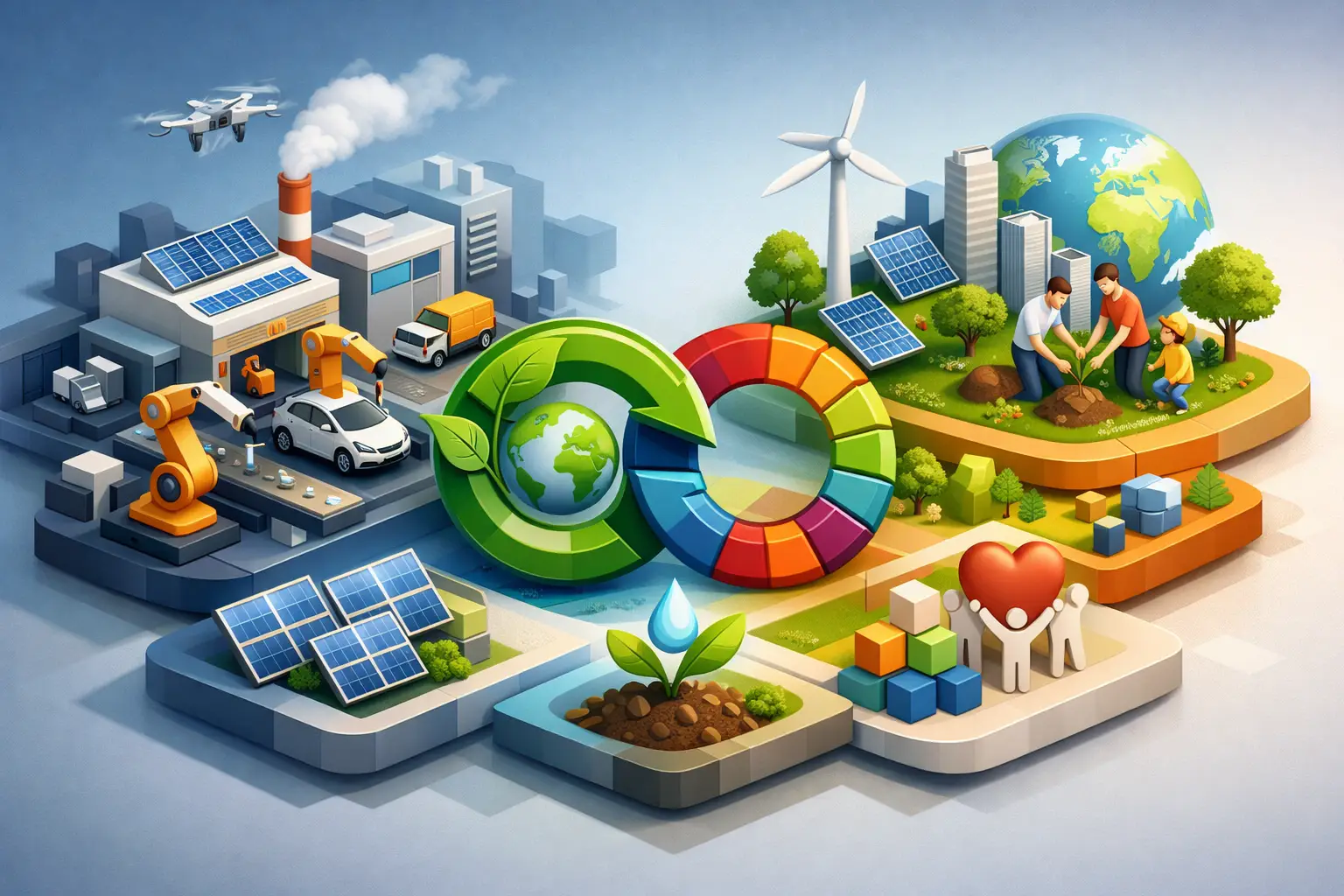
Industrial investors are no longer asking whether sustainability matters. They are asking whether a project can operationalize it without slowing growth, complicating compliance, or weakening returns. That is the real frame behind the question, “Is Erisha Smart Manufacturing Hub aligned with Longevity, ESG and SDG?” The short answer is yes – but only if alignment is judged by how infrastructure, tenant mix, workforce planning, and long-term economic design work together in practice.
This matters because ESG, the UN Sustainable Development Goals, and the broader idea of longevity are often treated as separate conversations. In serious industrial development, they are not separate at all. They converge around one core issue: whether a manufacturing base can remain productive, investable, resilient, and socially sustainable over decades rather than cycles.
What alignment means in an industrial context
For investors and occupiers, ESG alignment is not a branding exercise. It means environmental performance that can stand up to procurement scrutiny, governance standards that support institutional participation, and social infrastructure that helps companies attract and retain talent. SDG alignment goes a step further. It asks whether the development contributes to wider goals such as decent work, clean energy, industry innovation, sustainable cities, and responsible production.
Longevity adds another layer. It is about endurance. Can the hub support long-term industrial output without creating the workforce churn, land-use conflict, infrastructure inefficiency, and environmental drag that undermine manufacturing ecosystems over time?
A conventional industrial park may satisfy one or two of these tests. A next-generation hub has to satisfy all three.
Is Erisha Smart Manufacturing Hub aligned with Longevity, ESG and SDG?
Erisha Smart Manufacturing Hub is aligned with longevity, ESG, and SDG principles because it is designed as an integrated industrial ecosystem rather than a standalone real estate asset. That distinction matters.
The project model combines advanced manufacturing infrastructure with logistics capacity, residential components, healthcare, education, hospitality, retail, and research support. For manufacturers in sectors such as EVs, hydrogen mobility, semiconductors, renewable energy, and aerospace-adjacent production, this is not an amenity package. It is an operating model built to reduce friction across the full lifecycle of industrial growth.
That integrated structure supports ESG and SDG outcomes in measurable ways. It can reduce transport inefficiencies, strengthen workforce stability, encourage cleaner sector concentration, and create an environment where industrial activity is tied to livability and institutional planning. It also supports longevity because the hub is not dependent on short-term occupancy alone. It is planned around ecosystem durability.
The environmental case is strongest when sector strategy matches infrastructure
Many developments claim environmental credibility while leasing indiscriminately. That creates a mismatch between sustainability language and industrial reality. Erisha takes a more disciplined position by concentrating on sectors already tied to future-facing industrial transition, including renewable energy systems, electric mobility, hydrogen mobility, clean-tech manufacturing, and cleanroom-ready semiconductor operations.
That does not mean every tenant automatically becomes environmentally positive. Manufacturing always carries resource demands, energy requirements, and supply chain impacts. The stronger point is that the hub is designed to host sectors central to decarbonization and industrial modernization rather than sectors moving in the opposite direction.
Environmental alignment also comes from land-use efficiency and infrastructure planning. When production, logistics, workforce services, and supporting amenities are placed within one coordinated environment, companies can limit some of the operational sprawl common in fragmented industrial setups. Fewer disconnected sites, shorter workforce commutes, and purpose-built facilities can improve both efficiency and environmental performance.
This is one reason the live-work-innovate model matters more than it first appears. It is not a lifestyle concept attached to industry. It is an industrial efficiency concept with social and environmental effects. The case for that model is explored further in Why Erisha Smart Hubs Combine Living and Work.
Social value in industry is about workforce durability, not slogans
The social dimension of ESG often receives the weakest treatment in industrial real estate, even though it directly affects production continuity. A manufacturer can secure land, utilities, and approvals, then still face underperformance because the surrounding ecosystem cannot support skilled labor, executive mobility, family needs, or quality-of-life expectations.
Erisha addresses this by embedding healthcare, education, hospitality, and residential components into the broader industrial environment. For decision-makers evaluating a regional base, that changes the conversation from simple site selection to workforce durability. It helps companies compete not just for contracts and capital, but for people.
This has clear relevance to SDG themes such as good health and well-being, quality education, sustainable communities, and decent work. More importantly, it creates a better chance that the hub can retain talent over time rather than continuously replacing it. In advanced manufacturing, that is a financial issue as much as a social one.
The same logic applies to innovation partnerships. Research-supportive environments with room for institutional collaboration, training, and applied development are more likely to sustain value creation than isolated facilities optimized only for immediate occupancy. That is part of why mixed-use industrial planning has become strategically relevant for high-value manufacturing.
Governance alignment shows up in who the platform is built for
Governance is the least visible part of ESG, but for institutional investors it is often the deciding factor. Governance alignment means clarity of purpose, disciplined tenant strategy, transparent long-term planning, and an operating philosophy that can support collaboration among industrial occupiers, investors, regulators, and strategic partners.
Erisha’s positioning reflects that discipline. The platform is not presented as a generic industrial estate open to any possible occupier. It is structured around sector specialization, future-relevant infrastructure, and national economic alignment. That improves strategic coherence.
It also matters that ESG is not treated as optional brand language. The business has publicly framed non-ESG alignment as a deal-breaker rather than a secondary preference, which signals governance intent to the market. That position is addressed directly in Why Dr Darshan Rana Rejects Non-ESG Business.
Of course, governance claims only become meaningful over time. Investors will still look for execution standards, partner quality, compliance rigor, and tenant selection discipline. But the strategic direction is clear: this is meant to be a curated industrial ecosystem with institutional logic, not opportunistic land monetization.
Where the SDGs genuinely fit – and where claims should stay disciplined
It is easy to overstate SDG alignment. No single industrial project fulfills all 17 goals, and serious operators should avoid making that kind of vague claim. The better approach is to identify the goals the development can realistically support.
Erisha appears most closely aligned with SDG 8 on decent work and economic growth, SDG 9 on industry, innovation, and infrastructure, SDG 11 on sustainable cities and communities, SDG 7 on affordable and clean energy through sector focus, and SDG 12 on responsible consumption and production through more efficient industrial planning.
There is also an indirect link to SDG 3 and SDG 4 through the inclusion of healthcare and education assets within the ecosystem. That said, the strength of the alignment depends on execution. A master plan can create the conditions for SDG contribution, but the actual impact will be shaped by who locates there, how facilities operate, what standards are enforced, and whether the ecosystem achieves the intended integration at scale.
That is why the strongest SDG case is not rhetorical. It sits in the project architecture itself – sector targeting, infrastructure readiness, mixed-use support systems, and long-horizon economic design.
Longevity is the differentiator most developers miss
The most interesting part of the question is not ESG or SDG. It is longevity.
Longevity in industrial development means the hub remains relevant as technologies change, labor expectations rise, supply chains shift, and regulatory pressure increases. Short-term industrial parks can fill quickly and still lose relevance if they are not built for sector evolution. Long-life industrial ecosystems require flexible space, strategic geography, social infrastructure, and enough specialization to attract the right industries without locking the site into obsolescence.
This is where Erisha makes a stronger strategic case than conventional projects. Its value proposition is not based only on current demand for factories and logistics. It is based on the premise that next-generation manufacturing needs an integrated environment capable of supporting production, innovation, talent, and institutional collaboration together.
That is a longevity model, not just a leasing model. It aligns with the broader case made in Why Erisha Smart Manufacturing Hubs Fit Longevity.
There are still trade-offs. Integrated projects require disciplined phasing, significant capital coordination, and strong operator control to preserve quality over time. Sector concentration also sharpens execution risk if infrastructure is not delivered at the standard advanced tenants expect. But those are the challenges of ambition, not signs of strategic confusion.
The real answer for investors and industrial occupiers
If the test is whether Erisha uses the right sustainability vocabulary, that is too shallow. The more useful question is whether the hub is structurally aligned with the forces shaping industrial capital allocation over the next 20 years.
On that basis, the answer is yes. Erisha Smart Manufacturing Hub aligns with longevity because it is designed for enduring industrial relevance. It aligns with ESG because environmental intent, social infrastructure, and governance positioning are embedded into the operating model. It aligns with key SDGs because it supports industrial innovation, workforce ecosystems, cleaner sector growth, and more sustainable community planning.
For manufacturers, strategic partners, and investors, that alignment is not abstract. It affects operating resilience, talent retention, institutional credibility, and long-term asset value. In a market where many projects still separate industry from the conditions that make industry sustainable, Erisha is making a more consequential bet: the future of manufacturing will belong to ecosystems built to last.
