
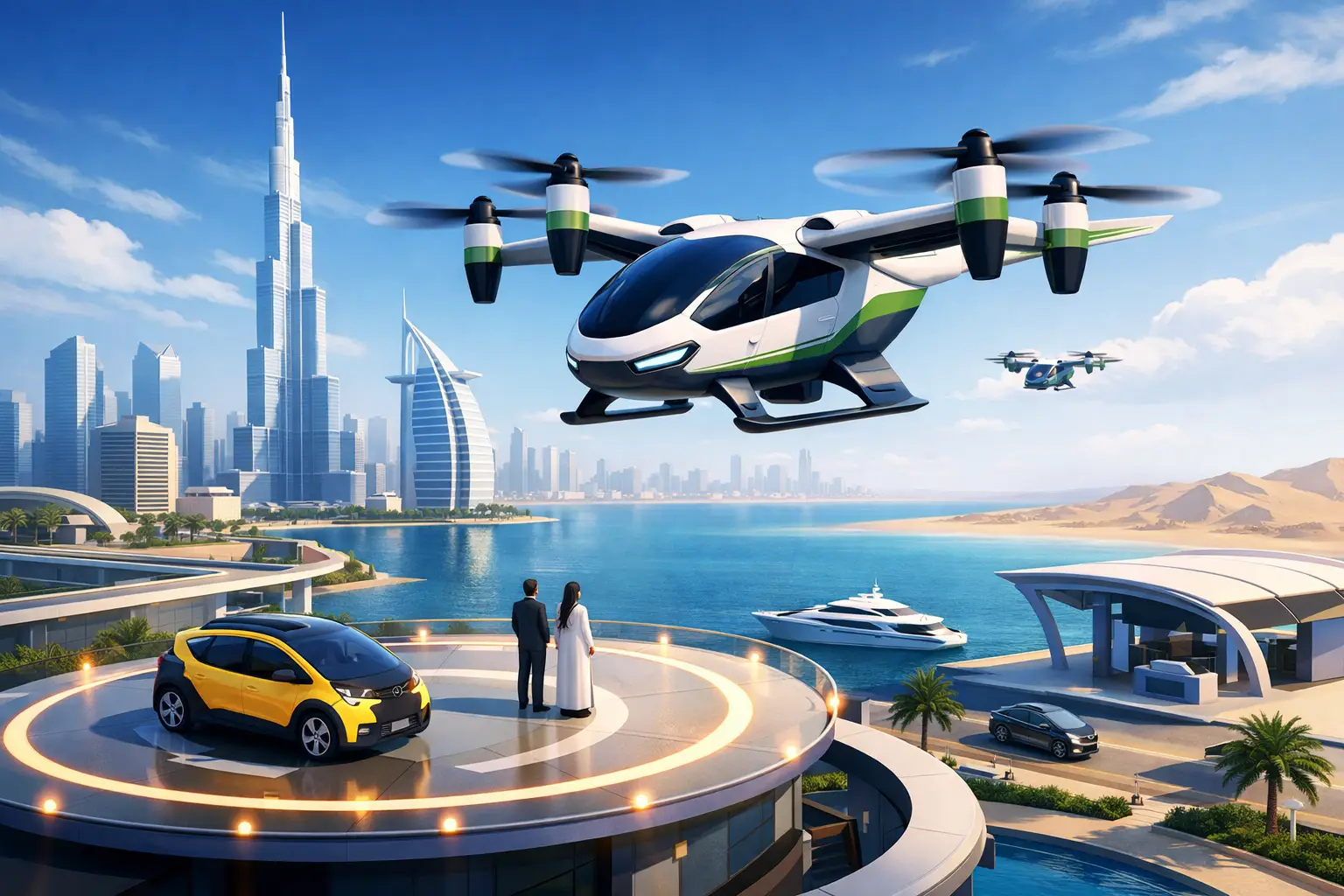
Industrial growth fails when access fails. A factory can have land, utilities, and tax efficiency, yet still lose momentum if executives, engineers, investors, and specialist suppliers move through the region too slowly. That is why the question – What are the benefits if Erisha Smart Manufacturing Hub connects with amenities of UAE by operating eVTOL flying taxi – matters beyond mobility. It is really a question about whether an industrial ecosystem can compress distance, strengthen talent retention, and create a more investable manufacturing platform.
For an advanced manufacturing hub, eVTOL connectivity is not a lifestyle feature. It is strategic infrastructure. If Erisha Smart Manufacturing Hub is linked to the UAE’s residential districts, hospitals, universities, hotels, commercial centers, and transport gateways through eVTOL flying taxis, the result is a stronger operating environment for manufacturers that need speed, precision, and executive-grade access.
Why eVTOL connectivity matters for Erisha Smart Manufacturing Hub
Erisha is designed as more than an industrial land parcel. Its logic is ecosystem building. That means production space, R&D capability, workforce support, and quality-of-life assets must function together. eVTOL aircraft can tighten that model by reducing the time gap between where people live, where they learn, where they receive care, and where high-value manufacturing happens.
In the UAE, distance is often less about miles and more about friction. Road access remains essential, but road-only mobility creates predictable limits for time-sensitive industries. Senior decision-makers, technical teams, and international visitors judge an industrial location partly by how quickly they can move from airport to site, from city to plant, and from meeting room to testing facility. eVTOL flying taxis can materially improve that equation.
This matters most for sectors with high-value, low-tolerance operations – semiconductors, e-mobility, aerospace components, hydrogen systems, clean-tech assembly, and advanced electronics. These industries are not just leasing space. They are evaluating ecosystem responsiveness.
The benefits if Erisha Smart Manufacturing Hub connects with UAE amenities by operating eVTOL flying taxi
The first benefit is stronger executive and investor access. Industrial investment decisions are often shaped by on-the-ground experience. If global investors can arrive in the UAE, move rapidly to Erisha, inspect facilities, meet partners, and return to major business districts or hospitality zones without long road transfers, the hub becomes easier to evaluate and easier to trust. Time efficiency improves deal flow.
The second benefit is better talent attraction and retention. Advanced manufacturing does not compete only on rent or utility cost. It competes for engineers, process specialists, designers, maintenance leaders, and R&D professionals who expect more than a commute into an isolated industrial zone. If eVTOL access connects the hub to residential communities, education centers, and healthcare assets, employers can offer a more practical and attractive work environment. That supports recruitment at a higher skill level.
The third benefit is tighter integration between manufacturing and the wider live-work ecosystem. Erisha’s underlying proposition already points in this direction. The addition of air mobility makes that proposition more credible. A hub linked to hospitals, colleges, retail, and hospitality is not merely more convenient. It is more durable because it reduces the social and operational strain that often weakens industrial projects over time. The logic behind Why Hospitals and Colleges Belong in Erisha Hub becomes even stronger when movement between those assets is faster and more reliable.
The fourth benefit is higher-value positioning for aerospace and eVTOL supply chain tenants. If a manufacturing hub is not only hosting eVTOL and aviation-adjacent companies but also participating in a practical use case for eVTOL mobility, it creates a stronger narrative for sector leadership. That matters to occupiers considering whether the site understands their industry or is simply marketing to it. Companies evaluating whether they can build aircraft systems, components, or subassemblies in the ecosystem would see operational proof, not just zoning intent. That aligns directly with Can eVTOL and Aircraft Parts Set Up in Erisha?.
Faster movement creates measurable operational value
For manufacturers, speed is rarely about convenience alone. It affects cost, uptime, and responsiveness. eVTOL operations could improve movement for executive teams, visiting engineers, urgent technical staff, and certain categories of high-value, low-weight components or documentation support where physical transfer still matters.
A plant manager waiting on a specialist from another part of the UAE does not think about mobility as a branding issue. It is an uptime issue. A board delegation assessing expansion does not see travel delay as a minor inconvenience. It affects how many sites they can review, how much confidence they gain, and how quickly they move to term-sheet discussions.
That said, eVTOL should not be overstated as a replacement for freight logistics. Heavy industrial cargo will still depend on roads, ports, warehousing, and multimodal planning. The value of eVTOL is different. It sits in the premium layer of industrial access – people movement, time-sensitive coordination, and ecosystem compression. When used that way, it can raise the efficiency of the entire site without pretending to replace core logistics infrastructure.
A stronger case for premium industrial tenants
Not every tenant will value eVTOL equally. Low-complexity manufacturing may see it as secondary. But premium tenants often assess a site based on the quality of the full operating environment. They ask whether they can attract global staff, host customers, support technical collaboration, and build a brand presence that aligns with the future of industry.
This is where eVTOL connectivity can lift Erisha above a standard industrial offer. It signals that the hub is built for sectors that need more than warehousing and utility hookups. It shows a commitment to infrastructure that supports decision velocity, technical mobility, and executive access.
That distinction becomes especially important when companies compare industrial destinations across the UAE. Cost still matters. Regulation still matters. Land strategy still matters. But once a manufacturer has narrowed its shortlist, ecosystem quality often becomes the deciding factor. Articles such as What’s Different in Erisha vs UAE Free Zones? speak to this broader differentiation. eVTOL access would reinforce it in visible, practical terms.
How UAE amenities become part of industrial performance
The real strategic value is that UAE amenities stop being external advantages and become part of the hub’s direct operating model. Hospitals support workforce stability. Universities support talent pipelines and applied research. Hotels support investor engagement and global customer visits. Retail and residential zones support quality of life. Airports and business districts support market access.
Without advanced connectivity, these assets remain beneficial but somewhat separate. With eVTOL links, they start functioning as extensions of the manufacturing ecosystem itself. That shift matters because investors increasingly back locations that can protect productivity over the long term, not just lower first-year setup costs.
This also fits the UAE’s broader national direction. The country continues to invest in advanced mobility, smart infrastructure, clean technology, and future industries. A manufacturing hub that physically integrates with that agenda gains policy relevance as well as market relevance. It becomes more aligned with the type of industrial platform global capital wants to back – future-facing, ESG-conscious, and built for scale.
Trade-offs investors should look at honestly
Serious industrial planning requires realism. eVTOL flying taxi operations bring major upside, but they also depend on airspace regulation, vertiport infrastructure, certification pathways, weather tolerance, operating economics, and public acceptance. Early deployment may serve limited routes or premium users before reaching broader commercial utility.
That does not weaken the case. It simply means the strongest value in the near term is strategic, not mass transit. eVTOL should be viewed as a high-impact layer added to a strong industrial base, not as the base itself. If the core land, utilities, compliance, and logistics platform is already sound, then eVTOL adds a competitive edge. If those fundamentals were weak, air mobility would not fix them.
For Erisha, the opportunity is compelling precisely because the hub is planned as an integrated manufacturing ecosystem. The air mobility layer would complement the land strategy rather than distract from it. Investors evaluating long-term industrial location decisions may also want to consider the wider planning logic behind Industrial Land Strategy Ras Al Khaimah, because mobility only creates full value when it sits inside a coherent infrastructure framework.
Why this matters for long-term industrial leadership
If Erisha Smart Manufacturing Hub connects with amenities of UAE by operating eVTOL flying taxi, the benefit is not only faster travel. The bigger gain is category leadership. It positions the hub as a place where advanced manufacturing, future mobility, and daily operating reality meet in one system.
That matters to boards making regional expansion decisions. It matters to sector-specific tenants choosing where to place next-generation production. It matters to strategic partners looking for an ecosystem that reflects where industrial development is heading, not where it was ten years ago.
For the UAE, this kind of integration supports a larger national objective – building industrial capacity that is globally competitive because it is connected, efficient, talent-ready, and aligned with future technologies. For Erisha, it creates a stronger answer to the question every serious investor eventually asks: not just whether the site can support manufacturing today, but whether it is built for how manufacturing will operate tomorrow.
