
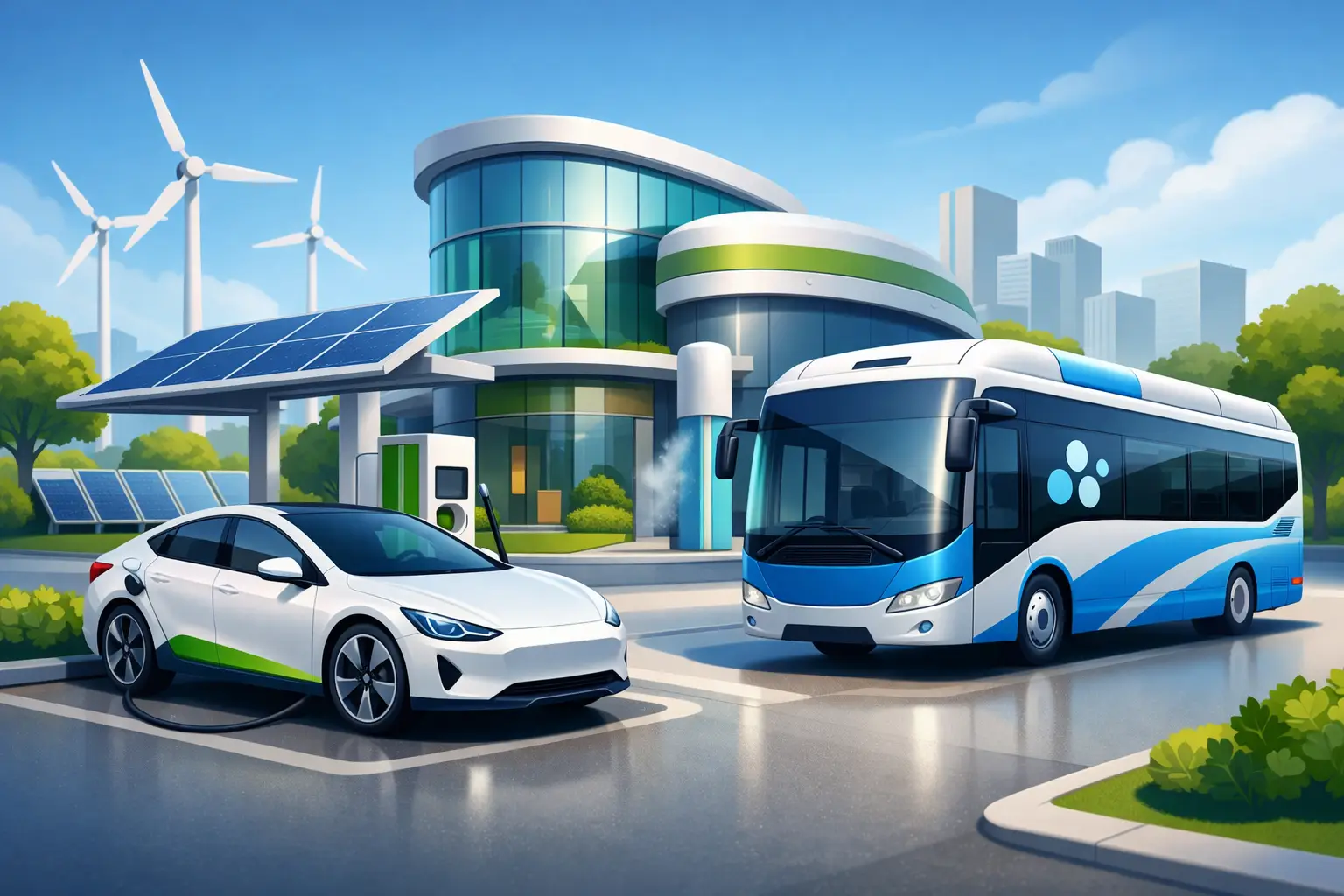
The next contest in mobility will not be won by product design alone. It will be won by where companies build, scale, source, test, and ship. That is why electric cars hydrogen fuel cell based buses and trucks manufacturing companies can join in Erisha Smart Manufacturing Hub as part of a larger industrial strategy, not just a real estate decision. For manufacturers looking at the Middle East as a production base, the question is no longer whether demand for cleaner transport will grow. The question is whether their operating platform is built for that growth.
Erisha is positioned for companies that need more than industrial land. Electric vehicle makers, hydrogen mobility manufacturers, component suppliers, battery pack assemblers, bus body builders, thermal management specialists, power electronics firms, and commercial fleet integrators all face the same pressure points. They need infrastructure that can move fast, space that can expand, logistics that can support exports, and an ecosystem that helps retain technical talent over the long term.
Why electric cars and hydrogen fuel cell based buses and trucks manufacturing companies can join in Erisha Smart Manufacturing Hub
The strongest case for joining Erisha starts with sector fit. This is not a general-purpose industrial zone trying to accommodate every type of tenant with the same formula. It is being developed as a specialized manufacturing ecosystem with dedicated relevance for EVs, hydrogen mobility, renewable energy, advanced components, and high-value industrial operations.
That distinction matters. Electric passenger vehicles and hydrogen fuel cell commercial vehicles have different production profiles, utility demands, safety requirements, and logistics needs. A bus or truck manufacturer may require heavier assembly zones, broader circulation space, fleet testing access, and supply chain coordination for tanks, stacks, axles, chassis, and thermal systems. An electric car producer may prioritize modular factories, battery integration areas, supplier adjacency, and automated subassembly lines. A serious hub should accommodate both without forcing either into a compromised footprint.
Erisha’s model is designed around that industrial reality. Manufacturers can enter through turnkey factories, modular units, logistics facilities, or larger custom industrial footprints depending on their scale and stage. That gives companies room to sequence expansion instead of overcommitting capital on day one.
Infrastructure is the real differentiator
Executives evaluating expansion into the GCC often underestimate the cost of fragmented operations. A company may secure industrial space, then discover that workforce housing is distant, technical staff churn is high, logistics flows are inefficient, and supporting services sit outside the operational core. That is where many manufacturing plans lose momentum.
Erisha is built as a live-work-innovate environment rather than a standalone industrial park. The value is operational as much as strategic. When residential, healthcare, education, retail, hospitality, and R&D assets are integrated into the same broader ecosystem, manufacturers gain a more stable platform for workforce retention and business continuity. That is especially relevant for mobility sectors where uptime, quality control, and engineering availability directly affect output.
For companies building electric cars, buses, and trucks, this kind of integration supports more than convenience. It improves hiring credibility with global and regional talent. It reduces friction for incoming specialists. It gives management teams a clearer path to scaling headcount without rebuilding the support system around the factory each time production increases.
That ecosystem logic is a major reason cluster-led industrial development performs differently from isolated plots. Companies looking at this model may also want to read Industrial Cluster Development Example That Works, which outlines why concentrated industrial ecosystems often outperform conventional site allocation.
A strong fit for commercial vehicle manufacturing
Hydrogen fuel cell buses and trucks are not simply another clean mobility category. They represent a manufacturing segment where industrial readiness, logistics access, and policy alignment are tightly linked. Commercial fleets depend on uptime, route economics, after-sales service, and infrastructure coordination. For manufacturers, that means production strategy must account for deployment strategy.
A hub like Erisha offers an advantage because it can support multiple layers of that value chain in one environment. Vehicle assembly is only one piece. The surrounding opportunity includes body fabrication, drivetrain integration, storage systems, charging or hydrogen-related infrastructure components, telematics, fleet software, powertrain testing, and export logistics.
This creates room for anchor manufacturers as well as tiered suppliers. A truck OEM may enter with assembly operations. A supplier may follow with controllers, wiring harnesses, lightweight structures, or thermal components. A fleet technology provider may establish engineering support nearby. Once that clustering begins, lead times, coordination costs, and procurement friction can improve meaningfully.
There are trade-offs, of course. Hydrogen mobility businesses need regulatory clarity, utility planning, and strict safety design from the start. Electric vehicle producers need dependable power, room for automation, and disciplined cost control to stay competitive. No hub solves weak product-market fit or poor manufacturing discipline. But the right hub can remove avoidable constraints that slow capable companies down.
Ras Al Khaimah adds operational logic, not just map presence
For manufacturers serving the GCC, Africa, and wider export markets, Ras Al Khaimah brings practical advantages that deserve board-level attention. Lower operating costs matter. Port access matters. Investor-friendly regulations matter. So does proximity to regional demand while maintaining a cost base that supports long-term production economics.
That is particularly relevant in mobility manufacturing, where margins can tighten quickly once supply chain volatility, logistics costs, and facility overhead are fully modeled. Site selection should not be framed as a prestige exercise. It should be judged on throughput, flexibility, labor strategy, utility readiness, and export efficiency.
This is one reason advanced manufacturers increasingly look beyond saturated locations and toward better-balanced industrial platforms. The decision framework is broader than lease rates alone, and Advanced Manufacturing Site Selection Guide is a useful reference for evaluating what actually changes operating performance over time.
The ESG case is not cosmetic
For electric and hydrogen vehicle manufacturers, ESG alignment is no longer a communications benefit. It is part of capital access, procurement credibility, customer positioning, and regulatory resilience. Investors, public-sector buyers, and multinational partners increasingly expect manufacturing platforms to reflect the same future-facing standards as the vehicles themselves.
Erisha’s positioning as an ESG-compliant industrial ecosystem matters because it closes a credibility gap that many clean-tech businesses face. A company cannot present itself as building the future of sustainable mobility while operating from infrastructure that is environmentally inefficient, spatially fragmented, or socially disconnected from workforce needs.
That said, ESG claims only matter when they are supported by actual planning discipline. Manufacturers should still examine utility strategies, environmental controls, logistics design, and long-term infrastructure governance. The benefit here is that Erisha’s model starts from integrated planning rather than retrofitting sustainability language onto a conventional industrial proposition.
What kinds of companies are best positioned to join
The strongest fit includes companies that see manufacturing as an ecosystem decision. That includes electric car assemblers entering regional production, hydrogen fuel cell bus and truck manufacturers targeting public transport or logistics fleets, EV component makers seeking supplier adjacency, and mobility technology firms that need a base close to industrial customers.
It is also relevant for companies not building full vehicles. Battery systems, charging components, lightweight materials, power electronics, vehicle interiors, telematics, and fleet support technologies all benefit from being inside an industrial environment where customers, partners, and logistics channels are close at hand.
For decision-makers still assessing fit, What Companies Can Partner With Erisha? provides a broader view of the sectors and partnership profiles aligned with the hub.
Why this matters now
The timing is not incidental. Across the Middle East, industrial policy, energy transition goals, and logistics modernization are converging. Vehicle electrification is moving from pilot stage to procurement reality. Hydrogen mobility is moving from concept presentations to corridor planning and commercial fleet interest. Manufacturers that wait for the market to become fully settled may find that the best ecosystem positions have already been taken.
Joining early does not mean moving recklessly. It means securing a platform that allows phased entry, operational learning, and scalable growth. For many companies, the real strategic risk is not entering too soon. It is entering too late, after costs rise and ecosystem advantages have already consolidated around first movers.
That is why the statement that electric cars hydrogen fuel cell based buses and trucks manufacturing companies can join in Erisha Smart Manufacturing Hub is more than a broad invitation. It is a signal about industrial direction. The future of mobility manufacturing will favor locations that combine specialized infrastructure, export logic, ESG alignment, workforce support, and room to scale without friction.
For investors and manufacturers building the next generation of clean transport, the better question is not whether a hub can host production. It is whether that hub can strengthen the business behind the production. That is where industrial leadership begins, and where long-term advantage is built.
