
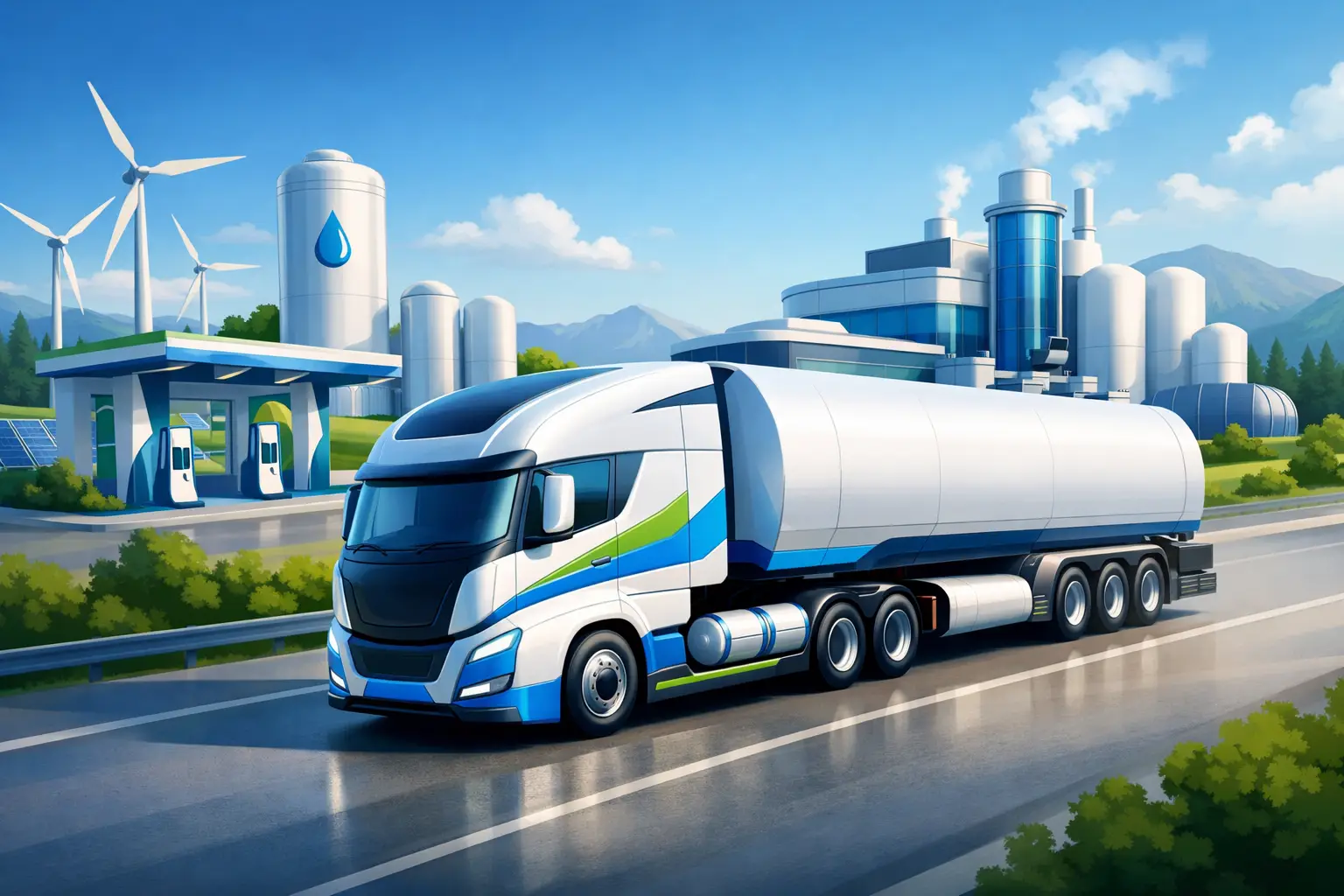
Freight decarbonization stops being theoretical when manufacturing capacity, energy strategy, and logistics infrastructure are planned together. That is why the move by Erisha E Mobility will produces hydrogen fuel cell powered long haul trucks in Erisha Smart Manufacturing hub matters far beyond a product launch. It signals a more serious industrial shift – one where clean mobility is built inside an ecosystem designed for scale, supply chain coordination, and long-term operating efficiency.
For investors, manufacturers, and strategic partners, this is not just a transportation story. It is a manufacturing platform story. Long-haul hydrogen trucks are among the hardest clean-mobility categories to industrialize because they depend on more than vehicle assembly. They require heavy engineering capability, fuel system integration, logistics access, industrial land, component ecosystems, regulatory readiness, and proximity to growth markets. Without those ingredients in one place, ambition rarely becomes output.
Why hydrogen long-haul trucks matter now
Battery electric vehicles have established clear momentum in urban delivery and short-range transport, but long-haul freight has a different operating profile. Range requirements are higher, payload sensitivity is more critical, and downtime carries a sharper financial penalty. In those conditions, hydrogen fuel cell powertrains remain highly relevant.
The case is straightforward. Hydrogen trucks can support extended driving range, faster refueling than large battery charging cycles, and lower payload compromise in some heavy-duty use cases. That does not mean hydrogen replaces battery electric trucking across the board. It means the freight market is segmenting, and long-haul routes are one of the places where hydrogen has a credible industrial role.
That distinction matters for decision-makers. The commercial question is no longer whether one technology wins everything. It is which technology fits which operating environment, and whether the manufacturing base behind it can support fleet deployment at scale.
Erisha E Mobility hydrogen truck production is an ecosystem play
If Erisha E Mobility is producing hydrogen fuel cell powered long-haul trucks in the Erisha Smart Manufacturing Hub, the strategic value lies in where production is happening as much as in what is being built. Advanced vehicle manufacturing does not thrive in fragmented industrial settings. It performs best in environments where land, utilities, supplier adjacency, mobility testing, warehousing, and workforce support are coordinated from the beginning.
That is the larger significance of the Erisha model. The hub is positioned not as a conventional industrial park but as a purpose-built environment for next-generation sectors – including EVs, hydrogen mobility, aerospace-adjacent manufacturing, semiconductors, and renewable energy. For a hydrogen truck program, that sector alignment creates practical advantages. Component suppliers, energy partners, logistics operators, fleet customers, and R&D stakeholders can operate in closer proximity, reducing coordination friction that often slows industrial ramp-up.
This is also where the economics become more compelling. Clean-mobility manufacturing is capital-intensive, especially in early growth stages. Operating cost structure, land availability, facility flexibility, and market access can determine whether a plant becomes regionally competitive or strategically constrained. A hub built for advanced manufacturing changes that equation by lowering the infrastructure burden on each individual tenant.
What makes hydrogen truck manufacturing more demanding than standard vehicle assembly
Hydrogen fuel cell truck production is not simply a matter of adapting a light vehicle line. The engineering stack is more specialized, and the industrial requirements are more layered. Fuel cell systems, hydrogen storage tanks, thermal management, electric drivetrains, power electronics, lightweight structural integration, and safety protocols all need to work together under demanding duty cycles.
Then there is the downstream challenge. Customers in long-haul freight do not buy on narrative alone. They buy on total cost of operation, serviceability, uptime, route viability, and fuel access. That means manufacturers need more than production space. They need an industrial base that can support validation, aftersales capability, parts movement, and partnerships around hydrogen distribution.
This is why cluster development matters. In a well-planned industrial ecosystem, manufacturers are not left solving every adjacent problem alone. The surrounding platform can support co-location of suppliers, logistics partners, storage facilities, clean energy stakeholders, and workforce-serving infrastructure. The result is a stronger path from prototype to volume production. Readers looking at the broader logic of this approach can see it in Industrial Cluster Development Example That Works.
Why the Erisha Smart Manufacturing Hub is a strategic fit
Hydrogen mobility needs room to scale. Not just physical room, but policy room, logistics room, and partnership room. A smart manufacturing hub with dedicated advanced-industry positioning offers all three.
First, there is the infrastructure question. Heavy vehicle production requires land, large-format facilities, utility planning, storage capacity, and efficient freight movement. Second, there is the market-access question. A manufacturing base connected to regional trade corridors and export pathways is better positioned to serve GCC demand as well as international customers. Third, there is the talent and retention question. High-value industrial operations increasingly depend on ecosystems where engineers, operators, technicians, and leadership teams can work within a broader live-work environment rather than a disconnected industrial zone.
That integrated model is particularly relevant for hydrogen truck production because commercialization depends on sustained collaboration across engineering, operations, logistics, and institutional stakeholders. Facilities matter, but ecosystem continuity matters more.
The hub’s relevance also sits within a larger transition already taking shape across mobility categories. The direction is not limited to one vehicle class, as reflected in Electric Cars, Hydrogen Buses Join Erisha Hub. That kind of sector adjacency supports shared infrastructure logic, stronger supply-chain density, and a more investable clean-mobility narrative.
The investment case behind hydrogen freight manufacturing
For industrial investors and expansion leaders, the headline is not only that hydrogen trucks may be produced. The sharper question is whether the production environment can support durable value creation.
A serious manufacturing case rests on five factors: scalability, cost efficiency, export readiness, ESG alignment, and strategic relevance to regional industrial policy. Hydrogen long-haul truck production checks these boxes only when it is embedded in a platform capable of handling industrial growth over time. A factory alone can assemble vehicles. An ecosystem can attract suppliers, improve delivery economics, support future model expansion, and deepen institutional partnerships.
There is also timing advantage. Freight decarbonization is still early enough that manufacturing footprint decisions made now can shape regional market leadership for years. Companies that establish operations in the right ecosystem can gain an edge in supply relationships, policy alignment, customer pilots, and infrastructure coordination before the market becomes crowded.
That does not remove execution risk. Hydrogen adoption still depends on corridor development, fueling infrastructure, vehicle economics, and customer confidence. But those are reasons to choose a stronger industrial platform, not reasons to delay strategy altogether.
A realistic view of the hydrogen opportunity
Hydrogen mobility should be discussed with discipline, not hype. The opportunity is real, but it is not uniform across every route, fleet, or geography. Some operators will remain better served by battery electric solutions, especially in short-haul and depot-based models. Others may delay adoption until fueling networks mature or policy incentives improve.
Yet long-haul freight remains one of the most credible use cases for hydrogen because the operational pain points are well defined. Where fleets need high utilization, extended range, and fast turnaround, fuel cell trucks have a practical argument. If production can be localized within a cost-efficient, export-oriented manufacturing hub, that argument becomes more investable.
This is where site strategy becomes decisive. The right location does more than reduce costs. It shortens time to production, supports ecosystem partnerships, and improves resilience as the business scales. For executives assessing industrial fit, Advanced Manufacturing Site Selection Guide offers a useful lens on what separates viable expansion platforms from expensive compromises.
What this signals for partners and industrial occupiers
The production of hydrogen fuel cell powered long-haul trucks inside the Erisha Smart Manufacturing Hub sends a larger market signal. It shows that advanced clean-mobility programs increasingly want to operate in coordinated industrial ecosystems rather than standalone facilities. That shift has implications for suppliers, energy companies, logistics providers, fleet operators, technical institutions, and capital partners.
For suppliers, it creates a pathway into a specialized manufacturing cluster. For fleet and logistics stakeholders, it opens the door to closer engagement with vehicle development and deployment planning. For institutional investors, it demonstrates that future-ready industrial infrastructure is becoming a competitive asset class in its own right.
It also reinforces a broader point about industrial transformation in the Middle East. The next chapter of manufacturing growth will not be defined only by factories. It will be defined by ecosystems that combine infrastructure, sector specialization, sustainability alignment, and market connectivity in one operating model. On that front, Rana Group is positioning a platform where the future works.
If hydrogen freight is going to move from promise to production, it will happen in places built to carry the weight of that transition.
