
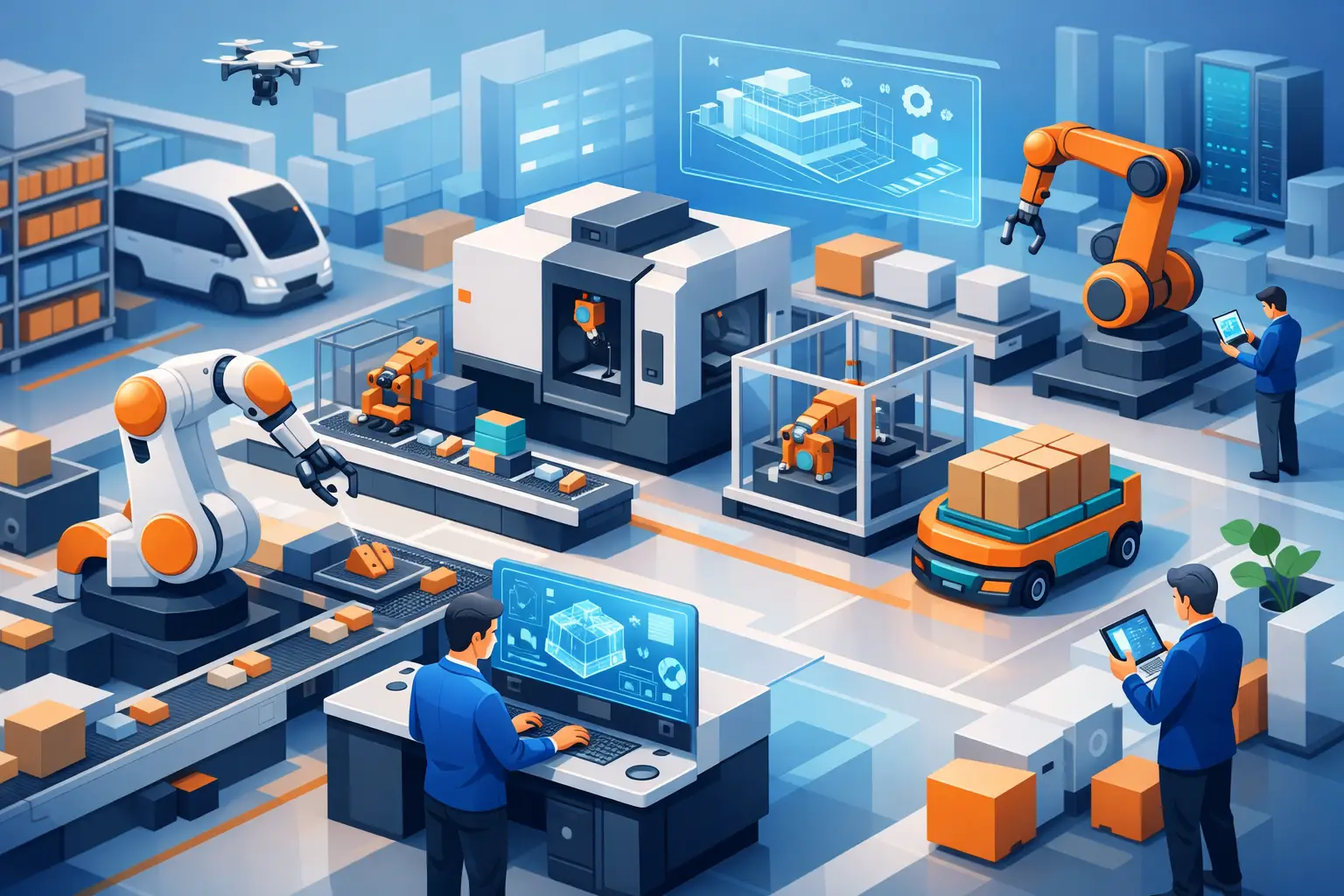
Production leadership is rarely created by a single advantage. It comes from a system that removes friction, lowers cost, protects quality, and gives manufacturers room to scale. That is the real answer to the question, What are the factors which make production much advance and competitive in Erisha smart manufacturing hub? The answer is not one feature. It is the combined effect of infrastructure readiness, sector clustering, logistics access, workforce support, ESG alignment, and a master plan built for industrial growth rather than short-term occupancy.
For manufacturers and investors, that distinction matters. A standard industrial zone may offer land and utility access. An advanced hub must do much more. It must reduce time to market, support high-value production, strengthen supply chain resilience, and create the conditions for continuous innovation. Erisha is positioned around that broader industrial logic.
Why production competitiveness depends on the whole ecosystem
Advanced production is not just about what happens inside the factory walls. It is shaped by what surrounds the factory – suppliers, logistics, workforce housing, healthcare, R&D capability, compliance support, and the ability to expand without disruption. When these pieces are fragmented across different locations, manufacturers absorb the cost through delays, talent churn, transport inefficiencies, and operational complexity.
Erisha’s model addresses that problem by building a live-work-innovate ecosystem instead of a conventional industrial park. For decision-makers in semiconductors, e-mobility, hydrogen, aerospace-adjacent manufacturing, and renewable energy, that changes the economics of scale. It means operations are not isolated assets. They sit inside an environment designed to support production continuity and long-term industrial retention.
That integrated approach is one reason the hub becomes more competitive over time. It is not merely attractive on day one. It becomes stronger as more industrial, technical, and institutional capabilities accumulate around it.
What are the factors which make production much advance and competitive in Erisha smart manufacturing hub?
The first factor is purpose-built infrastructure. Advanced manufacturing cannot rely on generic sheds and retrofitted units forever. It requires facilities aligned with process needs, whether that means turnkey factories, modular industrial units, logistics assets, or cleanroom-ready spaces for semiconductor and precision industries. Infrastructure that is planned around sector requirements shortens setup timelines and reduces costly customization after occupancy.
The second factor is sector specialization. Erisha is structured around high-growth industrial segments such as EVs, hydrogen mobility, eVTOL aircraft, renewable energy systems, and advanced technology manufacturing. This matters because sector concentration creates practical advantages. Shared suppliers, specialized service providers, common utility requirements, and talent overlap all help lower production costs and improve execution speed. A manufacturer entering a relevant cluster is not building alone. It is entering an operating environment that already understands its technical and commercial needs.
That cluster logic is especially important for industries with fast product cycles and high compliance demands. In those sectors, proximity to aligned businesses and institutional partners can shorten development cycles and support more efficient industrial collaboration. The dynamic is similar to what we outline in Industrial Cluster Development Example That Works, where the value of a hub comes from concentrated capability, not just co-location.
The third factor is scalability. Competitive production depends on the ability to expand capacity without relocating or rebuilding the business model from scratch. A manufacturer may begin with a moderate footprint and then require adjacent assembly, warehousing, testing, or supplier space. In a constrained environment, growth triggers disruption. In a master-planned industrial ecosystem with scale, expansion becomes a managed process. That reduces strategic risk for multinational manufacturers planning phased market entry.
Cost structure is as important as technology
Manufacturers do not gain competitiveness from advanced equipment alone. They gain it by improving the total cost equation. Erisha’s location strategy is built around lower operating costs compared with more saturated industrial markets, while maintaining connectivity to regional and global trade routes. For production leaders, this is not a secondary benefit. It directly affects margin, pricing flexibility, and capital efficiency.
Port access and broader logistics connectivity are central here. Manufacturing competitiveness weakens when import of components, export of finished goods, and regional distribution all require unnecessary complexity. A strategically positioned base in Ras Al Khaimah supports movement into GCC markets while maintaining reach to wider international supply chains. That gives occupiers a practical route to serve both regional demand and export-oriented production models.
Land economics also matter. High-value manufacturing often needs more than one building type – production halls, testing areas, warehousing, employee services, and future reserve capacity. When land is scarce or overpriced, manufacturers are pushed into fragmented layouts that weaken efficiency. An industrial strategy with room to scale protects the operating model from that pressure. Our perspective on this is closely tied to Industrial Land Strategy Ras Al Khaimah, where the long-term value of land availability becomes clear.
Workforce stability strengthens factory performance
One of the least appreciated drivers of production competitiveness is workforce retention. Factories do not perform at a world-class level when talent is forced into long commutes, weak social infrastructure, or disconnected living conditions. Skilled technicians, engineers, supervisors, and R&D teams stay longer and work better when the broader environment supports their lives, not just their jobs.
This is where Erisha’s mixed-use model becomes strategically important. Residential, healthcare, education, retail, and hospitality assets are not lifestyle extras. They are industrial enablers. They reduce attrition, support international talent attraction, and create a more stable labor base for sophisticated production environments.
For advanced manufacturing, stability translates into measurable value. Lower turnover protects process quality. Better access to services improves attendance and morale. Education and training proximity support workforce development. Healthcare access reduces operational vulnerability. These factors are often invisible in early site comparisons, but they become decisive over a five- to ten-year investment horizon. That is why integrated social infrastructure deserves as much attention as the factory shell itself. We address that more directly in Why Hospitals and Colleges Belong in Erisha Hub.
ESG readiness is now a production requirement
For many manufacturers, ESG is no longer a reporting layer added after operations begin. It is now part of customer qualification, investor review, procurement selection, and regulatory strategy. Production becomes more competitive when it is based in an environment that supports cleaner energy logic, more efficient land use, and future-facing industrial compliance.
Erisha’s alignment with sustainability and next-generation sectors gives manufacturers an edge in this area. Companies producing for automotive electrification, hydrogen systems, clean energy equipment, or advanced mobility need an industrial home that reinforces their market position rather than contradicting it. An ESG-compliant ecosystem supports that credibility.
There is also a practical side. Cleaner planning frameworks, efficient utility strategies, and integrated development often reduce waste, transport inefficiencies, and operating friction. ESG is frequently treated as a brand issue, but in advanced manufacturing it is equally an operating issue. Better environmental performance can support cost discipline, customer trust, and institutional financing access at the same time.
Innovation capacity increases when manufacturing and R&D stay close
The most competitive production hubs are not only places to assemble products. They are places where design, testing, iteration, and manufacturing can exist in active dialogue. When product development is physically and strategically disconnected from production, time is lost at every stage – engineering changes, validation cycles, supplier adjustments, and process optimization.
Erisha’s ecosystem model creates the conditions for stronger interaction between manufacturing operations, research capability, and institutional partners. That matters most in sectors where technology evolves quickly, including semiconductors, mobility systems, energy hardware, and aerospace-adjacent components. A factory in that environment does more than produce at scale. It becomes part of a broader innovation loop.
This is one reason advanced manufacturers increasingly choose ecosystems over isolated facilities. The future belongs to sites where product improvement can happen closer to production reality. That is especially relevant for companies evaluating specialized industrial environments, as discussed in Best Industrial Hubs for Semiconductors.
Regulatory clarity and investor confidence accelerate execution
A competitive manufacturing base must also be easy to do business in. Investor-friendly regulations, transparent operating conditions, and a development structure designed for industrial occupiers reduce uncertainty at the exact moment when capital decisions are most sensitive. In practical terms, that means faster approvals, clearer setup pathways, and fewer hidden obstacles during expansion.
For multinational operators, confidence is built when infrastructure, location strategy, compliance alignment, and ecosystem planning all point in the same direction. That is why the comparison with conventional zones is important. Some locations offer access, but not sector depth. Others offer land, but not ecosystem support. Others still may have market visibility, but at a cost level that damages competitiveness over time. Erisha’s value comes from balancing these variables as one platform.
Manufacturers evaluating this type of decision often benefit from looking beyond rent or land price alone. Site selection is about operational advantage over years, not occupancy cost in the first quarter. That broader lens is reflected in Advanced Manufacturing Site Selection Guide.
The strongest production hubs are never defined by buildings alone. They are defined by how well they compress cost, complexity, time, and risk while expanding room for innovation and growth. Erisha stands out because it is designed as economic infrastructure for advanced industry – a place where production can scale with greater precision, stronger resilience, and sharper competitive advantage.
