
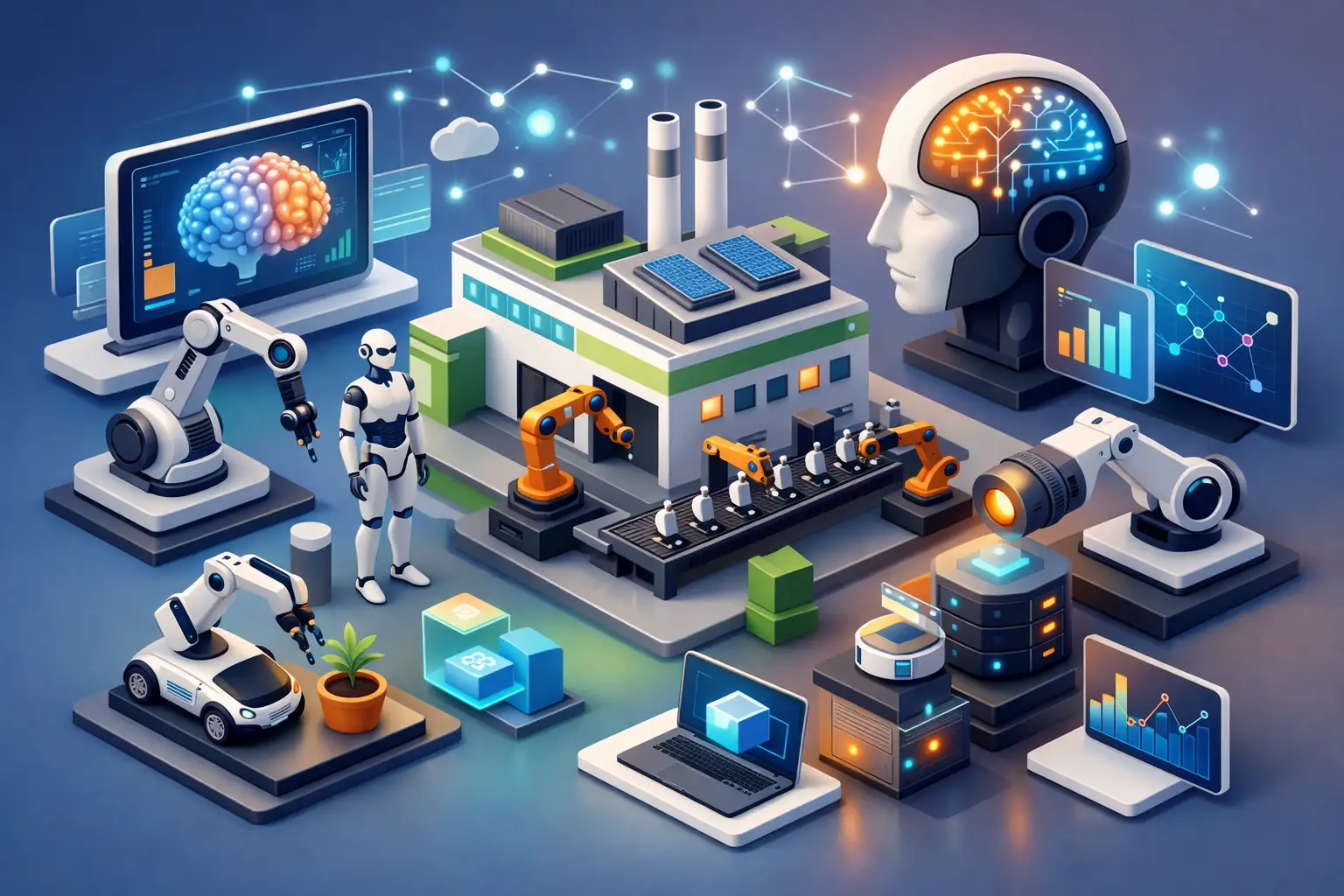
AI and ML companies do not fail because of weak models alone. They fail when infrastructure, power reliability, deployment conditions, workforce access, and expansion economics do not support scale. That is exactly why the question, “How Erisha Smart Manufacturing Hub is most suitable for AI and ML companies and Enterpreneurs?” matters to serious operators looking beyond office space and into long-term industrial execution.
For AI and ML businesses moving into applied intelligence, edge systems, industrial automation, autonomous mobility, semiconductor-adjacent production, or computer vision for manufacturing, location strategy is no longer a back-office decision. It shapes cost structure, pilot velocity, compliance readiness, and the ability to convert software capability into physical market advantage. Erisha Smart Manufacturing Hub stands out because it is built as an industrial ecosystem, not a generic business park.
Why Erisha Smart Manufacturing Hub suits AI and ML companies
Most AI and ML firms begin with a software mindset. The challenge starts when they need real-world deployment. Models need data pipelines from machines, sensors, cameras, vehicles, cleanroom processes, logistics systems, and energy assets. That requires an operating environment where digital systems and industrial infrastructure are designed to work together.
Erisha Smart Manufacturing Hub is suited to that transition because it supports advanced manufacturing, logistics, R&D, and sector-specific production in one coordinated platform. For AI companies serving industry, this creates a direct path from prototype to pilot to scaled deployment. A computer vision firm can work closer to production lines. A predictive maintenance company can build around actual industrial equipment. An autonomous systems startup can operate in a setting aligned with mobility, aerospace-adjacent manufacturing, or smart logistics use cases.
This matters because AI value increases when it is embedded in live industrial environments. A model built in isolation may impress in a demo. A model refined against real throughput, real downtime, and real supply chain conditions becomes commercially defensible.
Infrastructure that supports applied intelligence, not just software teams
AI and ML entrepreneurs often talk about compute, talent, and funding. Those are critical, but they are not the full picture for industrial AI. If a business is developing machine learning for factory automation, EV systems, semiconductor inspection, hydrogen mobility, or logistics orchestration, it needs more than desks and meeting rooms.
Erisha’s value is in purpose-built infrastructure. Turnkey factories, modular industrial units, logistics facilities, and cleanroom-ready semiconductor spaces create conditions where AI can be tested and monetized in context. That gives applied AI companies a different kind of operating advantage. They are not forced to bridge long gaps between software development and industrial execution.
For ML firms building around defect detection, robotics control, process optimization, or digital twins, proximity to manufacturing environments can reduce iteration cycles. Teams can move faster from model training to operational feedback. They can validate against production realities instead of synthetic assumptions. That is a major strategic difference.
This is also where Erisha becomes relevant for AI hardware and deep-tech founders. Companies working on edge devices, sensor systems, specialized electronics, or semiconductor-linked technologies need facilities that can grow with technical complexity. The hub’s infrastructure profile supports that evolution more credibly than conventional commercial real estate.
Readers evaluating industrial location strategy may also find value in What Makes Production Advanced at Erisha Hub?, which breaks down why the production environment itself matters.
Sector clustering gives AI firms better commercial access
AI companies rarely scale by selling to everyone. They scale by winning deeply in specific sectors. That makes cluster strategy more important than broad geographic presence.
Erisha is positioned around high-value sectors including EVs, hydrogen mobility, semiconductors, renewable energy, and eVTOL-related manufacturing. For AI and ML firms, that means the addressable opportunity is not abstract. It is physically organized around industries that increasingly depend on automation, optimization, predictive analytics, machine vision, supply chain intelligence, and energy management.
An ML company focused on battery analytics benefits from being near EV production activity. A computer vision firm serving clean manufacturing gains from adjacency to semiconductor-focused spaces. A route optimization or fleet intelligence company can find stronger fit in a hub connected to mobility and logistics infrastructure. A digital twin platform for energy systems gains relevance when renewable production and industrial utilities are part of the same ecosystem.
This cluster effect shortens business development cycles. Instead of chasing scattered clients across unrelated zones, AI companies can operate closer to likely partners, pilot customers, and strategic collaborators. That is especially important for entrepreneurs who need proof-of-deployment, not just proof-of-concept.
For companies assessing the strength of a cluster model, Industrial Cluster Development Example That Works offers a useful reference point.
Cost efficiency changes the math for AI growth
A surprising number of AI ventures still underestimate operating cost drag. Model development may be capital intensive, but commercialization becomes even more expensive when rent, logistics friction, fragmented vendor networks, and workforce churn compound over time.
Erisha’s positioning in Ras Al Khaimah adds a practical advantage that institutional decision-makers care about: lower operating costs without stepping away from strategic connectivity. That changes the economics for AI and ML companies that need to preserve capital while building real industrial capability.
Lower cost does not simply mean cheaper space. It can also mean more room for pilot facilities, easier expansion into modular units, more viable warehousing, and stronger economics for mixed teams that include engineers, operators, and field deployment staff. For entrepreneurs, that can extend runway. For mature firms, it can improve unit economics across regional expansion.
There is a trade-off here. Not every AI company needs an industrial base. A SaaS-only business selling general productivity tools may prioritize urban commercial ecosystems over manufacturing integration. But for AI firms serving real-world sectors, the operating model at Erisha is often more aligned with where value is actually created.
A live-work-innovate ecosystem helps retain technical teams
One reason industrial expansion fails is that talent strategy is treated as separate from site strategy. Skilled people do not choose locations based on factory design alone. They look at quality of life, family needs, education access, healthcare, convenience, and whether the location can support a long-term career.
Erisha’s mixed-use model addresses that directly. Residential, healthcare, education, retail, hospitality, and R&D assets are part of the proposition. For AI and ML companies, that matters because technical talent is highly mobile and highly selective. If a location supports both professional growth and day-to-day life, retention improves.
This is particularly relevant for firms building interdisciplinary teams. Applied AI does not run on data scientists alone. It requires software engineers, controls specialists, manufacturing experts, hardware teams, compliance staff, and operations leaders. An ecosystem that supports a stable workforce is a strategic asset, not a lifestyle add-on.
The workforce dimension is covered from another angle in Find Jobs, Do Production, Upgrade Education, especially for businesses thinking about long-term capability building.
ESG alignment is becoming a commercial requirement
For many investors and multinational operators, ESG is no longer branding language. It is part of procurement, financing, reporting, and partner selection. AI and ML companies entering industrial markets are increasingly expected to show that their operations and deployment environments align with sustainability standards.
Erisha’s ESG-compliant development model strengthens that position. This is particularly important for AI companies working in renewable energy, mobility, industrial efficiency, and resource optimization, where the credibility of the operating environment influences how the market perceives the solution itself.
There is also a practical layer. AI is being used to reduce waste, improve energy consumption, optimize maintenance, and increase yield. Those outcomes are easier to demonstrate when companies operate in an environment designed around sustainability rather than retrofitted to it.
That alignment can support enterprise sales, investor confidence, and regional policy fit at the same time.
Strategic geography matters when AI moves into industry
AI companies serving industry do not just sell code. They support installations, monitor systems, train local teams, manage hardware interfaces, and coordinate with supply chains. Geography therefore affects service quality and commercial scale.
Erisha’s access logic is compelling because it supports connectivity to GCC and wider global markets while sitting within an investor-friendly regulatory setting. For multinational companies, this helps position regional operations without inheriting the full cost burden of more saturated locations. For entrepreneurs, it creates a launch base with clearer room to grow.
That matters even more when a company is building for cross-border sectors such as logistics intelligence, mobility systems, energy tech, or industrial analytics. Regional access can shape client acquisition, maintenance responsiveness, and distribution planning.
If the decision at hand is site selection rather than branding, Advanced Manufacturing Site Selection Guide is a relevant next read.
Why entrepreneurs should pay attention now
Entrepreneurs often enter the market believing speed is everything. In reality, speed without infrastructure fit creates expensive detours. The stronger approach is to build where commercial pilots, industrial infrastructure, sector clustering, and workforce support can reinforce one another.
That is where Erisha has a compelling edge. It gives AI and ML companies a chance to operate inside a purpose-built industrial growth platform, not around one. For founders building industrial AI, mobility intelligence, smart manufacturing software, semiconductor tools, or advanced automation systems, that difference can shape the next five years more than the next five months.
The future of AI will not be defined only by who writes the best models. It will be shaped by who builds in environments ready to turn intelligence into industry.
