
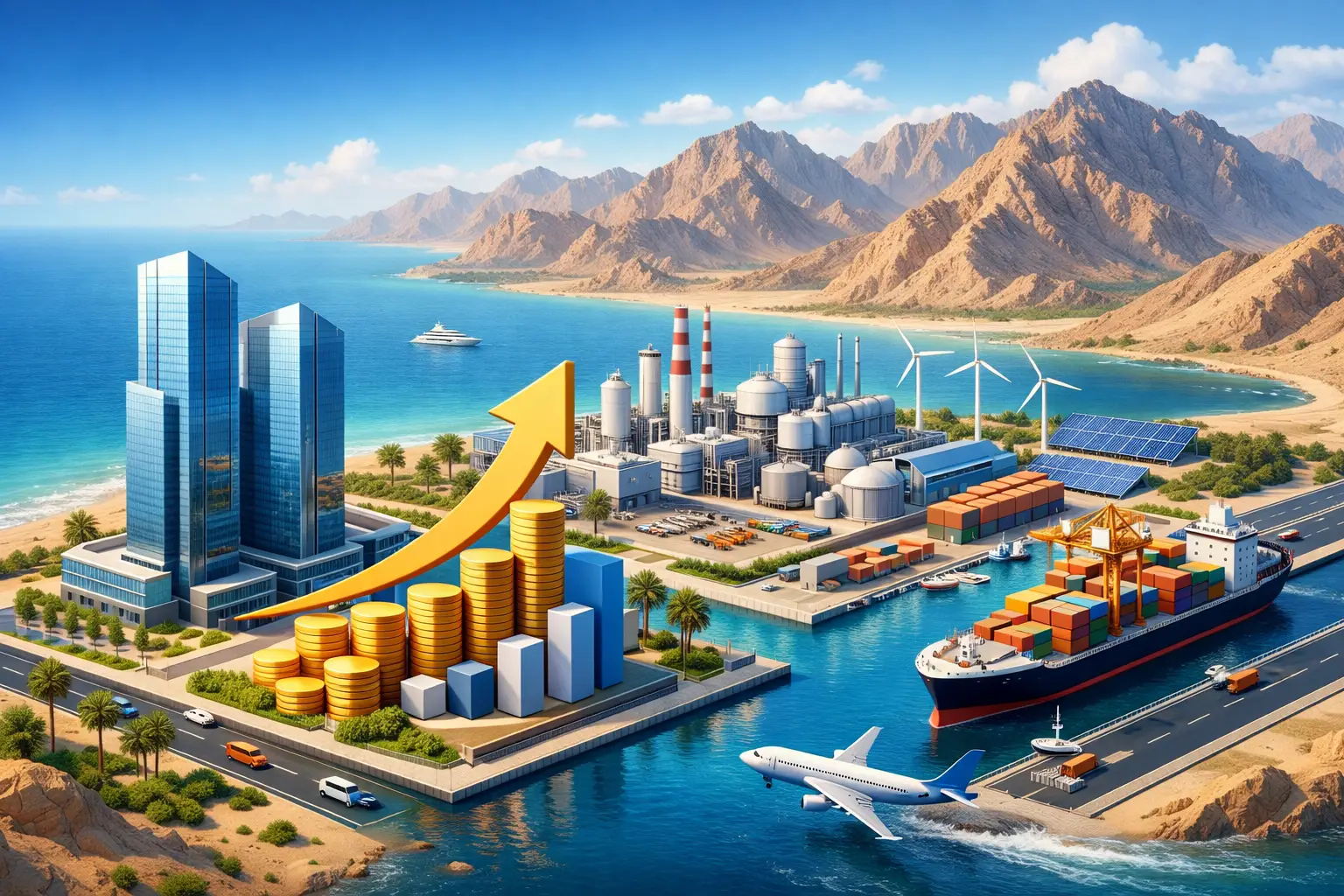
A $5-6 billion business impact is not created by warehouse volume alone. It is created when industrial land, power, logistics, housing, talent, and sector strategy are planned as one economic engine. That is why the proposition that Erisha Smart Manufacturing Hub will add 5-6 billion USD business in Ras Al Khaimah once its fully commissioned matters far beyond a single development milestone. It signals a new level of industrial capacity for the emirate, one built for high-value production rather than low-complexity occupancy.
For investors and manufacturers, the real question is not whether a large industrial hub can generate activity. It is whether that activity is durable, export-oriented, and positioned in sectors that will still command capital a decade from now. In Ras Al Khaimah, the answer depends on how well infrastructure aligns with next-generation manufacturing demand. Erisha is designed around that exact requirement.
Why the $5-6 billion figure matters
Economic projections only carry weight when they are tied to business mechanics. In this case, the projected $5-6 billion impact reflects a compound industrial model: factory operations, supplier ecosystems, logistics throughput, workforce demand, support services, and downstream trade. That is very different from quoting a land valuation or construction number and calling it economic growth.
When a hub is fully commissioned, value is generated across several layers at once. Tenants invest in fit-outs, production lines, machinery, utilities, and compliance systems. Suppliers follow anchor manufacturers. Freight volumes increase through ports and road corridors. Skilled labor demand expands. Service sectors, from technical maintenance to healthcare and hospitality, begin supporting the industrial base. The result is a broader commercial multiplier that can reshape the economic profile of a region.
That is what makes Ras Al Khaimah strategically important here. The emirate already offers a strong operating case through competitive costs, access to industrial land, investor-friendly regulation, and connectivity to regional and global markets. A hub that channels those advantages into advanced manufacturing can move the emirate up the value chain.
How Erisha Smart Manufacturing Hub will add 5-6 billion USD business in Ras Al Khaimah
The most credible path to a $5-6 billion outcome is not general industry. It is sector-focused manufacturing with export potential, technology depth, and long-term capital commitment. Erisha is structured around that principle.
Its model is built for manufacturers that need more than standard sheds. That includes turnkey factories, modular industrial units, logistics facilities, cleanroom-ready semiconductor spaces, and dedicated clusters for electric mobility, hydrogen mobility, eVTOL aircraft, and renewable energy production. These are not interchangeable categories. Each one attracts a different investment profile, supply chain structure, utility requirement, and labor base. Bringing them into one planned ecosystem creates density of capability, not just density of tenants.
That distinction matters because high-value industrial tenants do not choose locations solely on lease rates. They look for production readiness, permitting clarity, utility reliability, talent retention, ESG positioning, and proximity to logistics channels. If any one of those breaks, scale becomes expensive. If all of them are integrated, growth accelerates.
This is where the hub’s mixed-use logic becomes commercially significant. Industrial production is supported by residential, healthcare, education, retail, hospitality, and R&D assets within the same ecosystem. For a multinational operator, that reduces one of the least discussed costs of expansion: workforce instability. A site that can attract talent but cannot retain it will eventually hit productivity limits. A live-work-innovate environment changes that equation.
Industrial clustering creates compounding value
Advanced industry scales faster when companies do not operate in isolation. Clustering reduces friction between manufacturers, suppliers, service providers, logistics operators, and innovation partners. It also creates faster knowledge transfer and better infrastructure utilization.
In practical terms, an EV manufacturer located near battery systems, lightweight materials, charging components, software integration teams, and logistics support has a stronger operating position than one operating in a fragmented zone. The same is true for hydrogen mobility, semiconductors, and aerospace-adjacent production. Shared capabilities lower lead times and strengthen resilience.
That is why industrial cluster design is not a branding exercise. It is a cost, speed, and competitiveness strategy. Readers interested in how this model works in practice can see the logic in this related piece on industrial cluster development.
There is, of course, a trade-off. Cluster-led development requires discipline. If sector selection is too broad, the ecosystem loses coherence. If tenant curation is too narrow, occupancy can slow. The strength of Erisha’s positioning is that it targets sectors with long-term global demand and policy relevance while still allowing flexibility in how supporting industries enter the platform.
Ras Al Khaimah is positioned for industrial expansion
Ras Al Khaimah’s appeal is often described in simple terms: lower costs and good access. Both are true, but they understate the strategic case. For industrial occupiers, the emirate offers room to scale without the congestion, land scarcity, and cost pressure that can challenge more saturated markets.
That matters most for manufacturers planning second and third production lines, not just pilot operations. Expansion economics change quickly when land assembly becomes difficult or utility planning becomes uncertain. A location that supports phased growth is far more valuable than one that only supports initial entry. This is one reason why second-line manufacturing logic is central to the hub’s potential, as explored in this article on second production lines in Erisha Hub RAKEZ.
There is also a timing advantage. Global manufacturers are reassessing where they place production due to supply chain volatility, geopolitical risk, energy transition requirements, and the push for regionalized manufacturing. The UAE is increasingly part of that conversation because it offers policy stability and global connectivity. Ras Al Khaimah can benefit disproportionately if it converts those macro conditions into ready industrial capacity.
The sectors most likely to drive the business impact
Not every sector contributes equally to a multibillion-dollar industrial outcome. The sectors with the strongest potential are those that combine high capex, recurring production demand, and export relevance.
Electric mobility and hydrogen mobility fit that profile. So do semiconductor-adjacent operations, renewable energy component manufacturing, and selected aerospace-linked production such as eVTOL systems and advanced components. These industries require specialized space, technical compliance, and ecosystem support. They also create secondary demand in tooling, software, testing, maintenance, packaging, logistics, and workforce development.
That is why the hub’s sector focus is commercially credible. It is aligned with where industrial investment is moving globally, not where yesterday’s commodity manufacturing was concentrated. For companies assessing whether advanced production environments are viable here, the case for technical readiness is covered further in what makes production advanced at Erisha Hub.
There is an execution caveat worth stating clearly. Advanced sectors bring stronger upside, but they also require deeper planning around utilities, talent pipelines, and compliance. A semiconductor-ready environment, for example, is far more demanding than general assembly. The advantage of planning for these sectors from the outset is that infrastructure can be designed for complexity instead of retrofitted later at a higher cost.
Beyond factories: the multiplier effect on jobs, services, and capital
A fully commissioned industrial ecosystem changes more than output figures. It changes labor markets, service demand, and investor confidence. Direct manufacturing jobs are only part of the story. Indirect employment grows through maintenance services, logistics, technical training, hospitality, retail, healthcare, and business support functions.
That multiplier matters because industrial growth becomes more resilient when it is supported by a wider economic base. A tenant may enter for production economics, but long-term performance is influenced by whether managers can recruit talent, whether suppliers can co-locate, and whether families can live near opportunity.
This is why job creation should be viewed as strategic infrastructure, not a side effect. The broader workforce implications are reflected in How Erisha Smart Manufacturing Hub Creates 4000 Jobs, which speaks to the scale of social and economic spillover that industrial planning can produce.
For institutional investors, this wider effect matters because it signals permanence. Temporary industrial demand can fill units. Only a functioning ecosystem sustains valuation, occupancy quality, and reinvestment over time.
What this means for decision-makers
For manufacturers, the central opportunity is straightforward: secure a base that supports scale before regional industrial capacity tightens further. For strategic investors, the opportunity is to participate in an ecosystem where infrastructure, sector specialization, and economic diversification are reinforcing one another.
The statement that Erisha Smart Manufacturing Hub will add 5-6 billion USD business in Ras Al Khaimah once fully commissioned should be read as an industrial thesis, not a headline number. It points to a model in which land use, export production, supply chain density, workforce support, and ESG-aligned planning are brought together to build lasting economic infrastructure.
That is the difference between a project that fills up and a hub that changes the trajectory of a market. The future of industrial growth in the Gulf will belong to places that can host advanced production at scale, retain talent, and connect innovation to execution. Ras Al Khaimah has the conditions to do that. What matters now is who moves early enough to build inside that momentum.
