
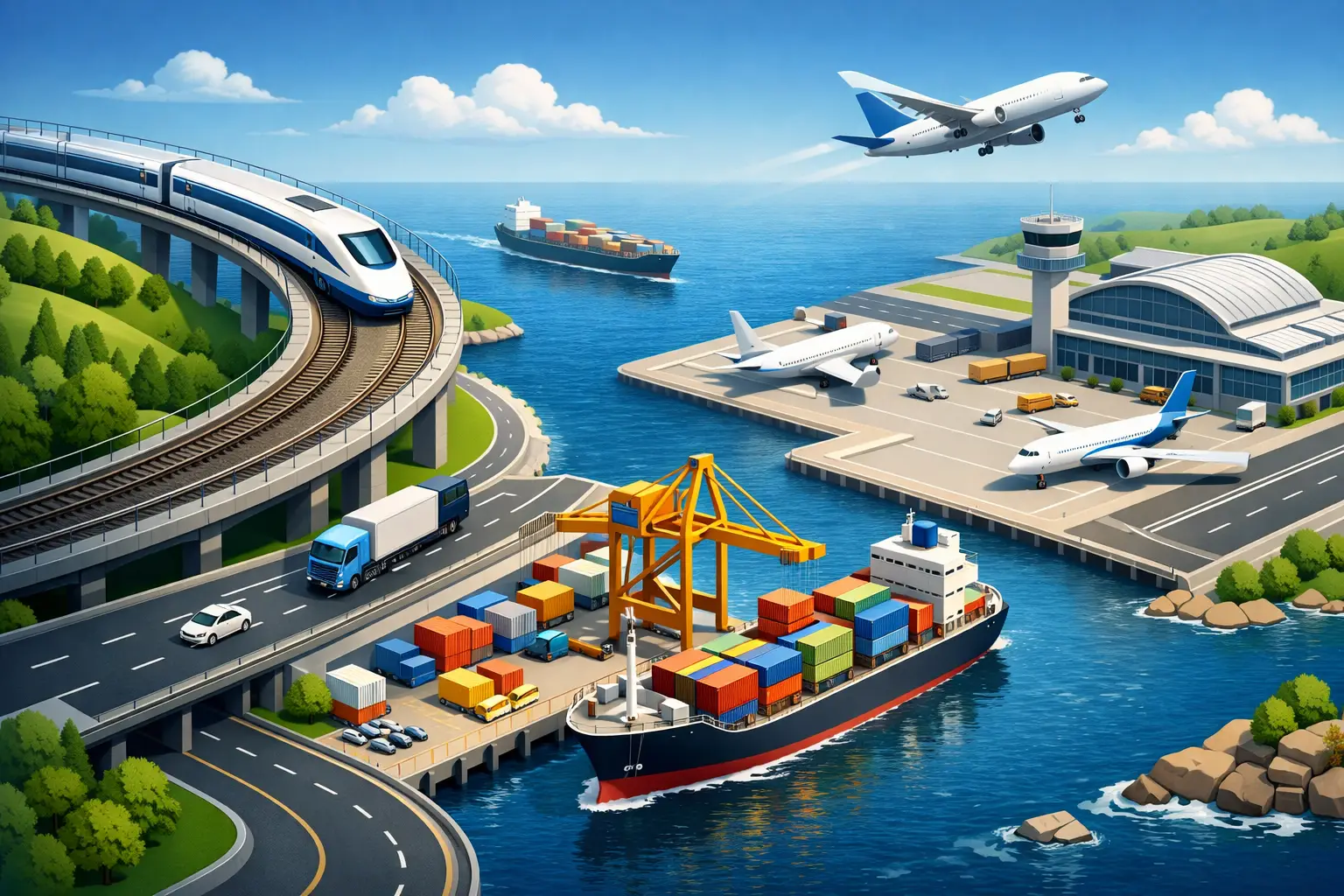
A factory can have advanced equipment, skilled labor, and attractive energy pricing, yet still underperform for one simple reason: it sits in the wrong logistics geography. Rail, road, port and airport connectivity matters for any industry because supply chains do not compete as isolated buildings. They compete as networks. For manufacturers, exporters, and industrial investors, connectivity is not a background feature. It is a core operating advantage that shapes cost, speed, resilience, and long-term expansion.
This is especially true in sectors where timing, compliance, and precision carry financial weight. Electric vehicle components, semiconductor inputs, hydrogen systems, aerospace-adjacent assemblies, and renewable energy equipment all move through layered supply chains. Raw materials may arrive by sea, specialized components may require air freight, finished goods may move by road to regional customers, and critical volumes may eventually depend on rail capacity for efficiency at scale. A site that connects well across all four modes gives operators far more control over performance.
Why rail, road, port and airport connectivity matter for any industry
The first reason is straightforward: every handoff in the supply chain adds cost and risk. If inbound materials must travel farther than necessary from a port, if high-value parts cannot be flown in quickly, or if outbound shipments face road bottlenecks, the business absorbs the penalty. Sometimes that penalty shows up in freight rates. Often it appears elsewhere – delayed production, higher inventory, missed customer commitments, and weaker margins.
Connectivity also changes how a site is perceived by investors and customers. A well-connected industrial location signals readiness. It suggests that expansion can happen without rebuilding the entire logistics model from scratch. For a multinational evaluating where to place a new production line, this matters as much as land cost or utility access. The right location does not only support current throughput. It protects future options.
There is also a strategic point many businesses underestimate. Transport diversity is a form of resilience. When companies depend too heavily on one route or one mode, disruption spreads fast. Weather events, shipping delays, customs congestion, labor shortages, and geopolitical shifts can all expose fragile logistics design. Multi-modal access gives operators room to reroute, prioritize, and recover.
Road access drives daily industrial performance
Road connectivity is usually the most immediate operational factor because it touches the day-to-day movement of people, materials, and finished goods. Trucks carry inbound supplies from ports and airports, distribute products to regional customers, and connect industrial assets to warehouses, service providers, and labor catchments.
Poor road access creates friction that compounds over time. Transit times become unpredictable. Fleet utilization drops. Fuel and labor costs rise. Shift changes become harder to manage, especially where workforce commuting options are limited. A factory may appear productive on paper, yet lose meaningful output through logistics drag.
For industrial occupiers, strong road infrastructure is not only about highways. It includes efficient last-mile access, internal circulation, vehicle staging, and the ability to support different freight profiles, from container trucks to specialized equipment transport. In integrated industrial environments, road planning also affects the broader ecosystem – workforce housing, service access, and supplier movement all rely on it. That is one reason the strongest industrial platforms think beyond plot-level development and build around mobility logic from the start.
Port connectivity protects cost competitiveness
For manufacturers serving regional and global markets, port access remains one of the clearest drivers of landed cost. Ocean freight is still the backbone of large-volume industrial trade, particularly for heavy machinery, metals, chemicals, energy systems, and containerized exports. The closer and more efficient the port relationship, the stronger the economics.
This is not just about physical distance. It is about how quickly cargo can move between plant and port, how predictable vessel access is, and whether the surrounding ecosystem supports customs handling, consolidation, and onward distribution. A location with credible port connectivity gives businesses the ability to manage inventory more intelligently. It lowers the need for excess safety stock and improves responsiveness to demand shifts.
Port adjacency also matters differently by industry. Heavy industrial players may prioritize bulk movement and container volumes. Clean-tech manufacturers may care more about exporting finished systems to multiple growth markets. Companies building large-format components need logistics routes that can accommodate non-standard cargo. The point is the same in each case: a connected port strategy expands commercial reach while containing cost.
In the Gulf and wider Middle East, this advantage becomes even more significant. Industrial platforms that sit within strong maritime corridors can serve GCC demand, access Africa and South Asia efficiently, and support global export ambitions from one base. That is why serious investors review port logic early, not late.
Airport access is a strategic asset, not a luxury
Some executives still treat airport connectivity as relevant only to passenger travel. For advanced manufacturing, that view is outdated. Airports matter because they support speed, contingency planning, executive mobility, technical service response, and urgent cargo movement.
In high-value industries, one delayed component can stop an entire production line. Air freight is expensive, but stoppages are often far more expensive. Semiconductor tools, specialized electronics, precision sensors, aerospace parts, medical-grade inputs, and prototype components all benefit from fast air access when timing matters more than freight efficiency.
Airport connectivity also supports business development and operations management. Senior teams, customers, auditors, engineering partners, and regulatory specialists need to move in and out without friction. For a globally integrated company, travel efficiency affects how often a site is visited, how quickly issues are solved, and how credible the location feels as a regional command base.
That is one reason future-ready industrial ecosystems are increasingly evaluated as business platforms, not just factory sites. A connected airport relationship supports the full operating model around the plant, including procurement, quality assurance, after-sales support, and investor engagement.
Rail remains a scale advantage many markets will rely on more heavily
Rail is not equally developed in every geography, but where it exists or is planned, it can be transformative for industrial competitiveness. Rail offers major advantages for heavy freight, bulk commodities, container movement, and long-distance inland logistics. It can reduce road congestion, lower transport cost per unit, and improve sustainability performance.
For manufacturers with large-volume throughput, rail access can become decisive over time. It supports network scale that road alone may struggle to deliver efficiently. It is particularly valuable for industries moving steel, chemicals, aggregates, energy equipment, automotive volumes, or repeated container flows between ports and inland production nodes.
Rail also aligns with the rising pressure on industrial tenants to improve ESG outcomes. Lower emissions per ton-mile, reduced congestion pressure, and better integration with port logistics can strengthen both environmental performance and supply chain stability. Companies focused on long-horizon expansion should view rail not as a bonus feature but as part of future capacity planning.
Connectivity shapes site selection more than many companies admit
When leadership teams compare industrial locations, they often begin with headline metrics: land cost, lease terms, labor availability, and incentives. Those factors matter, but logistics connectivity frequently determines whether the model actually works after go-live.
A cheaper site with weaker transport links can become more expensive within months. Inventory buffers rise, expedited shipping increases, customer service levels slip, and future scaling becomes constrained. By contrast, a well-connected location may justify a higher upfront commitment because it lowers friction across the full operating cycle.
This is where an integrated development approach becomes powerful. Industrial occupiers increasingly want more than a standalone plot. They need an ecosystem that supports production, logistics, workforce stability, and innovation in one coordinated environment. That broader logic is explored further in this integrated industrial ecosystem guide, particularly for companies building long-term regional platforms rather than short-term occupancy solutions.
Infrastructure choices also intersect with power readiness, sector suitability, and technical expansion. For advanced manufacturers, transport links and utility capacity should be evaluated together, not in separate workstreams. This is why world-class infrastructure and power matter when assessing the real readiness of an industrial base.
Connectivity is also a workforce and partner issue
Industrial performance depends on more than freight. Engineers, operators, suppliers, service partners, and institutional collaborators all move through the same infrastructure system. If travel is difficult, if commuting is inefficient, or if supplier access is inconsistent, operating quality declines.
This is one reason the next generation of industrial hubs is being designed as complete environments rather than isolated production zones. Efficient transport links support talent attraction, customer confidence, and partner integration. They also improve retention by reducing the friction between work, housing, services, and daily life. The relationship between environment and workforce productivity is not secondary to industrial strategy. It is part of it, as discussed in Employees Work More Efficiently in Good Environments.
For ecosystem builders such as Rana Group, this is the larger thesis: connectivity is not merely about moving goods from point A to point B. It is about creating an industrial platform where manufacturing, innovation, and growth can operate at full speed.
The strongest industrial locations will be the ones that understand a simple truth. Markets reward production capacity, but they value connected production capacity far more. When rail, road, port, and airport access work together, industry gains what it needs most – reach, resilience, and room to scale.

[…] second is logistics integration. Efficient access to ports, highways, airports, and regional trade corridors can materially change cost structures and delivery times. A hub that supports industrial growth […]