
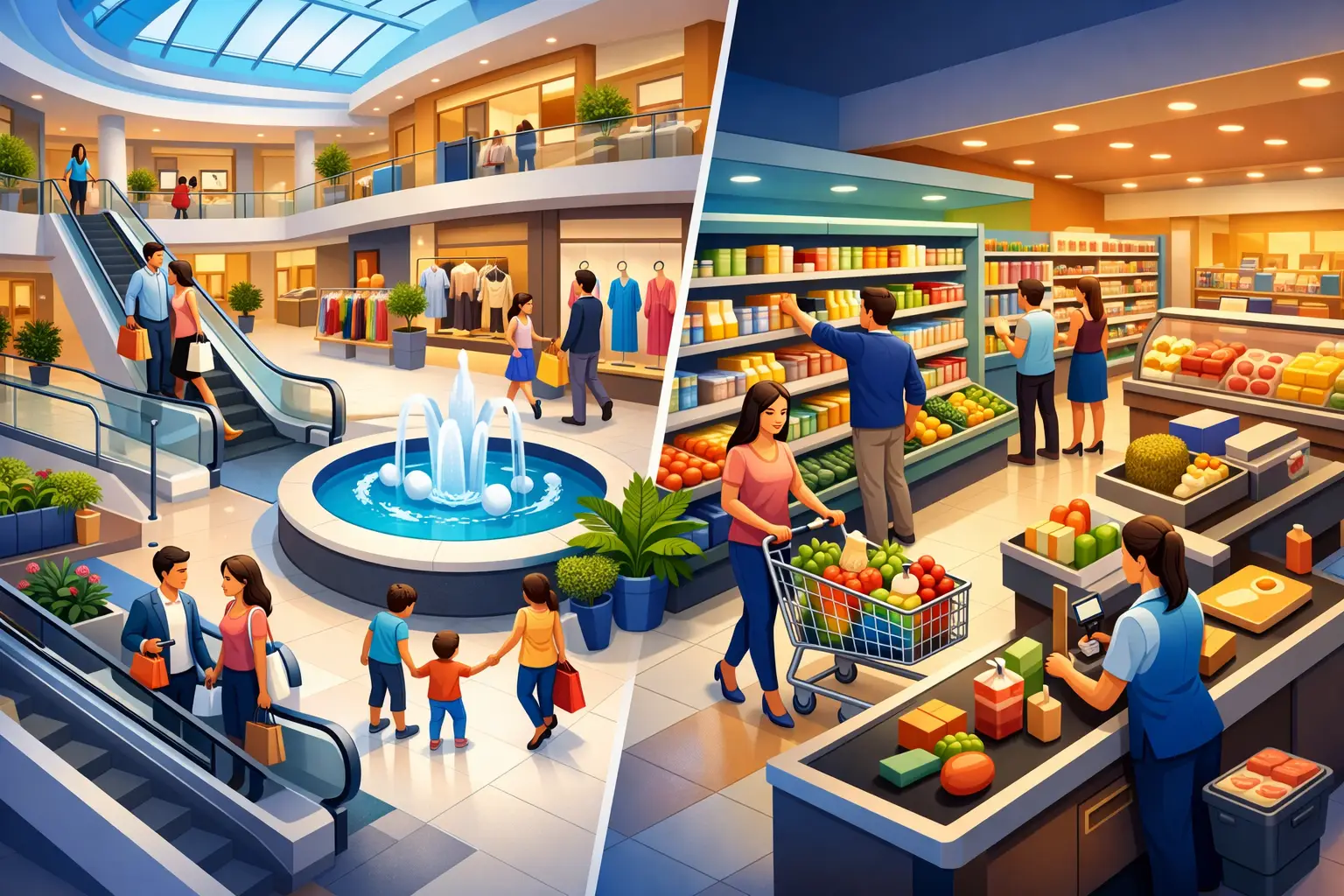
Consumer behavior changed long before many industries admitted it. Why now people prefer to shop in shopping mall or super market instead of normal shop is not just a retail question. It is a signal about how modern demand works. People no longer choose only on price or proximity. They choose ecosystems that save time, reduce friction, increase trust, and combine multiple needs in one place.
That shift matters far beyond retail. For industrial developers, manufacturers, and investors, the rise of the mall and supermarket model shows what people and businesses increasingly reward – integration, convenience, infrastructure readiness, predictability, and experience. Small independent shops still hold value in specific categories, especially where trust is personal or products are highly specialized. But at scale, the market is voting for organized environments.
Why people prefer malls and supermarkets instead of normal shops
The first reason is simple: consolidation of need. A shopper can buy groceries, compare brands, eat, pick up pharmacy items, use banking services, and solve family errands in one trip. A normal shop often serves one narrow purpose. That made sense when mobility was limited and expectations were lower. It makes less sense now, when households measure every hour and every inconvenience.
The second reason is perceived reliability. Organized retail offers fixed pricing, visible branding, quality standards, return policies, digital payments, parking, climate control, and longer operating hours. Even when a neighborhood shop is cheaper on a few items or more personal in service, many consumers still prefer the assurance that comes from standardized operations.
The third reason is experience. Malls and supermarkets are designed environments. Layout, lighting, product placement, cleanliness, security, and complementary services all influence behavior. People do not only buy products there. They buy certainty and comfort.
This is where many sectors make the same mistake. They assume customers choose only based on the core transaction. In reality, customers often choose the surrounding system.
The real driver is infrastructure, not just preference
Retail concentration is often described as a lifestyle trend. That is too shallow. The deeper force is infrastructure. Organized retail wins because it is backed by logistics, inventory systems, warehousing, transport access, utility reliability, digital billing, and coordinated tenant planning. The customer sees the clean shelf and easy checkout. Behind that simple moment is an operating model built for scale.
The same principle applies in industry. Manufacturers do not scale in isolation. They scale where power is dependable, transport links are efficient, compliance is manageable, labor can be retained, and suppliers can move with speed. A facility may look impressive on paper, but if the surrounding environment is fragmented, cost savings disappear into delays, turnover, and inefficiency.
That is why infrastructure-led thinking matters more than ever. A business that studies retail behavior carefully will see a larger pattern: the market prefers environments where multiple dependencies are already solved. This is also why world-class infrastructure and power matter so directly to industrial performance.
Convenience has become a competitive advantage
For years, convenience was treated as a consumer luxury. Now it is a serious economic variable. The mall and supermarket format respects the value of time. Consumers can access parking, broad inventory, transparent pricing, digital payment, and leisure options in one coordinated environment. The result is not just footfall. It is repeat behavior.
Industrial ecosystems follow the same logic. Investors and occupiers increasingly favor locations that reduce the number of separate decisions they need to make. If housing, healthcare, education, logistics, utilities, and workforce support sit far away from the production base, operations become more fragile. Leadership teams then spend more time solving ecosystem gaps than building output.
This is one of the clearest lessons industries should take from retail. Integration creates stickiness. Fragmentation creates hidden cost.
Trust has moved from the individual seller to the system
Traditional shops often built trust through familiarity. The shopkeeper knew the customer, extended informal credit, and offered personal recommendations. That model still works in many communities. But at a mass-market level, trust has shifted toward systems. Consumers trust barcodes, return counters, refrigeration standards, audited brands, loyalty platforms, and visible security.
In industrial strategy, the same transition is underway. Investors are less willing to rely on promises without institutional backing. They want master planning, compliance frameworks, utility commitments, clear sector clustering, and long-range expansion logic. They trust operating systems more than isolated assets.
This is especially true for advanced manufacturing, semiconductors, EVs, hydrogen mobility, aerospace-adjacent production, and renewable energy. These sectors cannot rely on ad hoc environments. They need precision, continuity, and confidence at every layer. The future belongs to platforms that make those conditions visible from day one.
What malls teach us about industrial ecosystems
A successful mall is not a random collection of stores. It is curated. Anchor tenants drive traffic. Supporting brands increase dwell time. Food, entertainment, and convenience services make the destination more useful. Parking, security, maintenance, and cleanliness hold the system together. The strength of the whole environment increases the performance of each tenant.
That idea translates directly into industrial development. A modern manufacturing hub should not be treated as land plus buildings. It should function as a coordinated ecosystem where infrastructure, logistics, workforce support, sector specialization, and surrounding amenities improve the economics of each manufacturer inside it.
That is why integrated industrial models are gaining momentum. The logic is the same as organized retail, but at a higher-value operational level. When companies locate in an environment designed around production, talent, compliance, and movement of goods, they reduce friction across the full value chain. This is the essence of an integrated industrial ecosystem.
Upgrade your thought for industries too
The phrase may sound unconventional, but the message is strategic: upgrade your thought for industries too. If consumers have already shown a clear preference for complete environments over isolated points of purchase, industrial decision-makers should pay attention. The same forces that made malls and supermarkets dominant are reshaping where capital goes in manufacturing and logistics.
Executives now ask harder questions. Can this location support future production lines, not just current ones? Is there transport connectivity that protects delivery schedules? Can talent live well enough nearby to remain productive and loyal? Is the site aligned with ESG expectations and regulatory direction? Can suppliers, technology partners, and service providers operate in the same orbit?
Those are not secondary considerations. They are now part of the investment case itself. Rail, road, [port and airport connectivity](/rail-road-port-airport-connectivity-matter) can determine whether a facility competes globally or merely operates locally. Workforce environment can determine whether expansion is stable or expensive. Ecosystem quality can determine whether a project attracts strategic partners or struggles in isolation.
Why normal shops still survive – and what that means
It would be too simplistic to say normal shops are obsolete. They survive where speed is hyperlocal, where relationships matter more than scale, where specialized knowledge is valuable, or where organized retail has not adapted to community nuance. The lesson is not that small formats always lose. The lesson is that they win only when they offer something ecosystems cannot easily replicate.
For industrial players, this means standalone facilities can still work in certain cases. Highly specialized production, confidential operations, or legacy supply chains may justify a more independent setup. But those are exceptions, not the default growth model. For most expansion strategies, especially in high-growth sectors, the market increasingly rewards locations that combine capability with context.
The investment takeaway
Consumer behavior is often the earliest visible expression of larger economic change. People moved toward malls and supermarkets because they offered more than goods. They offered a system that made life easier and decisions safer. Industry is moving the same way.
The next generation of industrial growth will not be led by isolated plots or generic parks. It will be led by ecosystems built for advanced production, operational efficiency, workforce stability, and strategic connectivity. That is the real meaning behind the retail shift. Markets prefer environments that reduce friction and multiply value.
For investors, developers, and manufacturers, the question is no longer whether integrated models matter. The question is how quickly they can align with them. The businesses that read this shift correctly will not only follow demand. They will help shape where the future works.
