
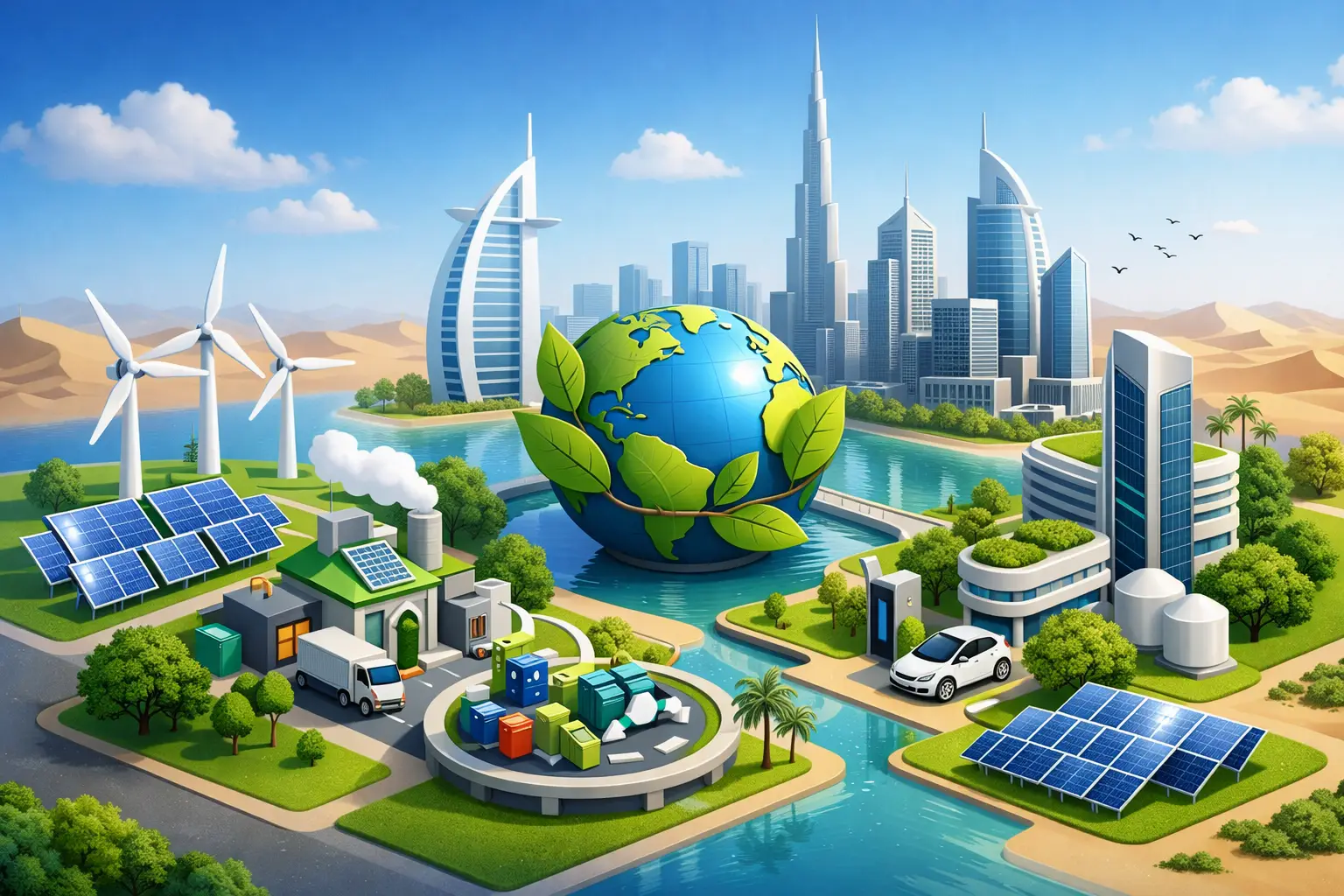
The next phase of Gulf growth will not be won by low-cost production alone. It will be won by industrial systems that can prove environmental discipline, social credibility, and governance strength at scale. That is why the UAE will require more ESG compliant industries to cater the demand of Gulf region, especially as capital, customers, and governments move toward higher standards for how products are made, moved, and financed.
For industrial investors and manufacturers, this is no longer a branding issue. It is a market access issue. Gulf demand is expanding across energy transition technologies, mobility, electronics, logistics, construction inputs, food systems, and advanced materials. At the same time, procurement expectations are tightening. Large buyers increasingly want traceability. Lenders want risk controls. Regulators want cleaner industrial growth. Workers want environments built for long-term retention, not short-term throughput.
The UAE sits in a strong position because it already combines logistics reach, investor-friendly regulation, export connectivity, and an industrial policy agenda aligned with economic diversification. But leadership creates its own pressure. If the country is to serve as the Gulf’s production and distribution base for next-generation sectors, its industrial capacity must grow in a way that is measurably ESG-aligned, not just operationally efficient.
Why the Gulf’s demand is changing the industrial equation
Demand across the Gulf is becoming more sophisticated in both volume and specification. Regional markets still need core industrial output, but the strongest growth is increasingly tied to sectors where ESG performance matters directly to product viability. Electric mobility supply chains, hydrogen-related equipment, renewable energy components, semiconductor-linked manufacturing, and aerospace-adjacent systems all depend on infrastructure that can support higher standards for energy use, waste control, water management, workforce conditions, and compliance reporting.
This shift matters because industrial expansion in the GCC is no longer simply about adding factories. It is about adding the right factories in the right ecosystems. A facility may have access to land and transport, yet still fall short if it cannot satisfy investor due diligence, global procurement requirements, or workforce expectations. The Gulf is demanding industrial output, but it is also demanding industrial credibility.
That creates a clear advantage for the UAE. It can serve this demand not only by increasing manufacturing footprint, but by building environments where ESG compliance is embedded into the industrial model itself. This is a different proposition from the old industrial park formula. It means power planning, logistics design, waste systems, housing access, health support, education pathways, and governance standards all become part of industrial competitiveness.
UAE will require more ESG-compliant industries to cater Gulf demand
The most practical reason is simple: the Gulf’s growth sectors are becoming harder to serve from fragmented, outdated industrial bases. Manufacturers need facilities that reduce compliance friction from day one. Investors need assets that remain financeable over the long term. Governments need industrialization that supports jobs, resilience, and international competitiveness without creating future environmental liabilities.
ESG compliance helps solve all three.
Environmentally, compliant industries are better positioned to manage energy intensity, emissions exposure, water use, and waste treatment. In a region where climate resilience and resource efficiency are becoming more material to policy and cost structures, that is not a side issue. It affects margin durability.
Socially, ESG-aligned industrial projects are more attractive to the skilled workforce required by advanced manufacturing. Engineers, technicians, operators, and managerial talent stay longer where the surrounding environment supports quality of life. That is one reason integrated industrial communities are gaining relevance. We have addressed this broader model in Future of Integrated Factory Communities, where infrastructure and livability work together rather than in isolation.
From a governance perspective, strong compliance frameworks reduce the uncertainty that often slows industrial expansion. Boards, joint venture partners, institutional investors, and export customers all need confidence in how a manufacturing operation is structured and managed. For capital-intensive sectors, that confidence can shape whether a project proceeds, how it is financed, and how quickly it scales. This is closely tied to the issues discussed in ESG Governance For Industrial Investors.
ESG is becoming an industrial infrastructure question
One of the biggest misconceptions in the market is that ESG can be added later through reporting templates and policy documents. In reality, serious industrial ESG performance is built into physical and operational design from the start.
A semiconductor-support facility cannot rely on generic utility planning. A hydrogen mobility manufacturer cannot operate inside infrastructure that was never designed for specialized handling, safety systems, and power requirements. An EV component producer cannot compete effectively if grid reliability, logistics access, and workforce support are weak. In each case, ESG outcomes are shaped by infrastructure readiness.
This is where the UAE has an opportunity to lead beyond compliance checklists. Industrial ecosystems can be designed with purpose-built utilities, efficient transport links, cleaner production planning, and talent-supportive community assets. That lowers operational risk while improving the credibility of the end product in Gulf and global markets.
Connectivity is especially critical. ESG performance is often discussed through emissions and reporting, but supply chain waste also comes from delay, duplication, fragmented transport, and poor site planning. Industrial locations connected to port, road, airport, and regional corridors can reduce cost and friction at the same time. The operational logic behind that is explored further in Why Rail, Road, Port and Airport Connectivity Matter.
Which industries will matter most
Not every sector will face the same pressure at the same pace. Heavy legacy industries may transition more gradually, depending on technology pathways and market structure. But several categories are already moving quickly.
Electric vehicle manufacturing and component supply chains will demand cleaner energy planning, traceable sourcing, and industrial zones capable of supporting advanced assembly and testing. Hydrogen mobility and renewable energy equipment will require even stronger ESG alignment because the products themselves are tied to decarbonization claims. Semiconductor and cleanroom-ready production environments will depend on precise utility, water, and governance controls. Aerospace-adjacent and eVTOL manufacturing will need high-spec industrial systems that satisfy both compliance and talent expectations.
These are not niche sectors. They are central to the next decade of Gulf industrial demand. If the UAE wants to capture a larger share of that demand, it must expand capacity in environments built for those industries rather than trying to retrofit generic sites after the fact.
What investors should evaluate now
For decision-makers assessing a UAE expansion, the question is no longer whether ESG matters. The question is whether the operating base can turn ESG into a strategic advantage instead of an added burden.
That means looking beyond plot size and headline incentives. Investors should evaluate whether a location offers reliable power, sector-specific infrastructure, logistics efficiency, governance clarity, workforce support, and room for long-term scaling. They should also ask whether the surrounding ecosystem can support collaboration with suppliers, research partners, and specialized service providers.
There is a cost dimension here, and it deserves honesty. ESG-compliant industrial development can require higher upfront planning discipline and, in some cases, greater capital commitment. But the trade-off is often lower operational volatility, stronger financing appeal, better workforce retention, and improved resilience against future regulatory tightening. In advanced manufacturing, those gains usually matter more than short-term savings from cheaper but weaker industrial setups.
That is why the strongest industrial platforms in the UAE are moving toward integrated models. They recognize that future competitiveness will come from combining manufacturing infrastructure with logistics capability, innovation support, and the kind of surrounding environment that keeps high-value operations stable over time. This is the basis of the ecosystem approach behind Rana Group’s industrial development strategy, where advanced manufacturing is planned alongside the supporting assets that make long-term growth possible.
The UAE’s advantage will depend on execution
The UAE already has many structural advantages over competing manufacturing locations in the broader region: policy ambition, trade connectivity, investment openness, and a clear commitment to economic diversification. But advantage does not hold by default. It has to be reinforced by execution.
If Gulf demand continues to rise across future industries, the winning industrial locations will be those that remove friction for occupiers. They will offer ready infrastructure, credible ESG alignment, and the scale to support sector clustering. They will not force manufacturers to solve utilities, talent retention, housing access, and compliance systems one by one.
That is the real implication behind the statement that the UAE will require more ESG compliant industries to cater the demand of Gulf region. It is not simply a call for greener factories. It is a call for a more mature industrial model – one built for capital confidence, workforce stability, export readiness, and long-term relevance.
The Gulf’s next wave of demand is already taking shape. The industrial leaders who move now, into environments designed for that future, will be better positioned to supply the region with credibility as well as capacity.
