
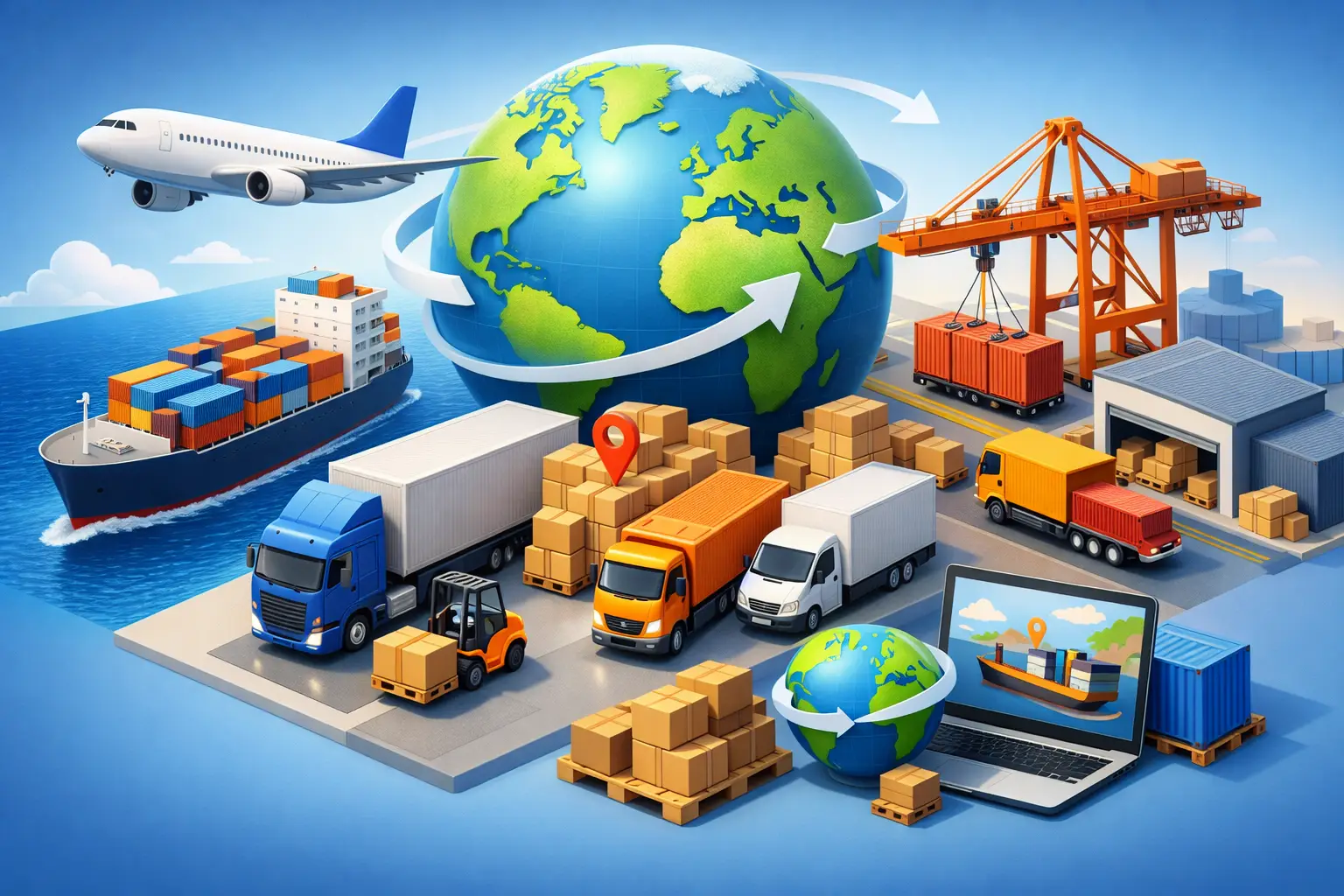
For export manufacturers, logistics is not a support function. It is a margin driver, a market access strategy, and in many cases the deciding factor between scalable growth and chronic operational drag. The Top Logistics Advantages For Export Manufacturers are no longer limited to moving goods faster. They shape working capital, customer confidence, regulatory performance, and the ability to compete across multiple regions at once.
This matters most in advanced manufacturing, where delivery windows are tighter, components are higher value, and production systems depend on reliable inbound and outbound flow. Whether a company is shipping EV components, semiconductor-related equipment, renewable energy systems, or aerospace-adjacent assemblies, logistics strength can raise output without requiring the same increase in fixed cost.
Why logistics has become a board-level advantage
Manufacturers once treated logistics as a downstream function – something to optimize after production was already in place. That model is outdated. Export-led manufacturing now operates in a climate shaped by freight volatility, customs complexity, geopolitical disruption, and customer expectations for shorter lead times.
For leadership teams, that changes the investment question. The issue is not simply where to produce. It is where production can connect to ports, airports, trade corridors, suppliers, and regional buyers with the least friction and the greatest resilience. A manufacturing site with strong logistics access often outperforms a lower-cost location that introduces transit delays, fragmented warehousing, or customs bottlenecks.
In practice, the best logistics environments compress the distance between factory output and customer delivery. They also reduce the number of operational handoffs, which lowers error rates and improves predictability.
Top logistics advantages for export manufacturers in real terms
The most valuable logistics advantages show up in financial and operational metrics, not just freight maps.
Faster access to export markets
Speed to market is one of the clearest competitive gains. A manufacturer positioned near major ports, air cargo gateways, and regional road networks can reduce transit time from finished goods to vessel loading or airfreight dispatch. That has a direct effect on order fulfillment, especially for industries serving project-based buyers, OEMs, or distributors with narrow inventory windows.
Shorter outbound timelines also create strategic flexibility. Companies can accept later order cutoffs, respond faster to demand shifts, and maintain lower finished-goods inventory without exposing customers to delays. In sectors where product cycles are tightening, that responsiveness can protect market share.
There is a trade-off, of course. Premium-speed logistics can increase cost if a company relies too heavily on airfreight or expedited handling. The real advantage comes from being located where mode choice is flexible, not where every urgent shipment requires an expensive fix.
Lower landed cost through supply chain efficiency
Manufacturers often focus on labor and utility costs while underestimating how much logistics inefficiency adds to total landed cost. Poor network design creates hidden expense through excess handling, container detention, buffer stock, demurrage, rework from damage, and elongated cash cycles.
A strong logistics platform lowers those costs by reducing unnecessary movement and improving consolidation. Proximity between production, storage, and export channels cuts internal transfer miles. Better freight coordination improves container utilization. More reliable customs processing reduces avoidable dwell time.
The result is not just cheaper shipping. It is a cleaner cost structure across the value chain. For export manufacturers operating at scale, even modest savings per container or per shipment can materially improve annual profitability.
Greater supply chain resilience
Resilience has moved from a procurement concern to an enterprise priority. Export manufacturers need operating environments that can absorb disruption without halting production or missing delivery commitments.
Logistics resilience comes from optionality. That includes access to multiple transport modes, dependable warehousing, bonded storage where relevant, and trade infrastructure that supports rerouting when one corridor tightens. It also includes geographic positioning that allows companies to serve the GCC, Africa, Asia, and Europe without overreliance on a single channel.
Not every business needs the same level of redundancy. High-volume commodity manufacturers may optimize primarily for cost, while high-value or regulated producers may place a premium on continuity and control. The right logistics setup depends on the cost of delay in that specific business model.
Better inventory control and working capital performance
Inventory is one of the most misunderstood consequences of weak logistics. When transit reliability is poor, manufacturers compensate by holding more raw materials, more safety stock, and more finished goods. That ties up capital and reduces operational agility.
A more efficient logistics environment allows companies to run leaner without becoming fragile. Inbound materials arrive with greater consistency. Finished goods can move out faster. Warehousing can be used strategically instead of defensively.
For executive teams, this is where logistics moves into capital efficiency. Reduced inventory exposure improves cash conversion, supports expansion planning, and frees capital for automation, R&D, and market development.
The infrastructure question behind export performance
Logistics advantages do not exist in isolation. They are created by infrastructure ecosystems that align industrial real estate, transport access, utilities, labor support, and trade administration.
This is why sophisticated manufacturers increasingly favor integrated industrial environments over standalone factory locations. A site may look attractive on lease economics alone, but if it lacks purpose-built logistics facilities, room for expansion, dependable utilities, and access to export corridors, the long-term operational penalty can be severe.
The opposite is also true. A well-planned industrial hub can create compounding value by bringing production, storage, freight movement, and workforce support into one operating logic. In that model, logistics is not an afterthought attached to manufacturing. It is built into the foundation of the manufacturing platform itself.
Proximity is valuable, but integration is more valuable
Many sites advertise port access. Far fewer offer true logistics integration. There is a difference between being near infrastructure and being designed around it.
Export manufacturers benefit most when logistics facilities, industrial units, customs workflows, and transport connections function as one coordinated environment. That reduces internal complexity and helps operations teams make faster decisions. It also simplifies scale-up when production volumes rise.
For manufacturers entering the Middle East or expanding regional export capacity, this distinction matters. A location such as Ras Al Khaimah can offer more than geographic access when paired with a purpose-built industrial ecosystem designed for advanced sectors and long-range growth.
Logistics advantages are sector-specific
Not every manufacturer values the same logistics strengths in the same way. Sector fit matters.
EV and battery-related producers often prioritize heavy cargo handling, reliable inbound component flow, and efficient outbound access to regional assembly and distribution markets. Semiconductor and cleanroom-dependent operations place greater weight on environmental control, precision handling, and low-disruption transport conditions. Renewable energy manufacturers may need project cargo capability, storage flexibility, and access to large-format shipping channels.
That is why generic industrial infrastructure is becoming less relevant for high-value exporters. Sector-specialized environments provide more operational alignment, and that alignment lowers friction across both production and logistics.
What decision-makers should evaluate before choosing an export base
The most strategic question is not whether a location has logistics access. Most industrial markets can claim that. The real question is whether the logistics model supports long-term export competitiveness.
Decision-makers should examine five factors closely: transit reliability, multimodal access, customs efficiency, room for warehouse and production expansion, and the strength of the surrounding industrial ecosystem. A sixth factor is often overlooked – workforce livability. If talent retention is weak because the operating environment lacks housing, healthcare, education, or daily-life infrastructure, logistics performance eventually suffers through labor instability and execution gaps.
This is where an ecosystem-led model becomes a serious advantage. Industrial growth is more durable when logistics, manufacturing readiness, and workforce support are planned together rather than assembled piecemeal. That broader approach is increasingly what separates export platforms built for short-term occupancy from those built for long-term industrial leadership.
For manufacturers planning their next phase of regional or global expansion, logistics should be evaluated as core strategy. The strongest export operations are built where movement is faster, cost is cleaner, disruption is easier to absorb, and scale does not require constant redesign. That is where the future works.
