
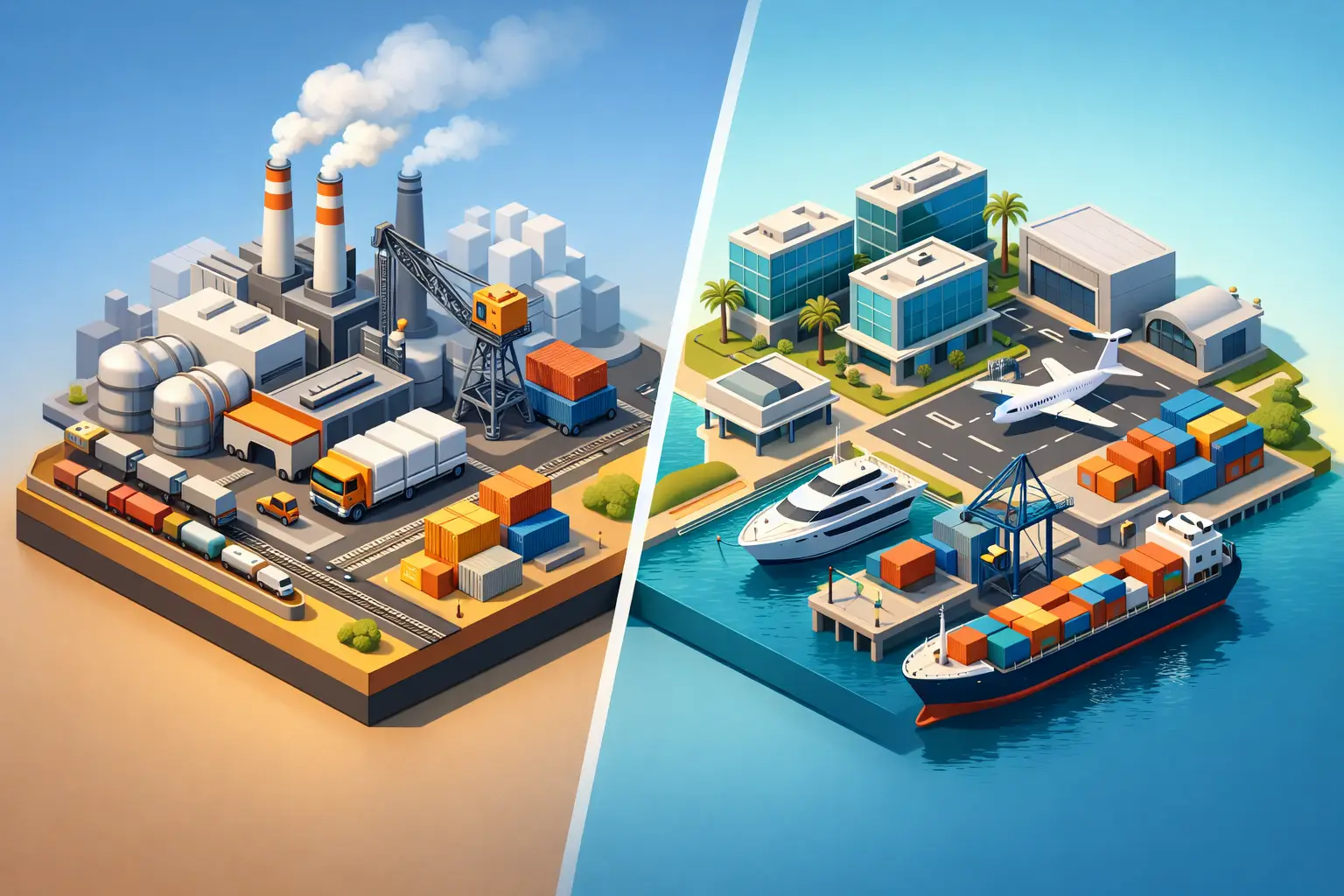
The wrong location model can cap growth before production even starts. For manufacturers entering the Middle East, the Industrial Hub Versus Freezone decision is not a paperwork issue – it is a strategic operating model choice that shapes cost, speed, workforce stability, and long-term competitiveness.
For years, freezones have been the default answer for international companies seeking a regional base. They offer familiarity, defined regulatory pathways, and recognizable incentives. But advanced manufacturing, clean technology, and industrial-scale production are no longer asking the same questions they asked a decade ago. Today, the real issue is not simply where to register a company. It is where to build durable industrial capacity.
Industrial Hub Versus Freezone: The real difference
A freezone is typically designed as a business jurisdiction with regulatory advantages. Its value often starts with ownership flexibility, customs treatment, and setup efficiency. For trading companies, light assembly operations, and regional commercial entities, that can be enough.
An industrial hub serves a broader function. It is built around production, logistics, supplier alignment, infrastructure depth, and ecosystem performance. In a serious industrial hub, the site itself is part of the operating strategy. Power, land planning, expansion capacity, worker access, mobility, warehousing, and R&D support are treated as core inputs, not secondary services.
That difference matters because industrial businesses do not succeed on registration benefits alone. They succeed when the physical environment reduces friction across the full operating lifecycle.
A company producing EV components, hydrogen systems, semiconductors, or aerospace-adjacent assemblies has a different decision matrix from a company importing and re-exporting goods. It needs more than a legal wrapper. It needs an environment that supports uptime, compliance, technical staffing, and future scaling.
Why freezones still matter
Freezones remain highly relevant, and dismissing them would be a mistake. They can be the right answer when speed of entry is the top priority, when the operation is commercially focused rather than production intensive, or when the business model depends on a clear customs and ownership framework with minimal complexity.
They also work well for companies testing a market before committing capital at scale. A regional headquarters, distribution business, or low-footprint light industrial unit can often operate efficiently inside a freezone structure. In those cases, the simplicity is part of the appeal.
The challenge appears when a company outgrows that model. Manufacturing leaders often discover that what worked at launch does not support the next phase. Expansion may become constrained by plot configuration, utility limitations, workforce commuting issues, or the absence of an integrated supplier and innovation environment.
This is where many location decisions become expensive. A setup optimized for incorporation speed can later create operating drag.
When an industrial hub is the stronger platform
An industrial hub becomes more attractive as capital intensity rises. The higher the dependence on specialized facilities, logistics coordination, skilled labor retention, ESG performance, and phased expansion, the more valuable a master-planned industrial ecosystem becomes.
This is particularly true for sectors that need precision-built environments. Semiconductor-related production, battery systems, hydrogen mobility, renewable energy manufacturing, and advanced engineering operations do not fit neatly into generic industrial stock. They require technical infrastructure, compliance readiness, and long-term planning.
A true industrial hub is also stronger when leadership is making a decade-long bet rather than a two-year market entry move. Industrial occupiers with long asset lives need confidence that the surrounding environment will mature with them. That includes transport links, warehousing support, housing access, healthcare, education, and adjacent innovation activity.
In other words, an industrial hub is not only about where machines sit. It is about whether the business can recruit, retain, move, and expand without rebuilding its operating logic every few years.
Cost is more than lease rates
Many executives begin with the visible line items: land, rent, utilities, and license costs. Those matter, but they rarely tell the whole story.
A freezone may appear efficient at entry because the setup package is clear and the commercial framework is familiar. Yet for industrial operators, hidden costs often emerge elsewhere. Transportation inefficiencies, fragmented warehousing, labor travel burdens, retrofit expenses, and limited room for phased expansion can materially change the economics.
Industrial hubs tend to shift the calculation from entry cost to total operating cost. That is the right lens for serious manufacturing. A site with lower friction across logistics, staffing, utility reliability, and future buildout may outperform a cheaper initial option over the life of the asset.
This is especially relevant in the UAE and wider Gulf context, where industrial policy is increasingly tied to value-added production, supply chain localization, and strategic sector development. Businesses positioned inside infrastructure-led ecosystems can be better placed to capture that momentum.
Talent changes the equation
One of the most underestimated differences in the Industrial Hub Versus Freezone debate is workforce performance.
Industrial companies do not just need labor. They need repeatable access to technicians, engineers, production managers, quality specialists, and support staff who can sustain output over time. If employees face long commutes, weak amenities, or fragmented living conditions, retention suffers. If retention suffers, training costs rise and operational continuity weakens.
That is why integrated industrial ecosystems have an edge. When industrial space is supported by residential, retail, healthcare, education, and service infrastructure, the platform becomes more stable for both employer and employee. It creates a more durable operating base, particularly for sectors competing for technical talent.
For board-level decision-makers, this is not a soft factor. It affects productivity, labor continuity, and the attractiveness of the site to international management teams.
Logistics and scale are where the gap widens
For light commercial users, logistics may be a manageable variable. For manufacturers, it is often the core variable.
Inbound materials, outbound finished goods, customs movement, warehousing, multimodal connectivity, and supplier proximity all shape margin and lead time. A location that looks acceptable on a map may still underperform if truck movements are constrained, storage is fragmented, or port access adds avoidable complexity.
Industrial hubs built around logistics performance are designed to reduce those frictions from the start. That includes road planning, yard access, warehouse integration, and the ability to co-locate adjacent functions. In places such as Ras Al Khaimah, where lower operating costs can combine with access to regional trade routes and port infrastructure, the industrial case can become significantly stronger for export-oriented manufacturers.
The advantage grows further when the hub supports clustering. Companies in related sectors benefit from shared suppliers, specialized services, and a stronger industrial identity that attracts both partners and talent.
ESG, compliance, and future readiness
Another shift is changing how this decision should be made. Investors and occupiers are under more pressure to demonstrate ESG alignment, operational resilience, and future readiness. This is no longer a branding exercise. It is affecting financing, procurement, tenant selection, and corporate reporting.
A conventional freezone setup may satisfy legal and administrative requirements, but that does not automatically mean it provides the built environment needed for next-generation industrial expectations. Energy systems, cleanroom readiness, land-use efficiency, mobility planning, and environmental performance increasingly matter.
Industrial hubs that are designed with sustainability and sector specialization in mind can offer a stronger platform for companies that need to show credibility to regulators, investors, and global customers. That is one reason ecosystem developers such as Rana Group are gaining attention among manufacturers looking beyond conventional industrial real estate.
Which model fits which business?
The answer depends on what the company is actually trying to build.
If the business needs a fast, efficient, lower-footprint base for trade, regional administration, or limited assembly, a freezone can be the right instrument. It is often efficient, legible, and commercially practical.
If the business is planning capital-intensive production, large-format industrial operations, technical manufacturing, or a scalable multi-phase presence, an industrial hub is often the stronger long-term platform. It aligns better with infrastructure depth, workforce needs, logistics integration, and asset longevity.
Some companies will also use both models at different stages. They may begin with a freezone presence, then transition to an industrial hub when production scale, technical requirements, or market confidence increase. That progression is valid, but it should be planned rather than forced by constraints.
The better question to ask
Instead of asking which model is better in the abstract, decision-makers should ask a harder question: which platform supports the operating reality of the business five to ten years from now?
That frame changes everything. It moves the conversation away from setup convenience and toward industrial performance. It forces a serious review of land strategy, utility demand, labor access, compliance expectations, logistics architecture, and expansion sequencing.
The businesses that will lead the next industrial cycle in the Gulf are unlikely to choose location models based only on short-term simplicity. They will choose environments built for production, resilience, and scale. That is where the future works.
