
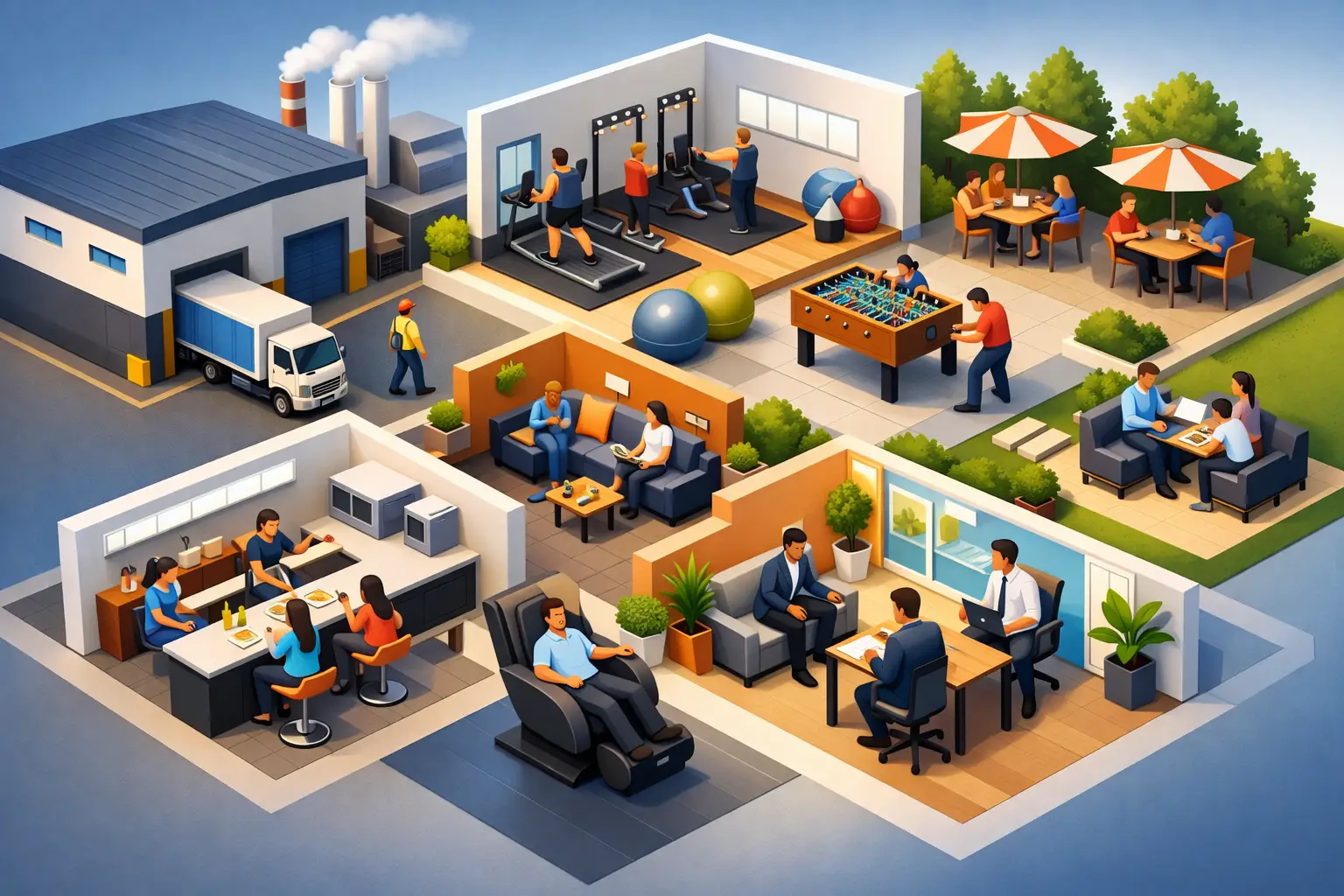
A manufacturer can solve for land, power, and logistics and still lose the equation on talent. That is why the best industrial amenities for workforce retention are no longer a nice-to-have at the edge of a site plan. They are now core industrial infrastructure, especially for advanced manufacturing operators competing for specialized labor, tighter hiring pools, and longer employee commuting patterns.
For decision-makers planning a new facility, expanding a regional footprint, or evaluating industrial hubs, the question is not whether amenities matter. The real question is which amenities actually change retention outcomes and which ones simply add cost without improving workforce stability. In industrial development, the difference is strategic.
What the best industrial amenities for workforce retention actually do
Workforce retention is often framed as an HR issue, but on industrial sites it is also an infrastructure issue. If employees face a long commute, limited food options, poor access to healthcare, weak transit links, or no nearby housing, attrition rises even when wages are competitive. Operators then absorb the cost through overtime, retraining, delayed production, and lower operational continuity.
The best amenities reduce friction in daily life. They make work more sustainable over multiple years, not just more attractive during recruitment. That distinction matters for industries such as semiconductors, EV manufacturing, clean technology, aerospace-adjacent assembly, and precision engineering, where onboarding is expensive and role-specific knowledge compounds over time.
Amenities also signal institutional seriousness. A well-planned industrial ecosystem tells employees that the employer and the broader development platform are built for permanence. For investors and multinational occupiers, that perception translates into a stronger talent proposition and lower operational volatility.
Housing near the industrial base is still the strongest retention lever
If one amenity consistently outperforms the rest, it is accessible housing. Long commutes are one of the fastest ways to erode retention in industrial environments, particularly where shift work is common and labor demand spans technicians, line workers, supervisors, engineers, and support staff.
Nearby residential options do more than shorten travel time. They improve punctuality, reduce transport fatigue, support family stability, and make second- and third-shift scheduling more manageable. For employers, that often shows up as lower absenteeism and a wider catchment area for hiring because candidates do not need to solve a difficult relocation equation on their own.
There is a trade-off, though. Housing only works as a retention asset when quality and affordability align with workforce realities. Premium residential units aimed at executives will not solve retention for technicians or plant operators. The strongest industrial ecosystems plan for multiple housing tiers and think about the workforce as a whole, not just senior management.
Healthcare access matters more in industrial settings
In office markets, on-site wellness perks can be overplayed. In industrial settings, healthcare access is much more practical and much more valuable. Workers on physically demanding schedules place real value on quick access to primary care, occupational health services, pharmacy access, and urgent treatment.
For employers, this is not just an employee benefit. It affects lost-time incidents, return-to-work timelines, and the overall reliability of the labor force. When healthcare is distant or hard to access, small issues become larger disruptions. When it is integrated into the broader industrial environment, workforce confidence improves.
The strongest model is not necessarily a full hospital on every site. It depends on scale. For some hubs, on-site clinics and occupational health support are enough. For larger mixed-use industrial platforms, integrated healthcare becomes a competitive advantage because it supports both workers and their families.
Daily convenience is not cosmetic – it is operational
Industrial leaders sometimes underestimate the retention impact of ordinary services. Food outlets, grocery access, banking, childcare, pharmacies, and essential retail may not sound transformative, but they directly shape whether a work location feels sustainable.
This is especially true in large industrial zones that were designed around freight movement rather than human experience. Employees notice when every errand requires a detour. Over time, that inconvenience compounds into dissatisfaction, particularly for mid-career employees balancing family responsibilities.
The best industrial amenities for workforce retention make the site work like a functioning community, not just a production compound. A cafeteria alone is not enough. The question is whether workers can move through a normal week with less logistical stress. If the answer is yes, retention usually follows.
Mobility and transport links can outperform wage increases
Many retention problems begin before the workday starts. If employees rely on fragmented transport, unpredictable shuttle systems, or long road commutes, the site becomes vulnerable to churn. This is one reason transport planning deserves a larger place in industrial strategy.
Reliable access roads, organized worker transport, last-mile connectivity, and proximity to urban centers or residential districts all matter. For higher-skill talent, airport access can also influence retention because it supports regional mobility and executive travel. For production roles, consistency is more important than prestige. A dependable route to work beats a glossy amenity package almost every time.
Transport also has a sector-specific dimension. Advanced manufacturing clusters often require mixed talent pools, from cleanroom specialists to maintenance crews to R&D staff. Their schedules and mobility needs are not identical. The best developments account for that complexity rather than assuming one transport model fits all.
Education and skills infrastructure support long-term retention
Retention is stronger when employees can see a future at the site. That is why training centers, technical institutes, certification pathways, and university linkages deserve to be treated as amenities, not separate policy issues.
For employers in growth sectors, skills infrastructure serves two retention functions. First, it helps workers advance. Second, it reassures employers that the labor pipeline will deepen rather than tighten over time. A worker is more likely to stay where upskilling is visible and accessible. An employer is more likely to commit capital where talent development is built into the ecosystem.
This is particularly important in emerging sectors where job roles evolve quickly. EV systems, hydrogen mobility, semiconductors, and advanced materials production all require continuous workforce adaptation. Industrial environments that support learning create a more durable operating base.
The best industrial amenities for workforce retention are integrated, not scattered
An isolated amenity rarely changes the workforce equation on its own. A gym without nearby housing, a clinic without transport access, or retail without childcare solves only part of the problem. Retention improves when amenities are planned as a coordinated system.
That is where integrated industrial ecosystems have a structural advantage over conventional industrial parks. They are able to combine production facilities with residential, healthcare, education, retail, hospitality, and innovation assets in one operating environment. For industrial occupiers, this creates a stronger platform for talent attraction and a more resilient base for long-term scale.
This model also aligns with the expectations of global manufacturers entering new markets. They are not only asking whether a site can support throughput today. They are asking whether the surrounding ecosystem can support workforce continuity over a decade of expansion.
In developments shaped around advanced industry, that integrated approach becomes part of the value proposition. It reduces friction for occupiers, improves quality of life for employees, and strengthens the case for sustained investment. That is one reason ecosystem-led platforms such as Rana Group’s industrial model have strategic relevance beyond real estate – they are designed to support where the future works.
What investors and operators should evaluate before calling an amenity package competitive
Not every industrial project that advertises amenities will deliver retention value. Decision-makers should ask a harder set of questions. Are the amenities within practical reach of shift workers? Are they designed for the real workforce mix on site? Are they scalable as occupancy grows? Are they integrated into the master plan or treated as a future phase that may never arrive?
Timing matters too. Amenities promised five years after first operations begin do little to support initial workforce stability. Governance matters as well. A mixed-use promise only becomes a retention asset when the operating model, partnerships, and service delivery are credible.
There is also a cost discipline question. The goal is not to overbuild lifestyle features that do not fit the labor market. The goal is to invest in the few amenities that materially reduce friction, increase workforce loyalty, and reinforce production continuity.
Industrial retention is now shaped by more than wages and plant design. It is shaped by whether the site can support a full working life. The most competitive industrial environments will be the ones that understand this early and build accordingly. For operators planning their next move, that is not a soft consideration. It is a hard advantage that compounds year after year.
