
An EV plant does not fail because demand is weak. It fails because one stamped part arrives late, a battery module line cannot localize fast enough, or homologation timelines slip across markets with different standards. That is why the EV supplier ecosystem Middle East now matters far beyond automotive headlines. For manufacturers, investors, and industrial planners, the region is moving from a sales market to a production platform, and that shift changes where value is created.
The central question is no longer whether electric mobility will expand across the Gulf and wider region. It is whether the industrial base can support that expansion at the speed, cost, and quality global manufacturers require. The answer depends less on a single anchor factory and more on the depth of the surrounding ecosystem.
What defines the EV supplier ecosystem Middle East
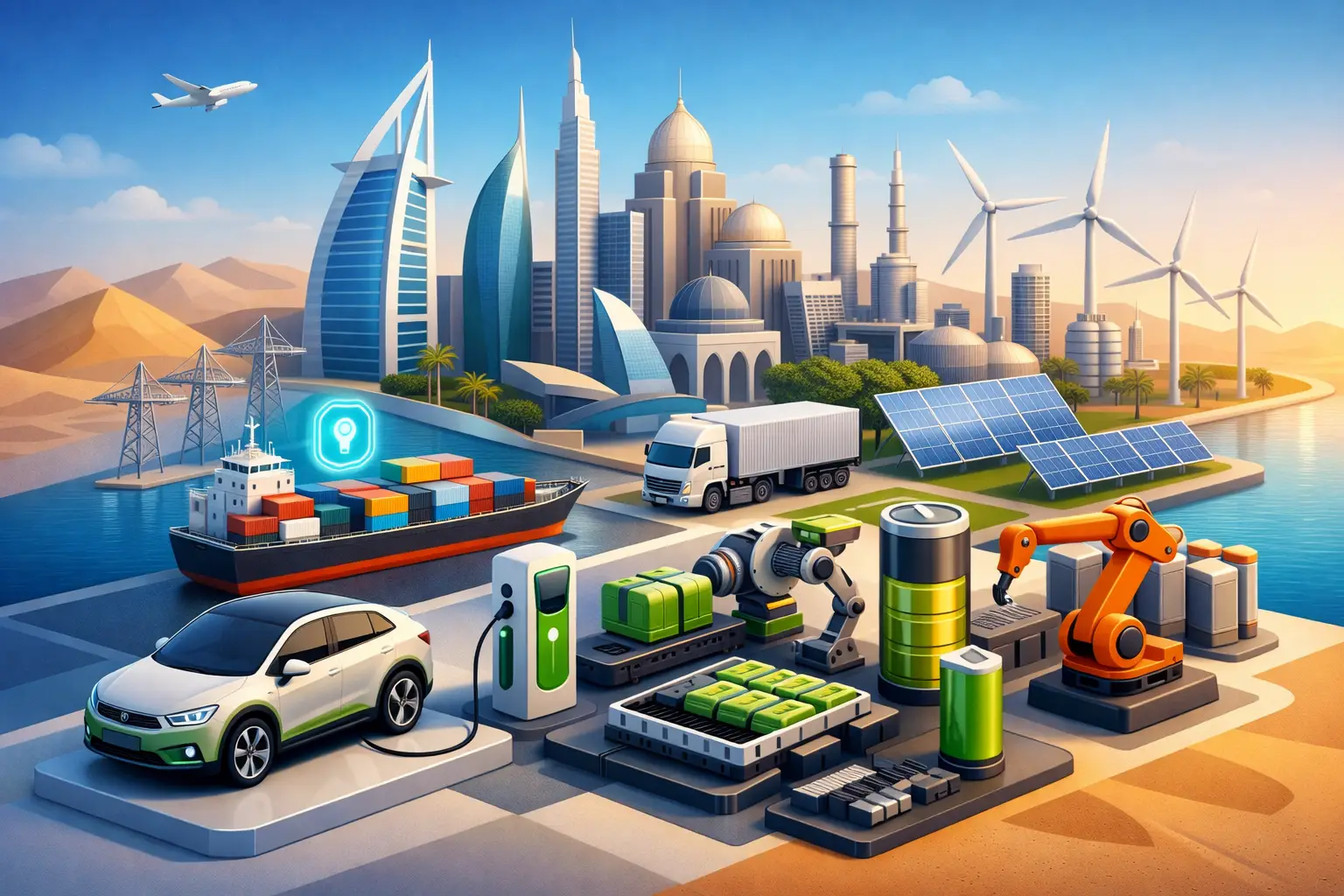
In practical terms, the EV supplier ecosystem Middle East includes far more than vehicle assembly. It spans battery pack integration, thermal management, lightweight materials, wiring harnesses, castings, electronics, charging hardware, test and validation capacity, logistics providers, software support, and aftersales infrastructure. A market can import finished vehicles for years without building real industrial capability. It becomes an ecosystem only when suppliers, utilities, regulators, talent pipelines, and logistics networks begin to operate as one industrial system.
That distinction matters for capital allocation. Investors tend to overestimate the strategic value of assembly and underestimate the leverage of components. In EV manufacturing, power electronics, battery subassemblies, precision plastics, magnetics, control units, and charging equipment often determine how much value can be localized and how resilient production becomes. If these capabilities remain offshore, the regional value proposition stays shallow.
The Middle East has a credible case for changing that. It offers capital availability, policy ambition, access to trade corridors, and growing pressure to diversify beyond hydrocarbons into advanced industry. But industrial credibility is not built through announcements alone. It requires supplier density, production-ready infrastructure, and a business environment that reduces friction for both global OEMs and specialized mid-tier manufacturers.
Why the region is gaining traction now
Several forces are converging at once. Governments across the Gulf are pushing industrial diversification strategies that prioritize advanced manufacturing, clean energy, logistics, and technology-led sectors. EVs sit at the intersection of all four. They create demand not only for vehicles, but for batteries, charging systems, software-enabled power management, and renewable-linked energy infrastructure.
At the same time, global supply chains are being redrawn. Manufacturers want redundancy outside traditional hubs, shorter routes to growth markets, and production locations with political stability, energy access, and export reach. The Middle East checks many of those boxes. It connects Asia, Europe, and Africa with strong port and air cargo networks, while also serving domestic and regional demand that is expected to rise as fleet electrification accelerates.
Energy economics also play a role. EV supply chains are energy-intensive, particularly in materials processing, thermal systems, and battery-related manufacturing. Regions that can offer reliable power, competitive operating conditions, and a pathway to cleaner energy have an advantage. For many industrial occupiers, this is no longer a branding issue. It is tied directly to procurement standards, investor expectations, and long-term margin protection.
Where value will likely concentrate first
The strongest near-term opportunities are not evenly spread across the entire EV bill of materials. Some segments are far more realistic for early localization than others.
Battery cell manufacturing attracts attention, but it is capital-heavy, technologically demanding, and highly sensitive to upstream raw material access and scale. Battery pack assembly, by contrast, is more attainable in earlier ecosystem stages, especially where there is regional demand for commercial fleets, buses, utility vehicles, and specialized mobility platforms. The same logic applies to charging infrastructure, power distribution equipment, enclosures, cable systems, thermal components, and control electronics. These are industrial categories where the Middle East can build capability faster if the right clusters are in place.
Commercial vehicle electrification may also outpace passenger cars in industrial significance. Fleet operators respond to total cost of ownership, route predictability, and policy incentives in ways that make regional manufacturing more viable. Buses, delivery vans, port vehicles, mining support fleets, and municipal service vehicles create a practical bridge between pilot projects and scaled production.
This is where industrial planning becomes decisive. A supplier ecosystem grows faster when adjacent capabilities share utilities, testing resources, warehousing, customs efficiency, and labor access. Fragmented sites increase cost and delay. Clustered manufacturing compresses the path from supplier onboarding to production readiness.
The infrastructure question investors should ask
Most discussions about EV localization focus on incentives. Incentives matter, but they are not the foundation. Infrastructure is.
An EV supplier considering a new regional base is evaluating site readiness, power quality, environmental compliance, freight access, workforce accommodation, and room for future expansion. It is also assessing whether neighboring tenants create commercial synergies or simply occupy land. Industrial real estate alone does not solve these questions. What matters is whether the platform is designed for advanced manufacturing from the outset.
That means facilities that can support precision production, clean manufacturing requirements where needed, modular scaling, inbound and outbound logistics efficiency, and ESG-aligned operations. It also means reducing the hidden friction that undermines startup timelines – permit complexity, fragmented support services, and the distance between factory operations and the broader ecosystem required to retain talent.
For this reason, integrated industrial environments have a structural advantage over isolated plots. They help manufacturers move faster because the operating model is already thought through. In the Middle East, where industrial transformation is happening at speed, this can be the difference between a strategic announcement and a functioning supply chain.
The policy and standards gap is still real
Momentum should not be confused with maturity. The region still faces gaps that will shape how fast the EV supplier base can scale.
Standards alignment is one of them. Vehicle specifications, charging protocols, safety requirements, and certification pathways can vary across markets. For suppliers serving multiple countries, inconsistency creates cost. Harmonization would improve economics for regional manufacturing and make the Middle East more attractive as an export platform.
Talent depth is another variable. Advanced EV manufacturing depends on process engineers, battery specialists, embedded systems talent, quality leaders, and industrial automation expertise. These capabilities can be built, but they do not appear automatically with a new facility launch. The strongest ecosystems will be those that pair industrial assets with training, research partnerships, and a living environment that helps companies recruit and retain skilled teams.
Local supplier readiness also takes time. Many conventional automotive or industrial suppliers can pivot into EV-related production, but qualification cycles are demanding. OEMs and Tier 1 suppliers will need confidence in quality systems, traceability, and scale discipline. In early-stage markets, supplier development programs are often just as important as factory construction.
What a winning ecosystem looks like
A credible EV supplier ecosystem is not defined by one flagship tenant. It is defined by compounding advantages.
First, it offers sector-specific infrastructure rather than generic industrial space. Second, it creates adjacency between manufacturers, component suppliers, logistics operators, and R&D functions. Third, it lowers operating friction through permitting efficiency, utilities planning, and export connectivity. Fourth, it supports workforce stability through a broader live-work environment instead of treating labor as an afterthought.
This is why ecosystem design has become a strategic asset. Manufacturers entering the region are not simply choosing a site. They are choosing whether their future supplier base can scale around them. A well-planned hub can shorten that timeline significantly by bringing production, logistics, talent support, and innovation capacity into one coordinated environment. That is the model Rana Group is building into advanced industrial development, because the next phase of mobility manufacturing will reward integrated platforms, not disconnected assets.
Why this matters beyond automotive
The EV supplier ecosystem Middle East has implications well beyond vehicle output. It can anchor broader industrial capabilities in semiconductors, industrial software, energy storage, lightweight materials, and advanced power systems. Those capabilities spill into adjacent sectors such as aerospace, grid infrastructure, hydrogen mobility, and defense-adjacent manufacturing.
That spillover is where national economic value becomes clearer. EV supply chains are not just about assembling cleaner vehicles. They are about building higher-value industrial capacity, attracting technical talent, deepening export relevance, and creating a manufacturing base that aligns with long-term diversification goals.
For decision-makers, the opportunity is real, but selective. Not every part of the EV value chain should be localized at once, and not every site can support the requirements of advanced suppliers. The winners will be the markets and platforms that understand sequencing, build density around the right component categories, and treat industrial ecosystems as strategic infrastructure.
The future of mobility in the region will be shaped less by who sells the most vehicles first and more by who builds the supplier base that others depend on.
