
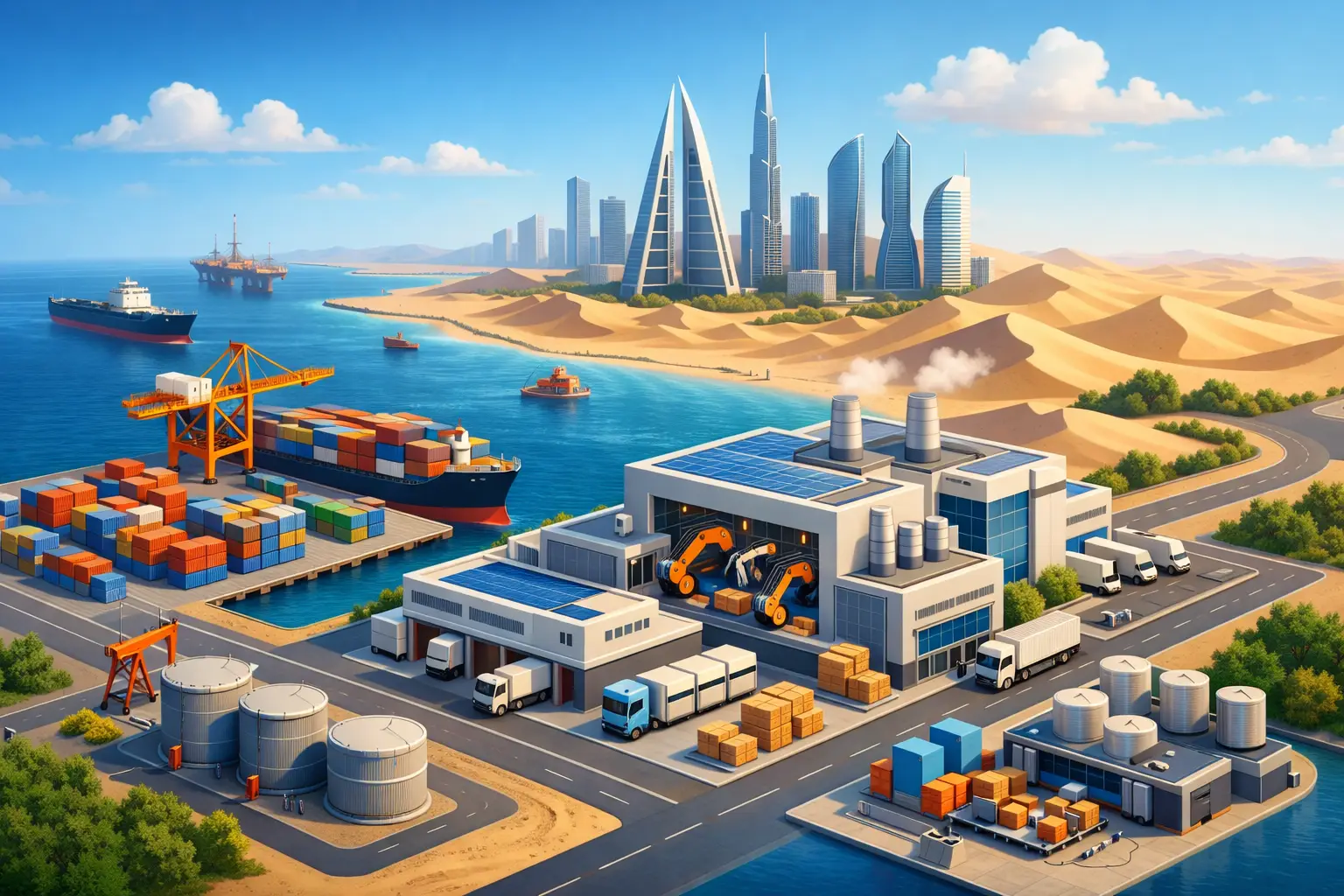
A company can secure demand across the Gulf and still lose momentum on execution if its operating base is wrong. For any manufacturer evaluating a manufacturing base for GCC markets, the real question is not simply where to produce. It is where to build with enough speed, cost control, infrastructure depth, and long-term flexibility to serve a region that is scaling fast and changing even faster.
The GCC is no longer a peripheral demand zone for industrial firms. It is becoming a strategic production, distribution, and technology destination in its own right. That shift matters for multinationals entering the region, but it matters even more for advanced manufacturers in sectors such as EVs, hydrogen mobility, semiconductors, renewable energy systems, and aerospace-adjacent production. These businesses are not looking for basic industrial land. They are looking for operational certainty.
What makes a manufacturing base for GCC markets viable
A viable manufacturing platform for the Gulf starts with geography, but geography alone is not enough. Proximity to ports, trade routes, and major customer markets creates reach. The harder issue is whether a site can support the rhythm of industrial operations once production begins.
That means utilities must be dependable, logistics must be efficient, and facility formats must match technical needs. A light assembly operator and a cleanroom-ready semiconductor manufacturer are both serving GCC markets, but they require very different environments. The same is true for an EV component producer compared with a hydrogen systems integrator. When decision-makers talk about regional expansion, they often focus first on incentives. In practice, infrastructure fit usually determines whether the investment performs.
The strongest industrial locations in the Gulf offer a combination of lower operating costs, business-friendly regulation, access to trade corridors, and room to scale. That combination is what turns a site into a real manufacturing base rather than a temporary foothold.
Why the GCC requires a different location strategy
The Gulf is often discussed as a single market, but from an operating perspective it is a network of linked economies with different procurement patterns, industrial policies, import channels, and sector strengths. A base that works for one product category may be inefficient for another.
For example, companies serving large-volume regional distribution need quick access to shipping and overland links. Higher-value manufacturers may place more weight on specialized facilities, ESG standards, data infrastructure, and workforce retention. If your product depends on precision processes, quality control, and regulatory confidence, then the industrial ecosystem around the factory matters almost as much as the factory itself.
This is where many expansion models become too narrow. They treat the site search as a real estate exercise, when it is actually a strategic supply chain decision. The right base should reduce landed costs, shorten fulfillment cycles, support regional partnerships, and create a platform for future product lines. If it cannot do all four, it may still be usable, but it is unlikely to become a long-term competitive advantage.
Cost matters, but hidden costs matter more
Most industrial investors begin with headline numbers such as lease rates, labor assumptions, and utility pricing. Those are necessary inputs, but they rarely tell the full story. A lower-cost site can become more expensive if it creates logistics friction, delays permits, limits automation, or forces the company into multiple fragmented facilities.
A serious manufacturing base for GCC markets has to be measured against total operating efficiency. Can inbound materials move predictably? Can outbound goods reach regional customers without unnecessary transfer points? Is there enough built-in flexibility to add production lines, warehousing, testing space, or technical support functions as demand grows?
The same applies to workforce economics. If an industrial zone is disconnected from housing, healthcare, training, and daily services, employers often absorb the cost through turnover, transport complexity, and retention challenges. These are not side issues. They affect output, quality, and the speed at which a plant can stabilize after launch.
That is why integrated industrial ecosystems are gaining ground. They reduce the friction between production and the human systems required to sustain it.
Infrastructure now needs to match sector complexity
The next generation of Gulf manufacturing will not be driven by generic warehousing and assembly alone. It will be driven by specialized sectors that need purpose-built environments. Semiconductor-related processes may require cleanroom-ready capacity and strict utility performance. EV and battery supply chains may need modular production layouts, testing zones, and logistics support tuned for component movement. Renewable energy and hydrogen mobility manufacturing often depend on heavy infrastructure, safety planning, and long-horizon expansion options.
This changes the criteria for site selection. Investors are increasingly asking whether a location was designed for industrial complexity or merely adapted for it. There is a material difference.
Purpose-built infrastructure shortens the path from capital commitment to operational output. Turnkey factories can reduce launch timelines. Modular industrial units can support phased entry. Dedicated logistics facilities create resilience. Sector clustering can strengthen supplier relationships, technical collaboration, and investor confidence. For firms entering high-growth categories, these factors can shape the economics of the entire regional strategy.
Manufacturing base for GCC markets and the rise of ecosystem thinking
The most competitive industrial developments are moving beyond the old industrial park model. They are being planned as ecosystems where manufacturing, logistics, research, workforce support, and daily living functions are designed to operate together.
This matters because industrial performance is no longer produced by the factory alone. It is produced by the surrounding environment. A company may have advanced equipment and strong market demand, but if the broader setting cannot support engineers, technicians, suppliers, and partner institutions, growth becomes slower and more expensive.
An ecosystem approach improves more than convenience. It supports continuity. Residential options near industrial operations can help retain skilled talent. Education and training assets can strengthen workforce pipelines. Healthcare, retail, and hospitality improve daily livability for employees and visiting partners. R&D integration creates a stronger bridge between production and innovation.
For manufacturers serving GCC markets, this model aligns with a practical reality: regional growth will increasingly favor companies that can scale production, support talent, and meet sustainability expectations at the same time.
Why Ras Al Khaimah is gaining attention
Not every Gulf location offers the same operating profile. Some bring market visibility but higher cost pressure. Others offer industrial land but limited ecosystem depth. Ras Al Khaimah is gaining attention because it presents a different balance – cost competitiveness, investor-friendly frameworks, logistics connectivity, and room for large-scale industrial development.
That combination is especially relevant for manufacturers that need to enter the GCC with discipline rather than excess overhead. A lower-cost jurisdiction is valuable, but it becomes far more powerful when paired with port access, regulatory clarity, and infrastructure that supports advanced industry instead of basic occupancy.
This is one reason integrated projects such as Erisha Smart Manufacturing Hub are strategically relevant. They reflect a larger shift in how serious industrial capacity is being built in the region: not as isolated plots, but as future-ready production environments designed for advanced manufacturing, logistics performance, and long-term investor alignment. For companies seeking a base that can serve GCC demand while supporting broader export ambitions, that distinction matters.
The trade-offs executives should weigh
There is no universally perfect manufacturing location. The best choice depends on sector, production model, customer geography, and growth horizon.
A business focused on speed-to-market may favor ready facilities over bespoke development. A company with highly technical processes may accept a longer setup period in exchange for specialized infrastructure. Firms with regional distribution priorities may optimize for multimodal logistics, while innovation-led manufacturers may place greater weight on clustering and R&D adjacency.
What should be avoided is a short-term decision that solves for entry but not scale. A site that works for year one and constrains year three can become a costly reset. Industrial investors should evaluate not only current fit, but the site’s ability to support automation, workforce expansion, product diversification, compliance requirements, and capital-efficient growth over time.
That is the real test of a manufacturing base for GCC markets. It must support the business you are building now and the one you expect to become.
The Gulf is entering a new industrial cycle, shaped by energy transition, strategic localization, supply chain realignment, and advanced manufacturing investment. Companies that choose their base with that horizon in mind will be positioned to do more than serve demand. They will help define where regional industry goes next.
