
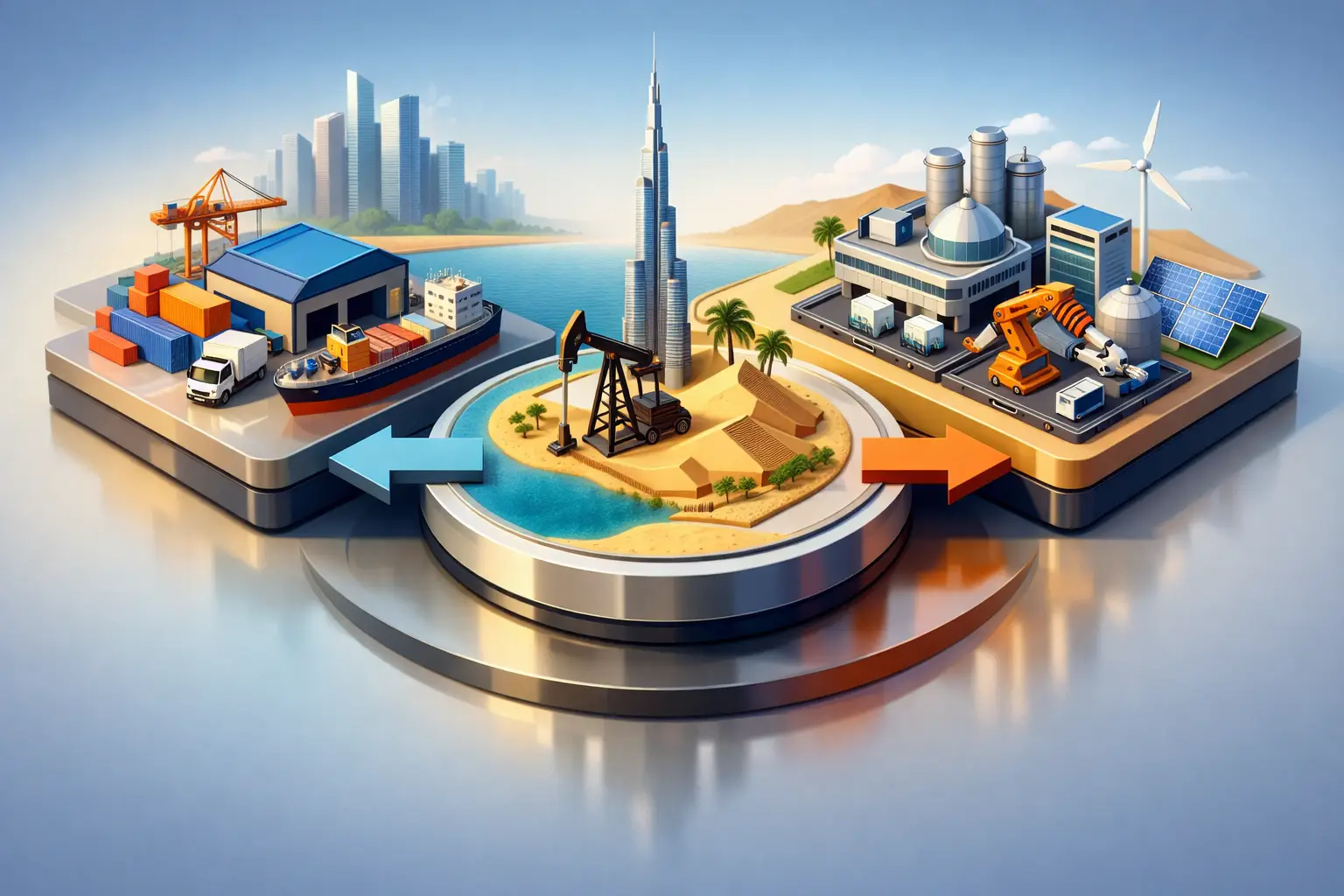
Site selection in the UAE is rarely a simple real estate decision. A serious uae industrial zones comparison is really a question of operating model, cost structure, export strategy, workforce stability, and whether a location can support the next ten years of industrial growth – not just the first lease term.
For advanced manufacturers, clean-tech operators, and global investors, the difference between one zone and another can shape margins, hiring, compliance, and expansion speed. Some zones are optimized for trade and warehousing. Others suit light assembly. A smaller group is better positioned for high-value production, specialized utility needs, and the kind of industrial clustering that creates durable advantage.
A UAE industrial zones comparison starts with strategy
Many companies begin by comparing incentives, lease rates, or proximity to a port. Those factors matter, but they do not tell the full story. Industrial performance depends on how well a zone matches the realities of your sector.
A semiconductor-adjacent operator, for example, is not solving the same problem as an EV components manufacturer or a hydrogen mobility business. Utility reliability, cleanroom readiness, logistics throughput, heavy vehicle access, future expansion land, and environmental compliance each carry different weight depending on the production profile. The strongest site choice comes from aligning the zone with the industrial process, not from chasing the headline discount.
That is why executives should treat UAE zones in three broad categories. First, there are trade-centered free zones that excel at import, re-export, and regional distribution. Second, there are established industrial areas that support conventional manufacturing with proven infrastructure and labor access. Third, there are next-generation industrial ecosystems designed around advanced manufacturing, innovation clusters, and integrated live-work environments. Each category can be the right answer, but only for the right operating model.
The main criteria in a UAE industrial zones comparison
Cost is usually the first lens, and it should be. Land, lease rates, utility charges, fit-out requirements, and labor accommodation all affect total operating expenditure. But lower headline occupancy costs can be offset by higher transport spend, fragmented supply chains, or the need to build specialized infrastructure from scratch.
Logistics is the second major filter. Port access, airport connectivity, highway links, and distance to GCC markets directly affect inbound materials and outbound finished goods. A zone close to major trade corridors can reduce cycle times and working capital pressure. For export-driven businesses, that advantage compounds over time.
Regulatory structure also matters. Investors should look beyond license issuance speed and ask more strategic questions. How clear are the rules around industrial use? How mature is the zone authority in handling complex manufacturing requirements? Can the ecosystem support staged growth, foreign ownership needs, customs efficiency, and ESG reporting expectations?
Then there is infrastructure depth. Many zones can host manufacturing in principle. Fewer can support high-spec industrial operations with scalable power, specialized facilities, logistics yards, heavy-load circulation, R&D adjacency, and purpose-built production environments. If your process requires precision, contamination control, large-format assembly, or specialized testing, infrastructure readiness becomes a board-level issue.
Finally, talent and livability are often underestimated. Industrial projects fail to scale when the workforce experience is weak, housing is disconnected, or the site lacks the broader ecosystem that helps attract engineers, technicians, managers, and innovation partners. The future of manufacturing is not only about factory floor efficiency. It is about whether skilled people can build long careers around the operation.
How major UAE industrial zone models differ
Dubai-based zones often lead on international visibility, multimodal logistics, and commercial connectivity. They can be strong choices for companies that prioritize trade velocity, customer proximity, and established business networks. The trade-off is that cost structures may run higher, and some occupiers may find that premium difficult to justify if their model depends on large land parcels or long-horizon industrial scaling.
Abu Dhabi industrial platforms tend to appeal to heavy industry, energy-linked manufacturing, and companies seeking alignment with major national industrial initiatives. They offer strategic depth and often benefit from significant infrastructure planning. For some investors, the fit is strong. For others, the question becomes whether the location and cost profile match the flexibility needed for mixed-use advanced manufacturing or mid-scale expansion.
Northern Emirates zones, particularly in Ras Al Khaimah and Sharjah, often shift the equation by offering more competitive operating costs, available land, and practical access to ports and regional markets. These zones can be especially compelling for manufacturers focused on efficiency, footprint expansion, and long-term margin discipline. The key difference within this group is that not every zone offers the same level of ecosystem integration or sector specialization.
That distinction is becoming more important as industrial strategy moves beyond conventional warehousing and assembly. The next wave of occupiers is looking for places that can host EV supply chains, hydrogen mobility production, clean-tech components, aerospace-adjacent manufacturing, and high-value industrial R&D. In those cases, a zone that simply offers land is no longer enough.
Why integrated ecosystems are changing the decision
The older industrial park model treated manufacturing as isolated from the rest of economic life. Factories sat in one place, housing in another, education elsewhere, and innovation partnerships were left to chance. That model can still function for basic industrial activity, but it is less effective for sectors competing on speed, precision, and talent.
Integrated industrial ecosystems are changing the benchmark. They combine production facilities with logistics infrastructure, residential options, healthcare, education, retail, hospitality, and research capacity in a coordinated environment. That model reduces operational friction and improves workforce retention. It also creates a stronger platform for collaboration across suppliers, technology partners, and investors.
For advanced industry, this is not branding language. It is a practical advantage. If your engineers, plant leadership, testing partners, and support services can operate within one planned ecosystem, the business gains resilience. Product development moves faster. Recruitment becomes easier. Expansion is less disruptive.
This is where the UAE market is beginning to separate into two distinct futures – zones that support occupancy, and zones that support industrial transformation.
What investors should ask before choosing a zone
Executives should ask whether the site can support the next manufacturing phase, not just current demand. Is there room for a second plant, adjacent suppliers, or new utility requirements? Can the authority accommodate sector-specific compliance needs? Does the infrastructure suit automation, clean manufacturing, or heavy equipment movement? If the answer is uncertain, the apparent short-term savings may create long-term friction.
They should also test the zone against sector clustering logic. An EV manufacturer benefits from nearby battery, electronics, lightweight materials, and testing capabilities. A hydrogen mobility business benefits from infrastructure planning that anticipates storage, transport, and specialized safety frameworks. Semiconductor-related occupiers need environments that can evolve toward higher technical standards. The more complex the industry, the more valuable ecosystem design becomes.
Another critical issue is strategic positioning. A zone should not only connect to regional markets. It should strengthen your credibility with customers, partners, and investors. Industrial location now plays a signaling role. It tells the market whether your business is built for scale, compliance, and innovation – or simply searching for low-cost space.
The direction of travel in the UAE
The UAE is moving decisively toward advanced industry, clean energy, and high-value manufacturing. That shift favors zones that can align with national diversification goals while offering practical industrial readiness. Investors are increasingly less interested in generic plots and more interested in platforms built around sector relevance, sustainability, and long-range operating efficiency.
Within that context, developments shaped as full industrial ecosystems have growing strategic relevance. Platforms such as the Erisha Smart Manufacturing Hub reflect where industrial location strategy is heading – purpose-built infrastructure, sector-focused clusters, ESG-aligned planning, and the integration of industrial operations with the wider environment that supports people and innovation. That is a different proposition from a conventional industrial park, and for many future-facing occupiers, a more compelling one.
The best choice in any uae industrial zones comparison depends on your sector, production intensity, export profile, and expansion horizon. But one principle is becoming clear across the market: the winning zone is not the one that offers space alone. It is the one that strengthens your industrial model, lowers friction across the value chain, and gives your business room to build the future with confidence.

[…] should assess ecosystems through an operating lens, not just a land lens. A large site can still be strategically weak if the ecosystem around it is underdeveloped or poorly […]