
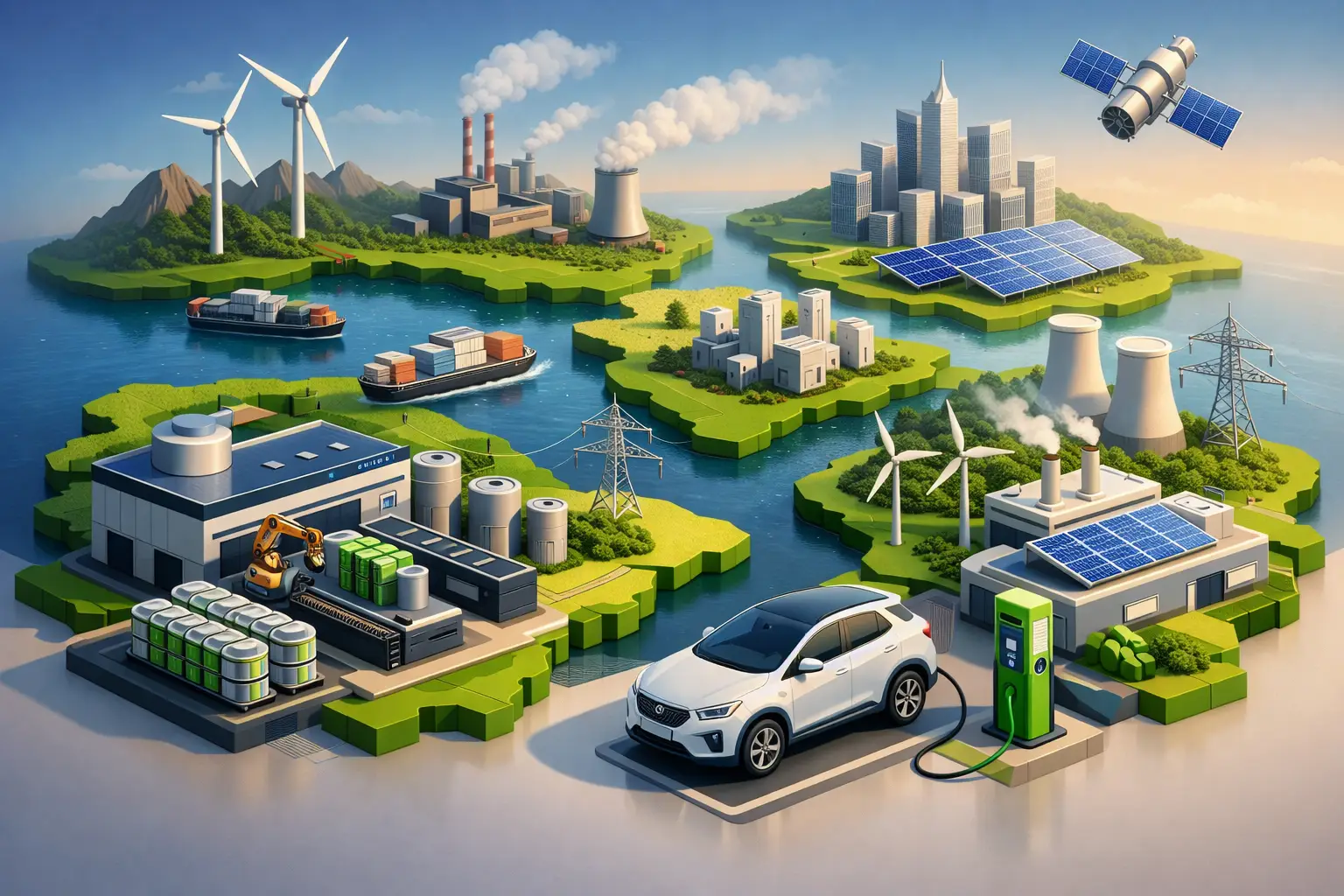
Battery manufacturing is no longer a site-selection exercise driven by land price alone. The Best Regions For EV Battery Plants are now defined by a tighter equation – policy certainty, energy economics, logistics reach, skilled labor, ESG compliance, and proximity to both automotive demand and critical material flows. For investors and manufacturers planning the next decade of capacity, the winning region is rarely the one with the cheapest plot. It is the one that can protect margins, accelerate commissioning, and keep expansion optional.
This market has matured fast. A battery plant is a strategic asset with long development cycles, heavy utility needs, stringent environmental controls, and a supply chain that stretches from mined material to final pack assembly. That means region selection has become a board-level decision, not just an operations task. The strongest regions are those building industrial ecosystems around advanced manufacturing rather than offering isolated sites.
What makes the best regions for EV battery plants
The first filter is demand access. Plants perform better when they sit near large vehicle manufacturing corridors or near ports that can efficiently serve multiple end markets. Shipping cells and packs over long distances adds cost, complexity, and regulatory friction, especially as countries tighten local-content rules and carbon reporting requirements.
The second filter is power. Battery plants need abundant, reliable electricity at competitive rates, and increasingly they need low-carbon power to satisfy OEM procurement standards and investor expectations. Regions that can offer grid resilience, renewable integration, and predictable industrial tariffs hold a structural advantage.
The third is execution speed. A region may look attractive on paper, but if permitting is slow, utility connections take years, or environmental approvals are inconsistent, the project loses momentum. In this sector, timing matters almost as much as cost. Delayed commissioning can erase the value of upfront incentives.
Talent also matters more than many industrial sectors. Battery manufacturing depends on precision process engineering, quality management, automation, materials handling, and increasingly dry-room and clean manufacturing capabilities. Regions with technical education pipelines and the ability to attract international expertise tend to outperform.
Then there is supply chain density. A battery plant is stronger when precursor materials, cathode and anode processing, pack integrators, chemical suppliers, recyclers, and equipment service providers are within reach. A single flagship plant can survive in a thin ecosystem, but a competitive cluster scales faster and de-risks procurement.
North America remains strong, but highly selective
The United States and parts of Canada remain among the Best Regions For EV Battery Plants because they combine strong end-market demand with large-scale industrial incentives and a growing domestic automotive transition. The policy environment, especially where advanced manufacturing and clean energy incentives align, has moved North America from an import market to a major battery production destination.
The advantage is clear. Plants can serve automakers directly, benefit from local-content frameworks, and plug into a manufacturing culture with established automation and quality systems. Regions in the US Southeast and Midwest are particularly compelling because they combine automotive density with lower operating costs than coastal markets.
Still, this is not a uniform opportunity map. Labor competition is intensifying in some clusters. Utility interconnection timelines can vary sharply by state. Land may be available, but suitable industrial sites with the right power, water, wastewater, and transport infrastructure are more limited than headlines suggest. For battery investors, North America works best when the selected state and local ecosystem can prove real delivery capacity rather than just incentive ambition.
Europe offers demand depth and ESG credibility
Europe remains one of the most strategically important regions for battery manufacturing because it brings policy pressure, premium vehicle markets, and a serious decarbonization agenda into the same geography. For manufacturers serving European OEMs, regional production is increasingly tied to both commercial access and compliance expectations.
The strongest European locations tend to be those that pair industrial heritage with renewable power availability and strong engineering talent. Northern and Central Europe have built momentum because they can support high-spec manufacturing environments and increasingly sophisticated battery value chains, including recycling and second-life systems.
The challenge is cost. Energy prices, labor costs, and regulatory overhead can make Europe less forgiving than other regions. That does not make it uncompetitive. It means the economics work best for manufacturers targeting premium markets, pursuing high-value chemistries, or needing a strong ESG position with investors and OEM customers. Europe is not the lowest-cost answer, but in the right business model it is one of the most defensible.
China still leads on ecosystem depth
Any serious assessment of the Best Regions For EV Battery Plants must acknowledge China’s unmatched battery ecosystem. No other market combines scale, supplier density, process know-how, equipment availability, and speed of industrial execution at the same level. For companies operating within China or closely tied to its supply chains, the ecosystem advantage is substantial.
The issue is not capability. It is strategic exposure. Trade policy, geopolitical tension, technology restrictions, and market access considerations have made some investors more cautious about concentrating too much battery capacity in one jurisdiction. For many global manufacturers, China remains vital as part of the supply chain, but not always as the sole answer for future expansion.
That creates a split strategy. Some companies will continue to expand in China for domestic demand and supplier proximity. Others will diversify production footprints while maintaining China-linked sourcing, engineering, or joint-venture relationships. In other words, China remains a leader, but the decision is now shaped by risk concentration as much as manufacturing logic.
Southeast Asia is rising fast
Southeast Asia is moving from emerging option to serious contender. The region benefits from improving industrial policy, strategic maritime routes, competitive labor economics, and in some countries, access to critical battery materials or precursor processing. It is especially relevant for manufacturers seeking export flexibility and a lower-cost production base than Europe or parts of North America.
What makes the region attractive is optionality. A plant can serve local vehicle assembly growth, wider Asian demand, and export markets through major ports. Several countries are investing aggressively in EV and battery ecosystems, offering manufacturers a chance to enter before clusters become saturated and expensive.
The trade-off is unevenness. Infrastructure quality, grid reliability, policy continuity, and talent depth can differ significantly between countries and even between industrial zones. This is a region where industrial park quality and local execution capability matter enormously. Investors cannot assess Southeast Asia as one market. They need a corridor-by-corridor and site-by-site view.
The Gulf is becoming a strategic platform, not just a future prospect
The Gulf deserves more attention than it usually receives in global battery manufacturing discussions. Historically, the region was seen primarily through the lens of energy, logistics, and downstream industry. That framing is now outdated. For battery and clean-mobility manufacturing, the Gulf is becoming a strategic platform built on industrial infrastructure, export geography, policy ambition, and increasingly strong sustainability alignment.
The region’s advantage starts with location. A Gulf-based plant can serve Europe, Africa, South Asia, and wider Middle East markets with shorter trade lanes than many competing regions. Add deepwater port access, investor-friendly industrial regulation, and lower operating costs than many Western markets, and the case becomes stronger.
There is also a growing alignment between national industrial strategies and clean-tech manufacturing. That matters because battery investment is capital intensive and long dated. Manufacturers want to know whether a region sees advanced industry as a temporary headline or a structural priority. In the Gulf, that commitment is becoming clearer, particularly where industrial hubs are being designed around integrated utilities, logistics, workforce accommodation, and sector-specific infrastructure.
This is where an ecosystem model matters. A battery plant does not thrive in isolation. It performs best where suppliers, logistics operators, R&D partners, workforce housing, and advanced manufacturing services can scale together. In markets such as the UAE, that integrated approach is turning industrial development into a competitive asset rather than a background variable. For companies evaluating Middle East entry, the question is no longer whether the region is relevant. It is which platform can support speed, compliance, and expansion without forcing costly workarounds later.
India is strategically important, but execution varies
India has one of the strongest long-term demand stories in the world. It offers scale, industrial labor availability, a large domestic market, and a government push toward advanced manufacturing and energy transition sectors. For battery makers targeting future volume, India belongs on any serious shortlist.
Yet India is a market where regional variation is decisive. Some states offer excellent industrial support, improving infrastructure, and strong policy engagement. Others still present friction around land assembly, approvals, logistics bottlenecks, or utility consistency. As with Southeast Asia, execution quality matters more than headline potential.
For manufacturers willing to build with a long horizon, India can be powerful. The upside is significant, especially when linked to vehicle production, energy storage growth, and industrial policy support. But investors need a realistic timeline and a region-specific operating model rather than a generic national strategy.
The best region depends on the plant’s role
There is no universal winner because not every battery plant is solving the same problem. A plant serving premium European OEMs has different priorities than a mass-scale export facility. A cathode or precursor plant has different logistics and environmental requirements than a cell gigafactory. A first regional foothold is different from a second-wave expansion inside an established cluster.
That is the real lesson in evaluating the Best Regions For EV Battery Plants. The most competitive locations are those that combine market access, infrastructure readiness, industrial policy, and room to scale within a broader manufacturing ecosystem. Regions that can offer all four will attract the next generation of battery capital. Regions that offer only incentives, or only cheap land, will struggle to convert interest into lasting industrial value.
For investors and operators, the smartest move is to think beyond the factory gate. The strongest battery regions are not just places to build. They are places where the future works.
