
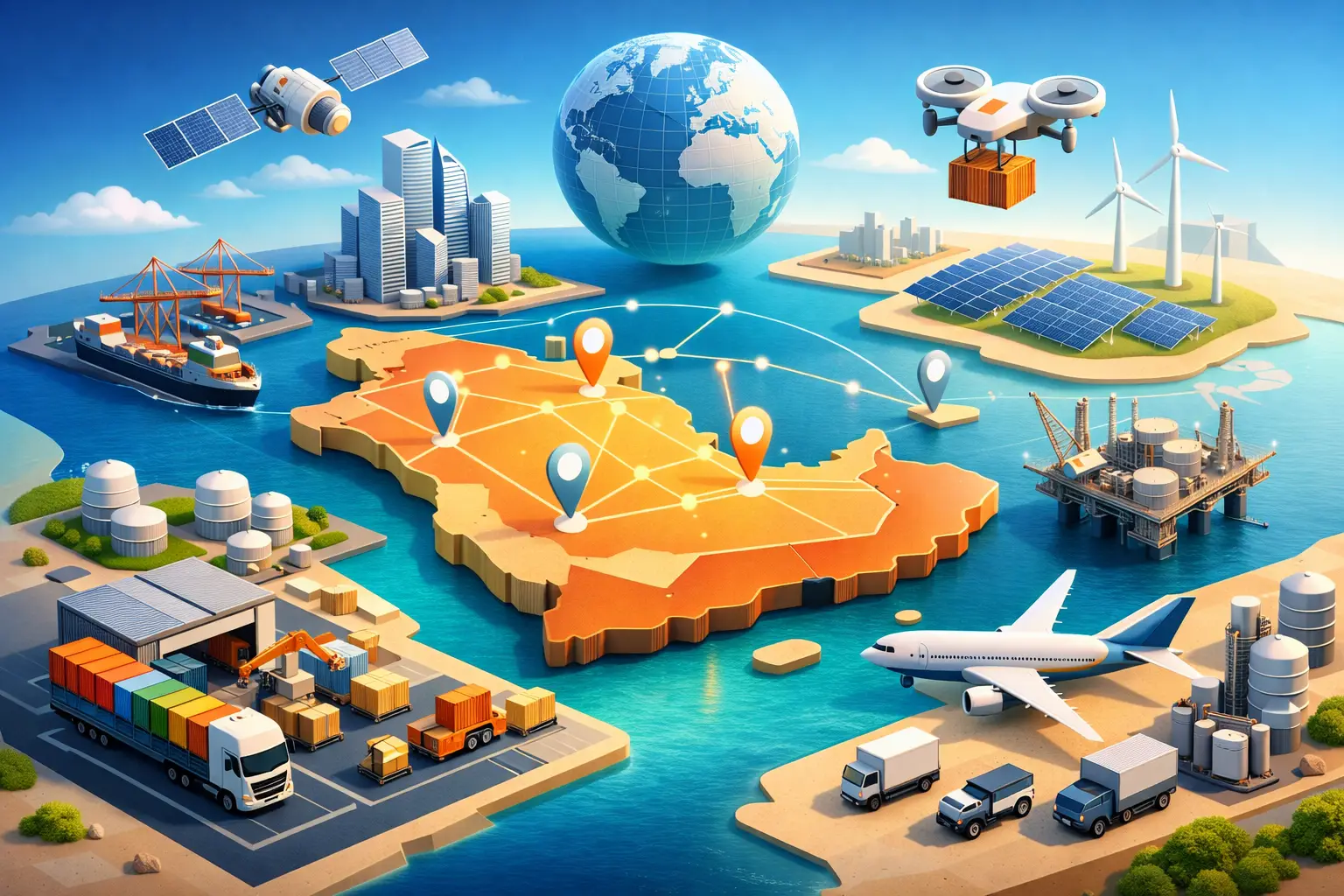
A supply network that saves 2 percent on freight but loses six weeks on lead time is no longer efficient. For manufacturers, investors, and industrial operators, the Future Of GCC Supply Networks will be decided by a different equation: resilience, proximity, energy transition readiness, and the ability to scale without rebuilding the entire operating model.
That shift is already underway. Across the Gulf, supply chains are being redesigned into supply networks – more distributed, more data-led, and far more tied to industrial policy than they were a decade ago. This matters because the GCC is not only a consumption market or a logistics corridor anymore. It is becoming a production platform for advanced industry, clean technology, and high-value manufacturing.
What is changing in GCC supply networks
The old model was straightforward. Raw materials came in, light assembly happened where costs were favorable, and finished goods moved outward through major ports. That model still exists, but it is no longer enough for sectors such as EVs, hydrogen mobility, semiconductors, aerospace components, and renewable energy systems.
These sectors demand more than warehouse access and import-export efficiency. They need specialized utilities, quality-controlled production environments, integrated testing capabilities, skilled labor pipelines, and regulatory settings that reduce friction. In other words, the competitive edge is shifting from isolated logistics assets to full industrial ecosystems.
This is where the GCC has an opening. The region sits at the intersection of Asia, Europe, and Africa, but location alone is not the strategy. The next phase of advantage comes from converting connectivity into manufacturing depth. Countries and industrial platforms that can combine port access, lower operating costs, policy support, and future-ready infrastructure will capture a larger share of regional and global value chains.
The Future Of GCC Supply Networks will be more regionalized
For years, many global manufacturers optimized around distance and labor arbitrage. Recent disruption exposed the weakness in that logic. Pandemic bottlenecks, geopolitical tension, commodity volatility, and shipping instability forced executive teams to rethink concentration risk.
In the GCC, that is driving a more regionalized model. Regionalization does not mean complete self-sufficiency. It means building enough production and assembly capacity within the region to shorten response times, reduce dependency on distant single-source suppliers, and support critical sectors with greater control.
That has several implications. First, intermediate manufacturing will matter more. The GCC will not only attract final assembly but also upstream activities such as component production, precision fabrication, battery-related processes, electronics packaging, and industrial services. Second, supplier clustering will become more important than standalone facilities. A factory is stronger when key vendors, logistics providers, testing facilities, and workforce support are all within operational reach.
There is a trade-off, of course. Regionalization can raise near-term capital intensity. Building local capability requires land, utilities, compliance systems, and tenant coordination. But for industries where downtime is expensive and market timing matters, the cost of dependency is now often higher than the cost of localizing selectively.
Infrastructure is becoming the real differentiator
Not all industrial capacity is equal. A plot of land near a highway is not the same as a production-ready environment designed for advanced manufacturing. Investors and occupiers are increasingly separating generic industrial real estate from strategic infrastructure.
The future belongs to sites that reduce setup time and operating friction. That means turnkey factories for speed to market, modular units for phased expansion, logistics facilities that connect efficiently to ports and inland transport, and specialized spaces for industries with technical requirements, including cleanroom-ready environments and high-load utility provision.
It also means planning beyond the factory gate. Manufacturers now assess whether a location can support workforce retention, executive mobility, supplier visitation, R&D collaboration, and ESG reporting. A disconnected industrial zone may appear cost-effective on paper, yet impose hidden costs in hiring, transport, downtime, and coordination.
The stronger model is the integrated industrial ecosystem – one that combines manufacturing space with logistics, housing, education, healthcare, commercial services, and innovation assets. For decision-makers expanding into the GCC, this is not a lifestyle feature. It is an operating advantage.
Technology will make GCC networks more visible and more selective
Visibility has become a board-level issue. Companies want to know where inventory sits, which suppliers are exposed, how quickly rerouting can happen, and what disruptions will do to margin. That requires digital infrastructure across the supply network, not only inside the plant.
Over the next decade, GCC supply networks will become more selective as technology makes performance easier to measure. Industrial operators will favor locations that support real-time data integration, automated warehousing, predictive maintenance, energy monitoring, and customs coordination. The winners will be ecosystems that can feed operational data across production, logistics, and compliance layers without excessive fragmentation.
Still, technology on its own does not fix structural weakness. A dashboard cannot compensate for poor port access, unreliable utilities, or land that cannot support expansion. The real advantage comes when digital systems sit on top of well-planned physical infrastructure.
ESG pressure is reshaping network design
ESG is no longer a reporting exercise managed after the fact. It is influencing site selection, procurement strategy, facility design, and investor appetite. In the GCC, this is especially significant because the region is positioning itself as a serious base for energy transition industries while also pursuing national diversification strategies.
That creates a new filter for supply network decisions. Companies will increasingly ask whether a site can support renewable energy integration, efficient water use, lower-emission logistics, green building standards, and transparent environmental performance. For sectors like EVs, hydrogen mobility, and renewable energy manufacturing, there is little credibility in selling transition technologies from inefficient industrial environments.
There are practical benefits as well. Energy-efficient facilities can improve operating margins. ESG-aligned infrastructure can strengthen access to institutional capital. Regulatory readiness can reduce the risk of future retrofit costs. The point is not optics. The point is competitiveness.
Sector specialization will outperform generic capacity
The Future Of GCC Supply Networks will not be built by treating every tenant and every industry the same. Sector specialization is becoming a core strategic advantage because advanced industries have very different infrastructure, compliance, and talent requirements.
An EV manufacturer needs more than warehouse volume. It may need battery-related handling protocols, test infrastructure, precision assembly environments, and supplier proximity. A semiconductor-related operation may require cleanroom-ready space, power quality management, and contamination controls. Hydrogen and renewable energy manufacturers need land, utility planning, safety systems, and room for scale.
Generic industrial supply can absorb some demand, especially in light manufacturing and storage. But for high-value sectors, specialization shortens deployment timelines and lowers operational risk. This is why purpose-built industrial clusters are likely to outperform broad, undifferentiated parks over time.
For strategic platforms such as Erisha Smart Manufacturing Hub in Ras Al Khaimah, the opportunity is clear. The market is moving toward industrial environments built around sector logic, ecosystem support, and long-horizon investment needs rather than simple land absorption.
Why geography still matters, but differently
The GCC’s geographic advantage remains powerful, but the criteria have evolved. Decision-makers are not asking only whether a facility is near a port. They are asking how quickly imported inputs can move into production, how efficiently finished goods can serve GCC demand, and whether the site can connect to export markets without excessive inland friction.
Cost also matters differently than it used to. Lower operating costs are attractive, but only when paired with reliability and scale. A cheaper site that creates labor shortages, long truck turnarounds, or delayed permits may become more expensive over the life of the project. The stronger locations will be those that combine investor-friendly regulation, trade connectivity, land availability, and infrastructure that supports phased growth.
This is one reason the GCC is becoming more interesting to multinationals looking for a regional production base rather than a sales outpost. The region can offer proximity to growth markets, policy support for industrialization, and increasing alignment with global sectors that are capital-intensive and future-facing.
What investors and manufacturers should watch next
The next winners in GCC supply networks will likely share five traits: production-ready infrastructure, cluster-based planning, digital visibility, ESG alignment, and access to scalable labor and living ecosystems. None of these factors work well in isolation. Their value compounds when they are planned together.
That is the central shift underway. Supply networks are no longer defined by transport links alone. They are being shaped by where advanced industry can operate with speed, certainty, and room to grow. For investors and manufacturers making long-term decisions, the question is no longer whether the GCC will play a larger role in global production. The question is which industrial ecosystems are being built to carry that future without compromise.
