
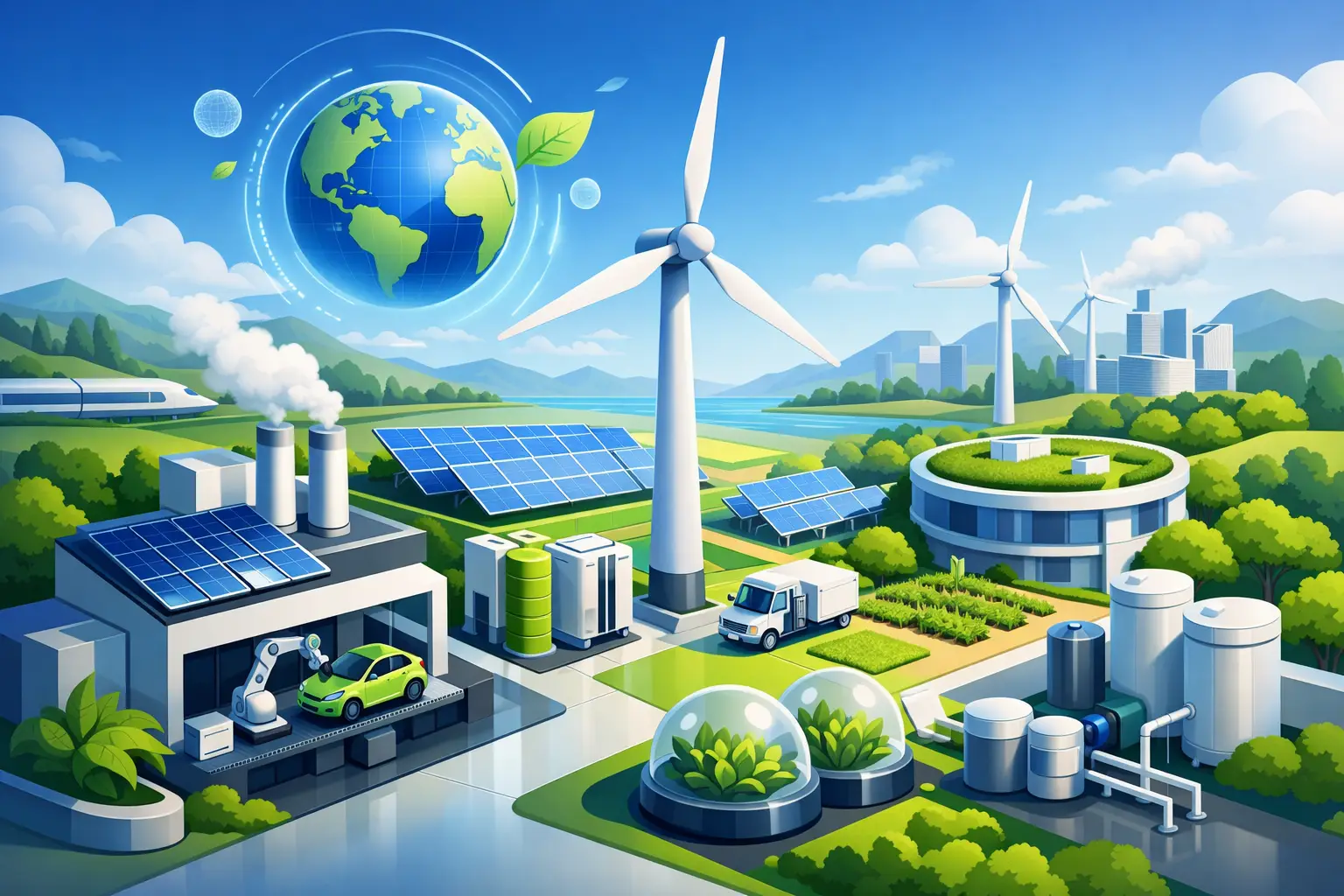
The Future Of Industrial Sustainability will not be decided by corporate pledges. It will be decided by where factories are built, how power is secured, how materials move, and whether industrial platforms can scale without locking in yesterday’s costs. For investors and manufacturers, that shifts sustainability from a reporting function to a hard infrastructure question.
That change is already underway. Industrial occupiers are facing a more demanding operating environment: stricter ESG expectations, pressure to decarbonize supply chains, rising energy volatility, and a growing need to attract specialized talent. At the same time, advanced manufacturing sectors such as EVs, semiconductors, hydrogen mobility, and renewable energy equipment cannot afford fragmented ecosystems. They need industrial environments that reduce friction across production, logistics, utilities, workforce access, and compliance.
This is why the next era of sustainable industry will not be defined by isolated green features. It will be defined by integrated industrial systems.
What the Future Of Industrial Sustainability Really Looks Like
For years, industrial sustainability was often treated as an add-on – solar panels on a roof, better insulation, lower water use, maybe an annual emissions target. Those measures still matter, but they are no longer enough. The new benchmark is whether an industrial site can support cleaner production, stable economics, and long-term operational resilience at the same time.
That means sustainability now sits at the intersection of energy strategy, facility design, logistics efficiency, land use, labor access, digital monitoring, and regulatory alignment. A modern factory may reduce carbon intensity through electrification, but if it is located far from ports, lacks grid resilience, or struggles to house and retain technical workers, the overall model is still inefficient.
Industrial sustainability is becoming more spatial, more financial, and more strategic. It is about building ecosystems where manufacturing performance and environmental performance reinforce each other rather than compete.
Why Infrastructure Will Separate Leaders From Laggards
The biggest gap in industrial sustainability is not ambition. It is execution capacity. Many companies know what they need to do. Fewer have access to the right physical platform to do it economically.
A future-ready industrial base needs more than land and warehouse shells. It needs utility planning that anticipates higher power loads, cleaner energy integration, water management, waste handling, and the technical specifications required by high-value sectors. Cleanroom-ready spaces, modular industrial units, specialized logistics assets, and room for phased expansion are no longer niche requirements. In many sectors, they are the price of admission.
This is where industrial development strategy becomes critical. If a manufacturing location can reduce lead times, lower infrastructure capex, support ESG compliance, and improve operational continuity, sustainability stops being a cost center. It becomes a competitive advantage.
That is especially true in regions competing to attract global production. The winners will be jurisdictions and industrial platforms that combine cost efficiency with policy clarity, logistics connectivity, and infrastructure built for next-generation sectors.
Energy Is Still the Core Variable
No discussion about the Future Of Industrial Sustainability is credible without addressing energy. For most industrial operators, energy remains the single most important lever in the decarbonization equation. It affects emissions, operating costs, investor perception, and resilience.
But there is no universal roadmap. Heavy industry, electronics, mobility, and precision manufacturing all have different load profiles and technology pathways. Some facilities will prioritize on-site solar and storage. Others will need access to cleaner grid power, district-scale energy systems, or future hydrogen supply. In energy-intensive sectors, redundancy matters almost as much as decarbonization.
The real issue is not whether energy can be cleaner. It is whether the industrial site is designed to make cleaner energy practical at scale. Retrofitting outdated industrial zones is expensive and slow. Building with energy transition in mind from the start is more efficient and usually more bankable.
For decision-makers, that changes site selection criteria. The question is no longer just how much power is available. It is what kind of power, under what cost structure, with what long-term flexibility.
The Supply Chain Is Now Part of the Sustainability Equation
Industrial sustainability used to focus mainly on what happened inside the facility gate. That boundary is gone. Customers, regulators, and capital markets increasingly assess emissions and risk across the full value chain.
That puts pressure on manufacturers to think beyond their own operations. Distance from suppliers, access to ports, modal flexibility, and customs efficiency now influence both carbon performance and profitability. A plant with lower direct emissions can still underperform if its logistics model is slow, fragmented, or fuel-intensive.
This is one reason integrated industrial hubs are gaining strategic importance. Clustering complementary industries, suppliers, logistics functions, and innovation partners in one ecosystem can reduce transport intensity, compress timelines, and strengthen operational visibility. It can also make collaboration around recycling, waste streams, shared utilities, and industrial symbiosis far more realistic.
Sustainability at scale depends on proximity. The closer critical functions are to one another, the easier it becomes to build a lower-friction industrial model.
Talent, Livability, and the New Industrial Geography
One of the least discussed realities in sustainable manufacturing is workforce retention. Advanced industry does not run on facilities alone. It runs on engineers, technicians, operators, and research talent who need reasons to stay.
This matters because the industrial geography of the future is not just about production zones. It is about whether people can live, learn, receive care, and build long-term careers around those zones. Sites that isolate factories from everyday life create hidden costs – longer commutes, weaker retention, slower hiring, and reduced appeal to global talent.
A more durable model integrates industrial activity with residential, healthcare, education, retail, and R&D assets. That is not a lifestyle upgrade. It is a productivity strategy. When workforce support systems are built into the industrial ecosystem, companies gain a stronger operating base and a more resilient labor pipeline.
For regions positioning themselves as advanced manufacturing destinations, this is becoming a defining advantage. The industrial park model solved for land. The ecosystem model solves for growth.
Digital Visibility Will Turn Sustainability Into an Operating Discipline
The next phase of industrial sustainability will be measured in real time. Energy consumption, water use, equipment efficiency, emissions intensity, logistics performance, and material waste are becoming operational datasets, not annual disclosures.
This shift matters because sustainability programs often fail when they remain too abstract. Once metrics are embedded into production systems and site management, leaders can identify where efficiency gains are real, where waste is structural, and where capital investment will have the strongest return.
Digital infrastructure also improves credibility. Investors and multinational partners increasingly want auditable performance, not broad claims. Industrial platforms that can support smart monitoring, reporting, and optimization will be better positioned to attract serious occupiers and institutional capital.
There is a caution here. Data alone does not create sustainability. Poorly planned digital overlays can add complexity without solving core infrastructure gaps. The best results come when digital systems are built into the physical and operational logic of the site from the beginning.
What Investors and Manufacturers Should Be Asking Now
The market is moving past symbolic sustainability. The more relevant questions are practical. Can this location support low-carbon growth over the next decade? Can it absorb future utility demands? Can it reduce logistics inefficiencies? Can it help attract and retain specialized labor? Can it keep pace with sector-specific compliance requirements?
Those questions are especially urgent for companies entering the Middle East, where industrial expansion is increasingly tied to diversification agendas, clean-energy investment, and advanced manufacturing policy. In that context, the most valuable industrial platforms will be those designed not simply for occupancy, but for strategic longevity.
That is the broader significance of ecosystem-led development. When industrial infrastructure, logistics access, sector specialization, and workforce support are planned together, sustainability becomes more than environmental alignment. It becomes a foundation for lower risk, faster scaling, and stronger long-term returns. This is the standard that next-generation platforms such as Rana Group are moving toward.
The Future Of Industrial Sustainability will favor industrial environments that think in decades, not development cycles. For manufacturers and investors making expansion decisions now, the strongest position is not to chase sustainability as a trend. It is to build inside systems that make sustainable growth the default setting.
