
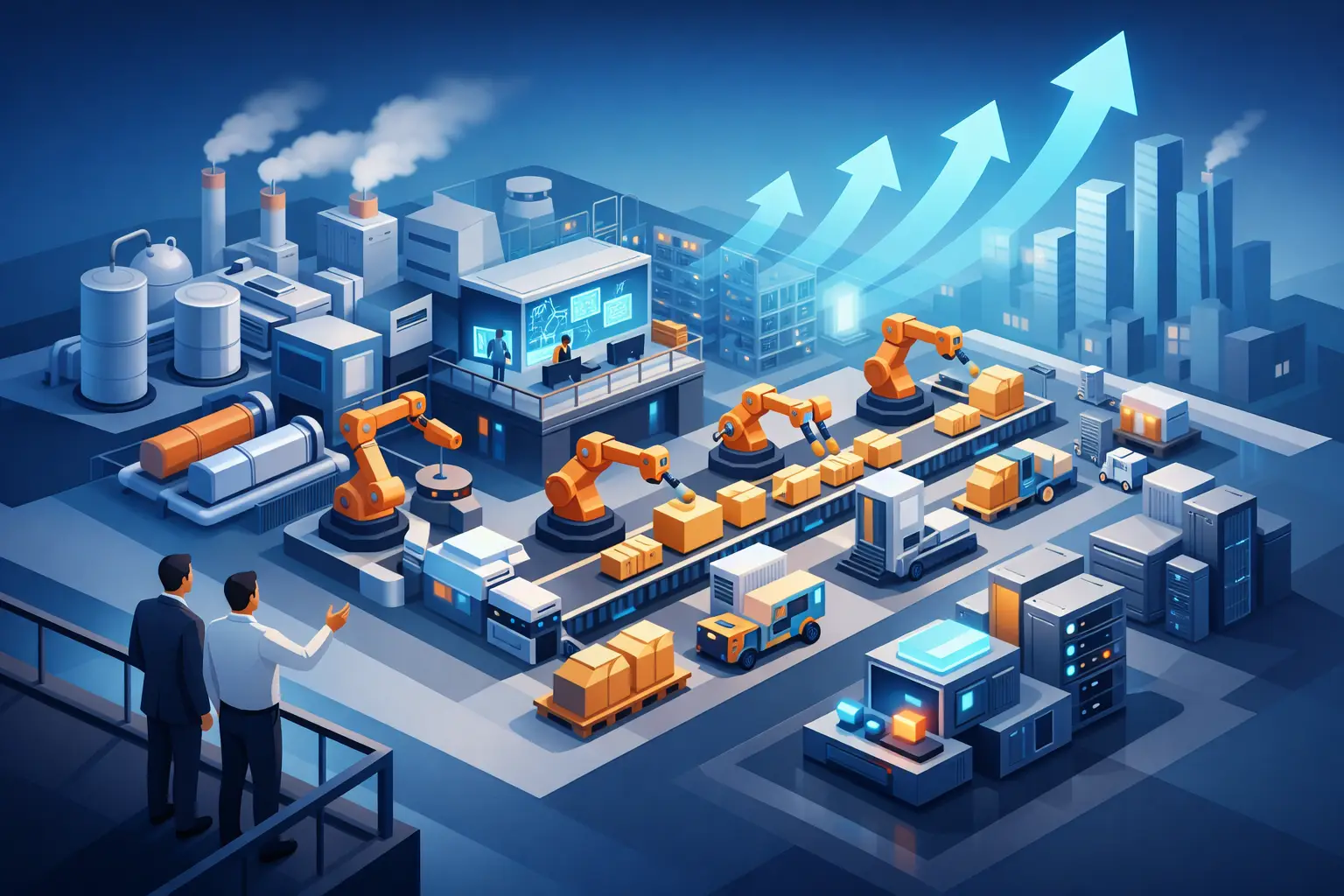
The first mistake companies make when planning growth is treating capacity expansion as a construction problem. For advanced manufacturers, the real question in how to scale advanced production facilities is whether the operating environment can grow with the process. If power quality slips, cleanroom performance varies, suppliers sit too far away, or technical talent cannot be retained, a larger plant simply multiplies friction.
That is why scaling must be approached as a systems decision. In sectors such as semiconductors, EV components, hydrogen mobility, aerospace-adjacent manufacturing, and renewable energy equipment, output is tied to infrastructure precision, workforce continuity, logistics speed, and regulatory certainty. Floor area matters, but it is rarely the limiting factor on its own.
How to scale advanced production facilities without creating bottlenecks
Serious expansion begins with identifying which constraint will fail first. In one facility, it may be utilities. In another, validation timelines. In another, inbound material flow or specialized labor. The companies that scale well do not chase square footage first. They build around the bottleneck that would otherwise undermine throughput, yield, or margin.
This is where many traditional industrial parks fall short. They can provide land, but not necessarily the integrated environment required for high-value manufacturing. Advanced production needs more than a plot and a shell. It needs power planning, redundancy, transport access, sector clustering, room for future line changes, and a surrounding ecosystem that supports both technical operations and the people who run them.
A strong scaling plan therefore starts with production architecture. Leaders need to assess whether the next phase of growth is line replication, product diversification, process intensification, or regional localization. Each path carries different implications for utilities loading, building specs, storage, testing areas, waste management, and labor profiles. Scaling a battery module plant is not the same as scaling a semiconductor packaging line, even if both are described as advanced manufacturing.
Build for phased expansion, not one-time capacity
The most resilient facilities are designed in phases. That does not mean underbuilding. It means preserving optionality. When a company locks itself into a single buildout model with no room for modular expansion, every future increase in output becomes slower and more expensive.
Phased growth allows capital to follow demand with greater discipline. It also reduces the risk of stranded infrastructure. Utilities corridors, loading strategy, circulation patterns, ceiling heights, and process adjacencies should all support future additions without forcing a shutdown of current operations. This is especially relevant in industries where product cycles are changing quickly and equipment footprints may evolve within a few years.
Modular industrial units and turnkey facilities can both play a role here, depending on the production profile. A bespoke facility may be essential for highly specialized manufacturing. But in many cases, a modular approach accelerates commissioning and preserves flexibility for later upgrades. The trade-off is that speed today can limit customization tomorrow unless the initial design anticipates process evolution.
The best expansion platforms solve this by combining ready infrastructure with strategic headroom. They make it possible to scale output in stages while protecting future design freedom.
Utilities are often the real growth ceiling
Advanced production does not scale on ambition alone. It scales on stable utilities. Power capacity, power quality, water treatment, compressed air, cooling systems, waste handling, and digital connectivity all become mission-critical as production ramps.
Many expansion plans underestimate how quickly utility demand compounds. A line that looks efficient at pilot or early commercial scale may stress facility systems once uptime expectations rise and parallel processes come online. That is why utility planning has to be done against peak operating scenarios, not average assumptions.
Redundancy also deserves board-level attention. In high-value manufacturing, a single interruption can damage product, disrupt yields, and delay customer commitments. The cost of overengineering is real, but so is the cost of instability. The right answer depends on the product category, regulatory burden, customer tolerance, and margin structure. There is no universal template, but there is a common principle: utility resilience should match commercial exposure.
Logistics must be designed into the production model
As facilities scale, logistics complexity rises faster than many operators expect. Inbound materials, sensitive components, hazardous goods, export schedules, and multimodal transport requirements all start to shape plant performance. A factory can be technically sound and still lose competitiveness if freight timing, customs flow, or port access adds friction.
This is why location strategy is not a branding exercise. It is an operating decision. Manufacturers expanding into the Middle East often evaluate not just land cost, but also connectivity to GCC demand centers, shipping routes, supplier networks, and investor-friendly regulations. Lower operating costs matter, but only if they are matched by efficient movement of goods and dependable market access.
The strongest industrial ecosystems reduce these variables by bringing production, warehousing, and logistics infrastructure into closer alignment. That lowers handling time, simplifies expansion sequencing, and makes regional scale more realistic.
Workforce scale is an infrastructure issue too
A facility can be technically perfect and still fail to scale if workforce retention is weak. Advanced manufacturing depends on skilled operators, engineers, quality specialists, maintenance teams, and R&D-linked talent. Recruiting them is one challenge. Keeping them is another.
This is where the industrial model itself matters. If a site isolates production from housing, healthcare, education, and daily life, labor churn often rises. Commute burden grows, relocation becomes harder, and long-term workforce stability suffers. For labor-intensive low-margin production, companies may absorb some of that friction. For advanced sectors, the cost is much higher because skills are specialized and retraining takes time.
A live-work-innovate environment changes the equation. It supports retention, creates a stronger employer proposition, and gives international and regional talent a more durable reason to stay. For investors and occupiers, that is not a lifestyle add-on. It is an operational advantage.
Sector clustering creates scale beyond the factory gate
One of the most overlooked answers to how to scale advanced production facilities is proximity to adjacent industries. Standalone plants can grow, but clustered industries often scale faster because they share suppliers, technical services, workforce pools, testing capabilities, and innovation partnerships.
This matters especially in sectors like EVs, hydrogen mobility, semiconductors, and renewable energy systems, where production is linked to evolving technologies and fragmented supply chains. A cluster can shorten problem-solving cycles and reduce time lost to external coordination. It also creates stronger conditions for joint ventures, co-development, and institutional collaboration.
That is why next-generation industrial hubs are being planned as ecosystems rather than isolated real estate projects. The goal is not just occupancy. The goal is industrial compounding.
Capital discipline matters as much as industrial ambition
Expansion decisions are often framed in operational terms, but capital structure plays a decisive role in whether scaling succeeds. Overbuilding too early can drag returns. Expanding too cautiously can cede market share and delay learning curves. The right balance depends on demand visibility, customer concentration, technology maturity, and the time required to validate new lines.
Investors and operators should ask a harder question than how much capacity is needed. They should ask what form of capacity is easiest to finance, activate, and adapt over time. In some cases, that points to a phased lease model. In others, it supports purpose-built ownership with long-term utility planning and room for adjacent expansion.
This is where a master-planned industrial ecosystem offers strategic value. If the site has sector-specific infrastructure, scalable land and building options, and institutional alignment around long-term growth, capital can be deployed with more confidence. Expansion becomes less speculative because the surrounding platform is already designed to support industrial continuity.
For companies evaluating regional manufacturing growth, that distinction matters. The question is not simply where to place the next facility. It is where to build the next decade of production.
At Rana Group, that future is being shaped around integrated industrial infrastructure built for scale, sector relevance, and long-range competitiveness. For manufacturers and investors alike, the smarter move is to choose an environment where expansion does not have to be reinvented every time demand rises.
The strongest facilities do not just produce more. They gain the ability to adapt, attract talent, maintain performance, and keep scaling when markets shift. That is where real industrial leadership begins.

[…] to coordinate. Market access becomes dependent on execution, not vision. A smart hub built for industrial performance shortens that gap between ambition and repeatable […]
[…] is whether the physical environment supports the commercial strategy. A facility should not trap a fast-growing business in a rigid footprint, and it should not force a precision-led operation to compromise on […]