
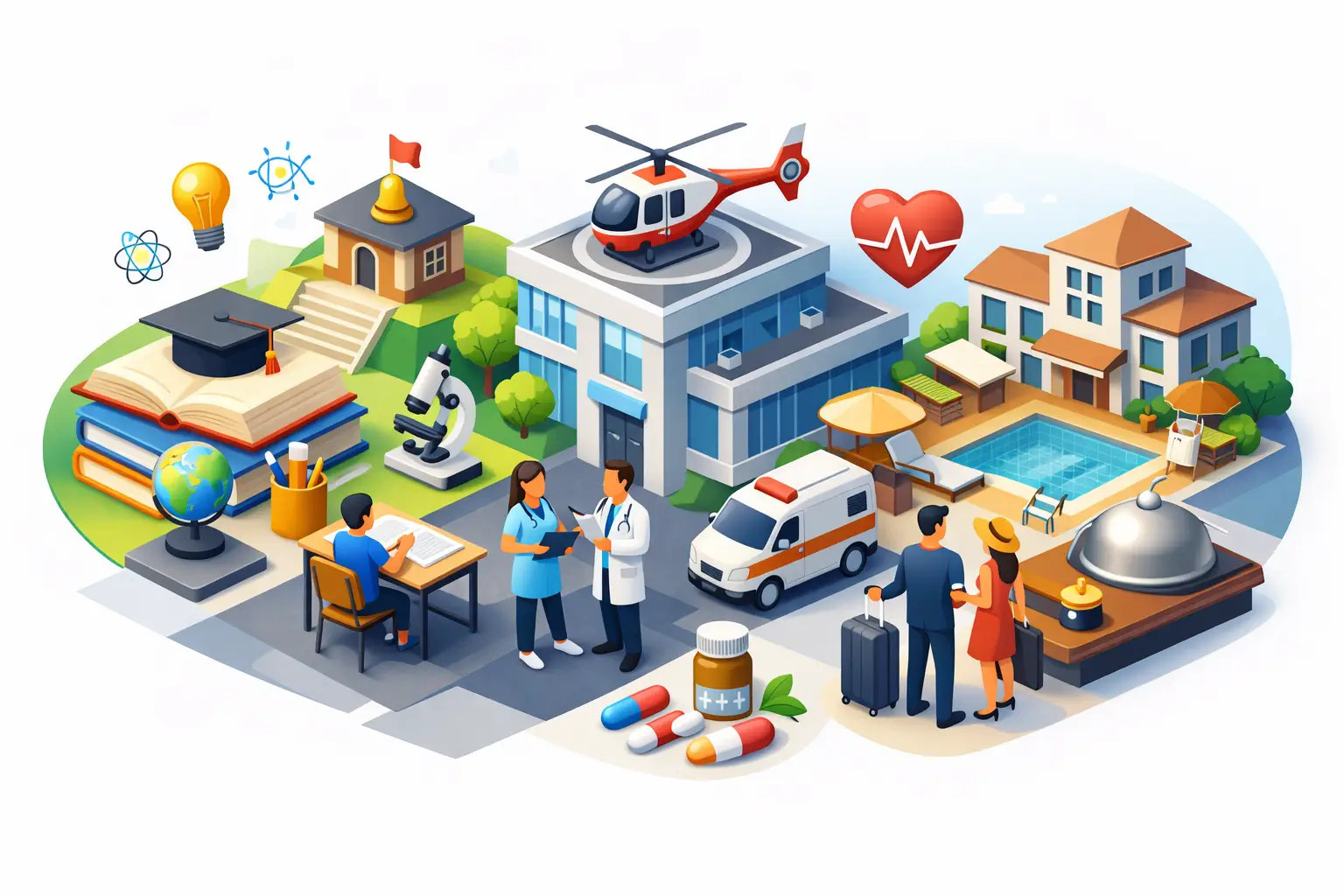
Industrial hubs do not fail because they lack factory shells. They fail because they cannot hold talent, attract leadership, support families, or sustain innovation over time. That is the real answer to the question of why education, healthcare, Hospitality and innovation are important features for making Erisha Smart Manufacturing Hubs successful. In advanced manufacturing, the decisive advantage is no longer land alone. It is whether the ecosystem can keep production moving, people engaged, and high-value companies expanding.
For investors and manufacturers, this shifts the definition of industrial readiness. A next-generation hub must do more than provide power, road access, and leasable space. It must reduce operational friction across the full business cycle – from recruitment and onboarding to research partnerships, executive mobility, compliance, and long-term workforce retention. That is where integrated education, healthcare, hospitality, and innovation infrastructure become strategic assets rather than lifestyle add-ons.
Why Erisha Smart Manufacturing Hubs need more than factories
A conventional industrial park is built around occupancy. A smart manufacturing hub is built around performance. Those are not the same thing.
If a semiconductor producer, EV assembler, hydrogen mobility company, or aerospace-adjacent manufacturer is evaluating a regional base, the core question is not simply whether a site can be occupied. The question is whether that site can support complex operations at scale for the next decade. High-value manufacturing depends on engineers, specialized technicians, supply chain managers, quality teams, regulatory experts, and R&D personnel. Those people do not choose locations based on warehouse availability alone.
They assess the broader ecosystem. Can employees build careers there? Can executives relocate without disruption? Can partners, customers, and visiting technical teams operate efficiently on site? Can innovation move from concept to pilot to production inside one coordinated environment? If the answer is no, a project may launch, but it will struggle to mature.
That is why Erisha Smart Manufacturing Hubs are designed as integrated industrial ecosystems rather than isolated production zones. As discussed in Why Erisha Smart Hubs Combine Living and Work, the live-work model is not cosmetic. It is an operating advantage.
Education is a workforce engine, not a social accessory
Manufacturing investors often underestimate how quickly workforce gaps become growth constraints. In advanced sectors, the problem is not just hiring. It is upskilling, specialization, managerial development, and technical continuity.
Education infrastructure matters because the labor needs of modern industry are dynamic. Clean energy systems evolve. EV architectures change. Semiconductor processes demand precision. eVTOL and aerospace-adjacent production require strict quality systems and specialized training. A hub that integrates education can create a direct pipeline between industrial demand and workforce capability.
This has practical implications at every level. Technical institutes can support operator training and maintenance capability. Higher education partnerships can feed engineering, automation, and design functions. Executive learning and industry collaboration can strengthen leadership depth inside tenant companies. Over time, that reduces dependence on costly external recruitment and improves operational resilience.
There is also a speed advantage. When training, knowledge transfer, and applied research are connected to the same physical ecosystem, manufacturers can shorten the time between expansion and stable output. New lines can be staffed faster. Process improvements can be tested more efficiently. Talent development becomes part of the production model.
For industrial occupiers, this means education is not a peripheral amenity. It is a mechanism for productivity, retention, and sector competitiveness.
Healthcare protects uptime as much as people
Healthcare is often framed as a quality-of-life benefit. In reality, for manufacturing hubs, it is also an uptime issue.
Industrial operations depend on attendance, safety, continuity, and confidence. When healthcare access is distant or fragmented, companies absorb the cost in multiple ways: more disruption for employees, more stress on families, slower emergency response, and greater difficulty convincing senior staff to relocate. The hidden cost is operational instability.
Integrated healthcare capacity helps solve that problem. It gives workers and executives confidence that routine care, urgent support, and long-term family needs can be addressed without leaving the ecosystem. That matters for recruitment, but it matters even more for retention. Experienced technical teams are hard to replace. The best hubs remove reasons for them to leave.
Healthcare also strengthens the investment case for multinational occupiers with ESG and duty-of-care standards. Boards and leadership teams increasingly evaluate site selection through workforce welfare and resilience metrics, not just cost-per-square-foot. A hub that embeds healthcare is better aligned with how global companies assess risk.
In that sense, healthcare is part of serious industrial planning. It supports labor stability, executive relocation, and responsible long-term growth.
Hospitality is not secondary when the business model is global
Many industrial developers treat hospitality as optional. That logic breaks down in globally connected sectors.
Advanced manufacturing hubs host more than workers. They host investors, auditors, technical consultants, equipment suppliers, OEM partners, government delegations, training teams, and visiting customers. In sectors such as semiconductors, mobility, clean energy, and aerospace, these interactions are constant. If a site cannot receive and support those stakeholders efficiently, collaboration slows and commercial momentum suffers.
Hospitality therefore serves a direct business purpose. It enables site visits, extended technical stays, investor due diligence, executive meetings, launch events, supplier onboarding, and customer engagement without forcing participants into disconnected arrangements. The closer these services are to the industrial platform, the lower the friction.
It also affects perception. A manufacturer making a multimillion-dollar commitment wants to know that the ecosystem reflects institutional seriousness. Hospitality assets signal readiness for global business conduct, not just local occupancy. This is especially relevant in mixed-use, high-value industrial environments where decisions are made by international leadership teams expecting professionalism at every touchpoint.
The commercial logic is clear enough that the role of premium hospitality in the ecosystem deserves dedicated attention, as explored in What’s the Impact of Five-Star Hospitality in Erisha?.
Innovation is what keeps a hub relevant after phase one
A manufacturing project can be filled and still underperform strategically. The difference usually comes down to innovation capacity.
Without embedded innovation infrastructure, an industrial zone risks becoming a static collection of tenants. With it, the hub becomes an engine for new products, process improvements, collaboration, and sector leadership. That distinction matters enormously in industries where technology cycles are short and competitive pressure is high.
Innovation must be treated as operating infrastructure. That includes R&D space, collaboration environments, pilot capability, testing support, and proximity between researchers, manufacturers, and capital. When these functions sit inside one ecosystem, the path from research to commercialization becomes shorter and more investable.
This is particularly important for sectors that define the Erisha model: EVs, hydrogen mobility, semiconductors, renewable energy, and eVTOL-adjacent production. These are not industries that remain stable for long. Companies in these fields need room to iterate, certify, scale, and adapt. A hub that only offers industrial units will struggle to keep them. A hub that supports innovation can grow with them.
Innovation also attracts a different class of partner. Universities, technology providers, institutional investors, and strategic collaborators are more likely to engage where the infrastructure supports experimentation and scale in the same environment. That creates compounding value across the ecosystem.
The real advantage is how these features work together
Education, healthcare, hospitality, and innovation are powerful individually. Their full value appears when they operate as one integrated system.
Education builds the workforce pipeline. Healthcare supports workforce stability. Hospitality enables investor, customer, and partner engagement. Innovation keeps the industrial base competitive and future-relevant. Together, they solve one of the biggest weaknesses in industrial expansion: fragmentation.
Fragmented ecosystems create hidden costs. Employees commute long distances. Technical training sits far from production. Healthcare access is inconsistent. Visiting partners lose time in transit. R&D happens in one place while manufacturing happens somewhere else. Every gap adds friction, and friction compounds into slower execution.
An integrated hub removes those breaks in the chain. It creates a platform where companies can recruit, operate, host partners, train teams, support families, and pursue innovation in one coordinated environment. That is why industrial ecosystem design has become a strategic differentiator rather than a planning preference. What Industrial Ecosystem Development Gets Right addresses that larger shift well.
Why this matters to investors and occupiers now
The timing matters. Manufacturers expanding into the Middle East, India, or the United States are making longer-horizon decisions under more pressure than before. They are balancing resilience, cost, ESG requirements, workforce access, regulatory clarity, and market reach all at once.
In that environment, a hub that integrates social and innovation infrastructure is not offering extras. It is reducing execution risk. It is improving talent attraction. It is supporting faster ramp-up. It is giving companies a better chance to stay competitive five years after entry, not just on opening day.
That is the central investment logic behind Erisha Smart Manufacturing Hubs. Success in modern industry is built on far more than production capacity. The winning platform is the one that can hold people, ideas, capital, and operations together over time.
Factories may start the story. Education, healthcare, hospitality, and innovation are what give that story the scale to endure.

[…] factories and modular units exist within a wider environment that also includes housing, healthcare, education, retail, hospitality, and innovation-support assets. For many manufacturers, this changes the expansion model. Instead […]
[…] is fragmented, companies face avoidable friction in recruiting and retaining talent. If housing, healthcare, education, retail, and mobility sit too far from production zones, labor costs rise indirectly through turnover, commuting […]
[…] employment. In practice, that means the industrial base is supported by residential options, healthcare access, transport links, food and retail services, training pipelines, and a surrounding social […]
[…] favor locations that reduce the number of separate decisions they need to make. If housing, healthcare, education, logistics, utilities, and workforce support sit far away from the production base, operations […]
[…] industrial park. It combines advanced manufacturing space with logistics, R&D potential, workforce-supportive amenities, and sector-specific infrastructure for industries such as EVs, hydrogen mobility, semiconductors, […]
[…] is often decisive. Can engineers be hired and retained locally? Are there training institutions, housing, healthcare, and services that support long-term workforce stability? Does the location help attract global technical talent, […]
[…] around strategic integration. It brings together industrial space, R&D, offices, education, housing, healthcare, retail, and often public or shared environments that support collaboration. The objective is not […]