
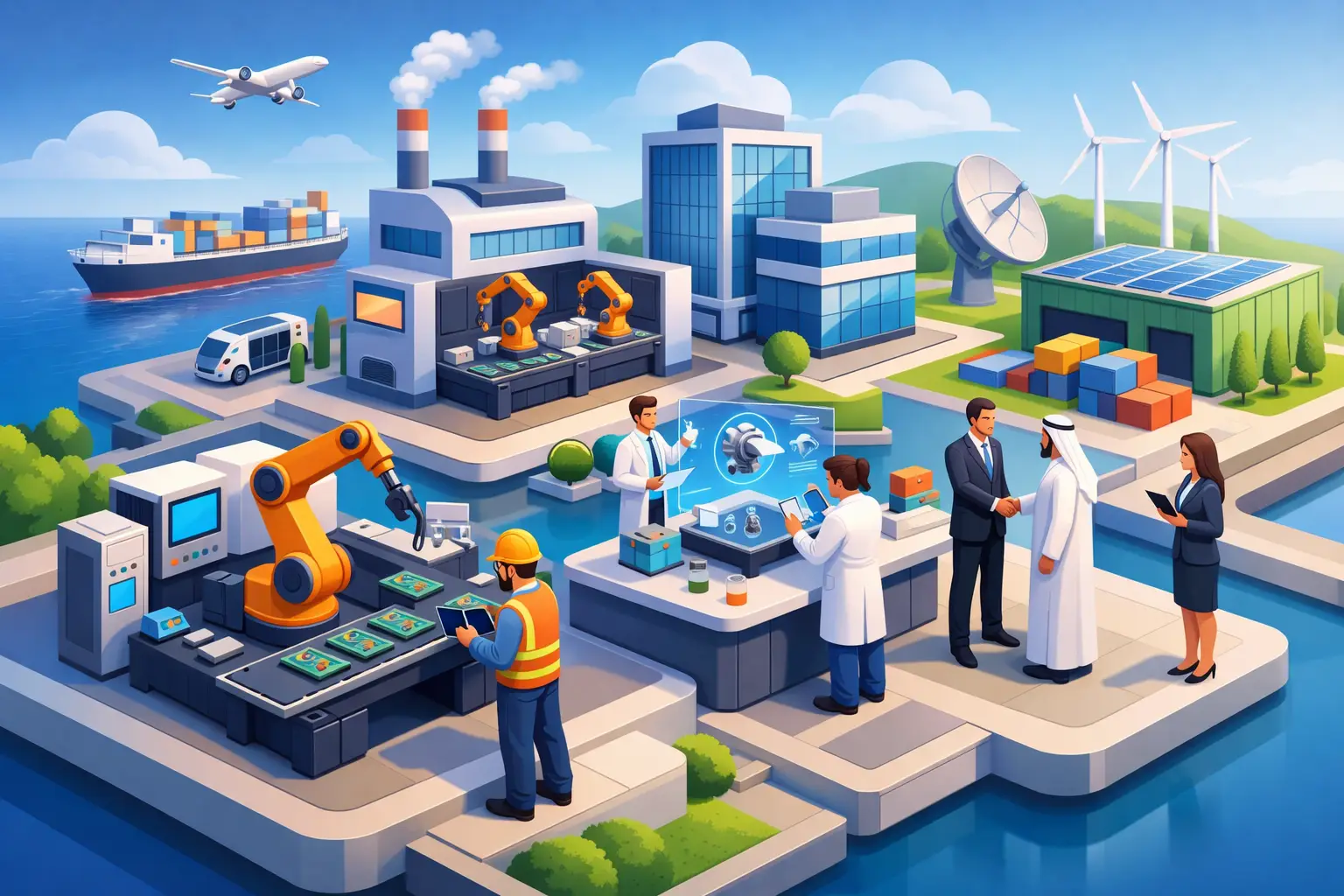
When expansion teams ask who can set up project in Erisha Smart Manufacturing Hub-Rakez, the real question is not just eligibility. It is strategic fit. The hub is not built for generic industrial occupancy. It is designed for manufacturers, technology companies, logistics operators, and institutional partners that need scale, infrastructure readiness, sector alignment, and a credible base for long-term growth in the Middle East.
That distinction matters. Many industrial zones can offer land or shell units. Very few can support advanced production, ESG-aligned operations, workforce retention, and cross-sector clustering in one environment. Erisha Smart Manufacturing Hub is positioned for companies that are not simply looking for space, but for an operating platform.
Who can set up project in Erisha Smart Manufacturing Hub-Rakez
The short answer is this: industrial occupiers, strategic investors, clean-tech companies, advanced manufacturers, logistics businesses, R&D-led enterprises, and ecosystem partners can all be strong candidates, provided their activities align with the hub’s industrial vision and regulatory framework.
In practice, the strongest fit comes from companies operating in high-value sectors. That includes electric vehicle manufacturing and supply chain players, hydrogen mobility businesses, renewable energy equipment producers, semiconductor and electronics-related operations, aerospace-adjacent manufacturing, eVTOL-focused companies, and industrial technology firms that require purpose-built facilities rather than conventional warehouse stock.
The hub is also relevant for multinational groups establishing a regional production base, fast-scaling industrial companies moving from pilot stage to commercial manufacturing, and global suppliers that need proximity to GCC demand, port infrastructure, and a lower-cost operating environment than many urban industrial markets can provide.
This is why the better lens is not can you set up, but should you. If your project depends on future-ready infrastructure, industrial adjacency, and the ability to grow within a master-planned ecosystem, the answer is far more likely to be yes.
The businesses that are the best fit
Erisha Smart Manufacturing Hub is designed around sector logic, not broad industrial sprawl. That means the best-fit tenants are businesses whose operations benefit from clustering, technical infrastructure, logistics access, and a surrounding live-work environment that helps attract and retain talent.
Advanced manufacturing companies are a natural fit because they often need more than floor area. They need power reliability, production flexibility, compliance-compatible layouts, room for equipment installation, and a setting that can support suppliers, engineers, quality control teams, and future production lines.
Clean-tech and energy transition businesses are also well aligned. EV component makers, battery-related operations, hydrogen system manufacturers, renewable energy equipment producers, and circular economy ventures increasingly need industrial sites that reflect their ESG commitments. A project built around sustainability alignment is not a branding extra in this context. It is part of investment logic, customer qualification, and long-term market access.
Semiconductor-related and cleanroom-ready occupiers represent another important category. These operators face stricter requirements around environmental conditions, facility design, process integrity, and specialist workforce needs. Not every industrial location can support that path. A hub designed with advanced use cases in mind offers a stronger platform than retrofitted industrial inventory.
Logistics and supply chain companies can also be a fit, especially when they serve manufacturing tenants inside the wider ecosystem. The distinction is that logistics here is most compelling when it supports industrial value creation, not when it functions as a standalone low-complexity storage model.
Investors and partners, not just tenants
A common mistake is to assume that only factory operators belong in a manufacturing hub. In reality, a project of this scale needs a broader industrial coalition.
Strategic investors can set up in Erisha Smart Manufacturing Hub when their role supports industrial growth, technology transfer, supply chain depth, or long-term ecosystem value. That can include joint venture partners, industrial platform investors, equipment partners, R&D collaborators, and institutional groups that see manufacturing infrastructure as part of a larger regional strategy.
This is especially relevant for businesses entering the UAE through phased market development. Some may begin with assembly, specialized production, testing, or regional distribution before scaling into full manufacturing. Others may enter through a strategic partnership, supplier operation, or innovation collaboration. A hub like this allows different forms of participation, provided the use case strengthens the overall industrial ecosystem.
That broader model is part of what makes Erisha distinct. It is not simply a place to lease industrial units. It is an ecosystem designed to support industrial formation, scale-up, and long-horizon value creation. For a deeper look at that model, see How Erisha Smart Manufacturing Hub Is Different.
What matters more than company size
Large multinationals are obvious candidates, but size alone does not determine fit. A mid-sized advanced manufacturer with a strong technology edge and clear expansion roadmap may be a better match than a larger business with generic space needs.
What matters more is operational profile. Does the company need specialized infrastructure? Does it require sector adjacency? Does it value integrated worker and executive amenities? Is it building for export, regional market access, or industrial collaboration? Does it need room to scale without relocating again in three years?
A project built on short-term opportunism is less suited to this type of environment. Erisha is more relevant for companies making deliberate decisions about production geography, cost structure, resilience, and strategic positioning.
That is also why ESG alignment is not optional at the edges. Businesses that are structurally misaligned with sustainability expectations, future industry standards, or responsible industrial development may not be the strongest fit. The hub is built for industries that are shaping the next phase of manufacturing, not replicating the oldest models.
Who may not be the right fit
Not every business should set up in a specialized manufacturing hub, even if it technically could.
Low-value storage-led operators, businesses with no industrial adjacency, and companies whose primary need is the cheapest possible square footage may find better options elsewhere. The same applies to businesses that do not require sector-specific infrastructure, have limited interest in ESG-aligned operations, or do not benefit from a mixed-use live-work ecosystem.
There is also a practical consideration around readiness. Some firms are still too early in their planning cycle. If a company has not clarified its production process, utility load, facility specifications, staffing model, or regulatory pathway, it may need feasibility work before committing to a project setup. Growth ambition is necessary, but execution discipline matters more.
Why sector alignment changes the investment case
Manufacturing leaders do not choose a location only on rent or land cost. They choose based on operating outcomes. Can the site support throughput, talent, compliance, supply chain reliability, and future expansion? Can it reduce friction across permitting, logistics, workforce access, and ecosystem partnerships?
That is where sector alignment strengthens the business case. An EV supplier inside an ecosystem that understands vehicle production, mobility infrastructure, and advanced component manufacturing gains advantages that a generic industrial address cannot easily match. The same applies to hydrogen mobility, semiconductor production, and aerospace-adjacent manufacturing.
This clustering effect becomes more valuable over time. It supports supplier density, knowledge sharing, service specialization, and stronger long-term competitiveness. Companies looking beyond immediate occupancy often recognize this quickly. Those focused only on near-term lease economics usually miss the larger industrial advantage.
For decision-makers evaluating strategic longevity rather than short-cycle occupancy, Why Erisha Smart Manufacturing Hubs Fit Longevity adds useful context.
The role of integrated infrastructure
One of the clearest answers to who can set up here is this: companies that understand industrial success now depends on more than factory walls.
The integrated model matters because talent matters. Executive teams, engineers, technical staff, and specialist operators do not choose locations based only on factory efficiency. They also assess housing, healthcare, education, hospitality, convenience, and quality of life. That is particularly important for international operators building a long-term regional base.
This is where a mixed-use industrial ecosystem changes the equation. It helps companies reduce workforce friction, strengthen retention, and create a more stable operating environment. For advanced manufacturers, that is not a lifestyle add-on. It is operational infrastructure. You can see that logic more clearly in Why Erisha Smart Hubs Combine Living and Work.
A practical way to assess whether your project belongs here
If you are evaluating market entry or regional expansion, the right test is straightforward. Ask whether your project needs at least three of the following: specialized industrial infrastructure, sector clustering, scalable production space, ESG-compatible positioning, logistics connectivity, workforce ecosystem support, or access to a long-term industrial growth platform.
If the answer is yes, Erisha Smart Manufacturing Hub deserves serious consideration.
If your operation is generic, highly temporary, or driven only by lowest-cost occupancy, it may not be the right platform. That is not a weakness. It reflects the fact that this hub is designed for industrial transformation, not commodity real estate playbooks.
The companies most likely to succeed here are the ones building durable capacity – manufacturers, innovators, investors, and partners that see the UAE not as a satellite market, but as a strategic base for the future of industry.
