
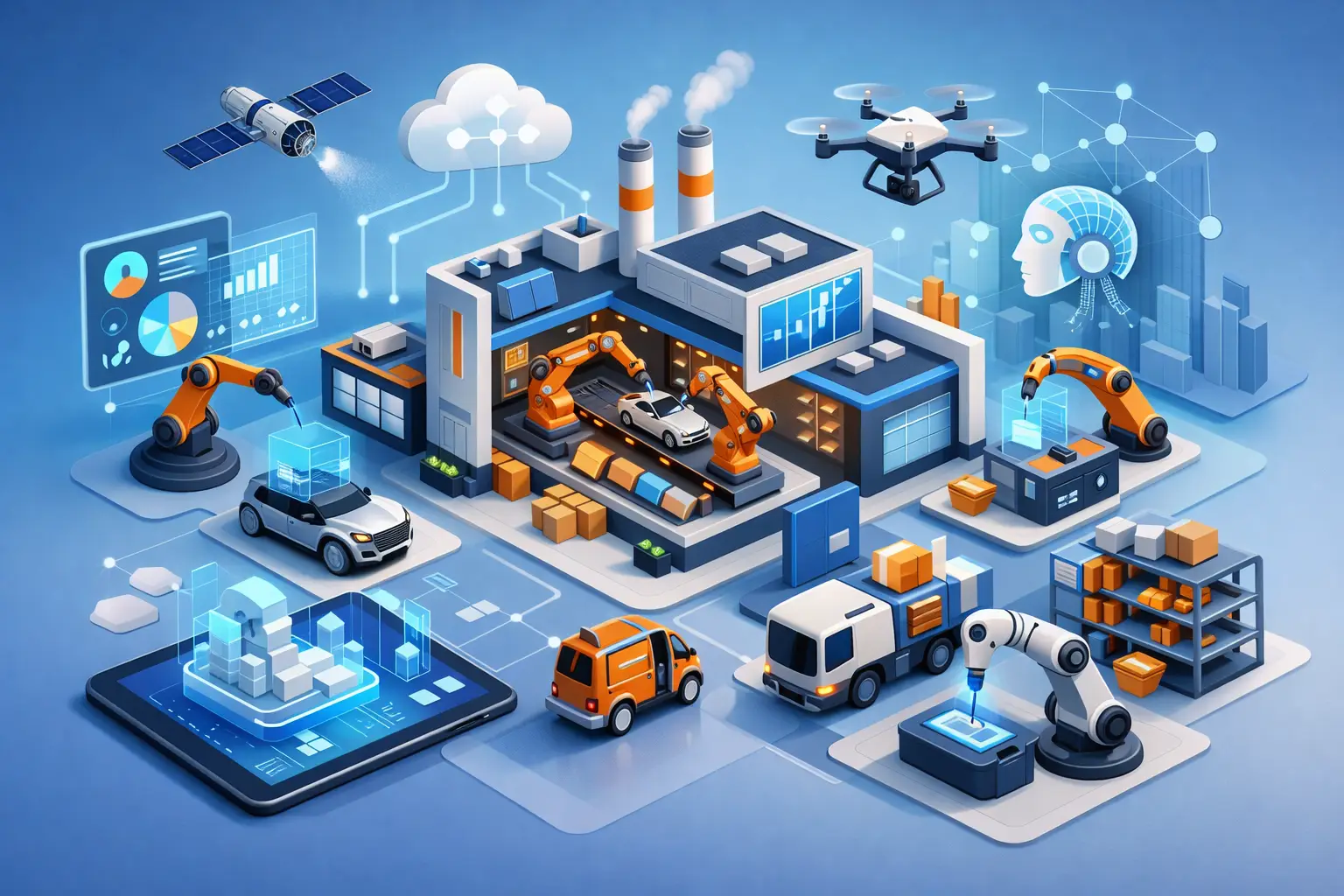
Most industrial parks solve for land. Very few solve for industrial growth. That is the real answer to how Erisha Smart Manufacturing Hub is different than other industrial parks. It was not conceived as a plot-and-warehouse offering. It was designed as a next-generation industrial ecosystem built for manufacturers, strategic investors, and technology-led industries that need more than square footage.
That distinction matters because advanced production does not scale on land alone. It scales on infrastructure readiness, logistics efficiency, workforce stability, regulatory clarity, sector fit, and the ability to keep expanding without rebuilding the operating model every two years. Traditional industrial parks often address one or two of those variables. Erisha Smart Manufacturing Hub is structured to address them together.
How Erisha Smart Manufacturing Hub is different than other industrial parks
The clearest difference is that Erisha is built as an integrated platform, not a conventional industrial estate. In a standard industrial park, tenants typically secure land or shell buildings, arrange utilities, solve workforce commuting, source nearby services, and manage ecosystem gaps on their own. That model can work for basic industry, but it creates friction for high-value manufacturing where uptime, compliance, talent retention, and supplier coordination directly affect margins.
Erisha takes a different position. It combines advanced industrial infrastructure with residential, healthcare, education, retail, hospitality, logistics, and R&D assets inside one master-planned environment. That creates a live-work-innovate model rather than a separated industrial zone. For occupiers, this is not a branding exercise. It changes operating reality. A manufacturer can plan production capacity, workforce access, supplier integration, and future expansion within one coordinated ecosystem instead of stitching those pieces together across multiple locations.
This is why the project is more comparable to a strategic industrial platform than to a typical park. It is built for companies that are making long-horizon decisions about regional manufacturing presence, capital deployment, and supply chain positioning.
It is purpose-built for advanced sectors, not generalized occupancy
Many industrial parks are intentionally broad. They accept a wide range of tenants, which helps fill inventory but often leads to infrastructure that is generic by design. Generic infrastructure lowers specialization. It can also create hidden fit-out costs for occupiers in sectors with strict technical requirements.
Erisha is differentiated by sector specificity. Its infrastructure strategy is aligned with advanced manufacturing segments such as EVs, hydrogen mobility, eVTOL aircraft, semiconductors, renewable energy production, and other technology-intensive industries. That means the development logic starts with industrial use cases rather than retrofitting conventional units for complex production.
This has practical consequences. Cleanroom-ready semiconductor spaces, modular industrial units, turnkey factories, and logistics facilities are not interchangeable products. They serve different timelines, capex profiles, and operational models. A company entering a new market may need speed to commissioning through a turnkey solution. A growth-stage manufacturer may need modularity that expands in phases. A semiconductor or precision electronics operator may need facility planning that anticipates technical control requirements from day one. In a generalized park, those paths often require substantial reinvention. In a sector-planned hub, they are part of the base offering.
That focus also improves adjacency. When mobility, energy, electronics, and advanced production players operate within the same master plan, partnerships become easier to build. Supplier ecosystems mature faster. Shared services become more relevant. Specialized infrastructure is more economically justified. This is one reason ecosystem-led development tends to outperform isolated occupancy models over time. For a closer look at that principle, see What Industrial Ecosystem Development Gets Right.
Scale is part of the strategy, not an afterthought
A common weakness in industrial development is that initial occupancy succeeds, but growth becomes difficult. Tenants outgrow facilities, adjacent land is limited, support infrastructure lags, and the original location stops serving long-term expansion. At that point, the occupier is forced into costly fragmentation.
Erisha is structured around scale from the outset. That matters for multinational manufacturers and institutional investors because expansion planning is rarely linear. Capacity may need to double. Product lines may diversify. Ancillary logistics, warehousing, testing, or supplier operations may need to sit closer to core production. A serious industrial base must be able to accommodate that progression.
The difference here is not simply large land area. It is master-planned scalability. Industrial, logistics, workforce, and community functions are designed to evolve together. That reduces the risk that production growth will be constrained by external bottlenecks such as housing shortages, service deficits, or disconnected infrastructure planning.
For decision-makers evaluating a Middle East platform, this is a meaningful distinction. Lower operating costs are valuable, but they are not enough if future phases become harder to execute. Scale only creates advantage when the ecosystem around it is equally scalable.
The live-work model supports industrial performance
Traditional industrial parks often treat workforce needs as external to the asset. Employees commute in, services sit elsewhere, and community infrastructure is someone else’s problem. For low-complexity operations, that may be acceptable. For advanced manufacturing, it becomes a structural weakness.
High-value production depends on stable talent pipelines, lower attrition, reliable shift coverage, and an environment that can attract technical and managerial staff. Erisha’s mixed-use model addresses that reality directly. Residential, healthcare, education, retail, and hospitality components are not side amenities. They support the industrial base by making it easier to recruit, retain, and sustain a capable workforce.
This is particularly relevant for sectors where production quality, process discipline, and technical training matter. The value of nearby education and skills infrastructure is not abstract. It shortens the distance between talent development and operational demand. It also gives companies a stronger foundation for long-term localization and workforce continuity. The relationship between industrial growth and talent infrastructure is explored further in Education Infrastructure for Manufacturing Talent.
There is a trade-off worth stating clearly. Mixed-use industrial development requires stronger planning discipline than a simple warehouse park. If executed poorly, it becomes diluted. If executed well, it creates a more resilient industrial environment. Erisha’s differentiation lies in treating mixed-use integration as core industrial logic, not as an add-on.
ESG alignment is built into the development case
Another major difference is that ESG compliance is not framed as a marketing layer. For industrial occupiers and investors, ESG increasingly affects financing, customer qualification, procurement status, and long-term regulatory positioning. Yet many industrial parks still approach it as a limited checklist rather than a design principle.
Erisha is positioned as an ESG-compliant environment, which is significant for companies operating under growing pressure from global customers, boards, and capital partners. In advanced manufacturing, sustainability positioning now intersects with site selection, especially in energy transition sectors such as EVs, hydrogen mobility, and renewables.
What matters is not the label alone, but how it shapes development choices. Energy systems, land use planning, building readiness, transport efficiency, and integrated community infrastructure all influence whether a site can support credible ESG objectives. A park that offers cheap land but weak sustainability alignment may look efficient at entry and become expensive in strategic terms later. A hub built with ESG in mind gives occupiers a stronger base for future compliance and market access. For a deeper look at what that requires, see What Makes Industrial Projects ESG Compliant?.
Location advantage is operational, not just geographic
Industrial developers often talk about location as if proximity alone closes the deal. In practice, location only matters when it improves operating outcomes. Erisha’s positioning in Ras Al Khaimah matters because it combines lower cost structures, investor-friendly conditions, connectivity to GCC and global markets, and practical access to port-led logistics.
That combination is different from choosing a premium-cost city with stronger name recognition but heavier cost burdens. For manufacturers, the right location is the one that supports throughput, export movement, labor accessibility, and margin protection over time. In that context, Ras Al Khaimah offers a compelling operating case, especially for companies that need strategic access without absorbing unnecessary overhead.
This is not to suggest that every manufacturer should choose the same geography. Some businesses prioritize brand visibility, others prioritize ecosystem maturity, and others need immediate access to specific customer nodes. But for companies balancing cost efficiency with industrial scalability, the location strategy behind Erisha is a real differentiator, not a secondary feature.
It is designed for investment partnerships, not just tenancy
One final difference is how the hub positions itself in the market. Conventional industrial parks primarily lease or sell space. Erisha is built to attract tenants, investors, innovation partners, and institutional collaborators into a coordinated industrial growth model. That expands the value proposition beyond occupancy.
For strategic investors, this means the hub can function as a platform for sector development rather than a standalone property play. For manufacturers, it means greater potential for collaboration, supply-chain formation, and long-term ecosystem depth. For governments and institutional stakeholders, it creates a structure more closely aligned with economic diversification and future industry formation.
That is why Erisha stands apart. It is not competing to be another place where factories sit. It is building the conditions under which advanced industry can expand with fewer constraints, stronger alignment, and greater strategic durability. For companies deciding where the future works, that difference is not cosmetic. It is foundational.
