
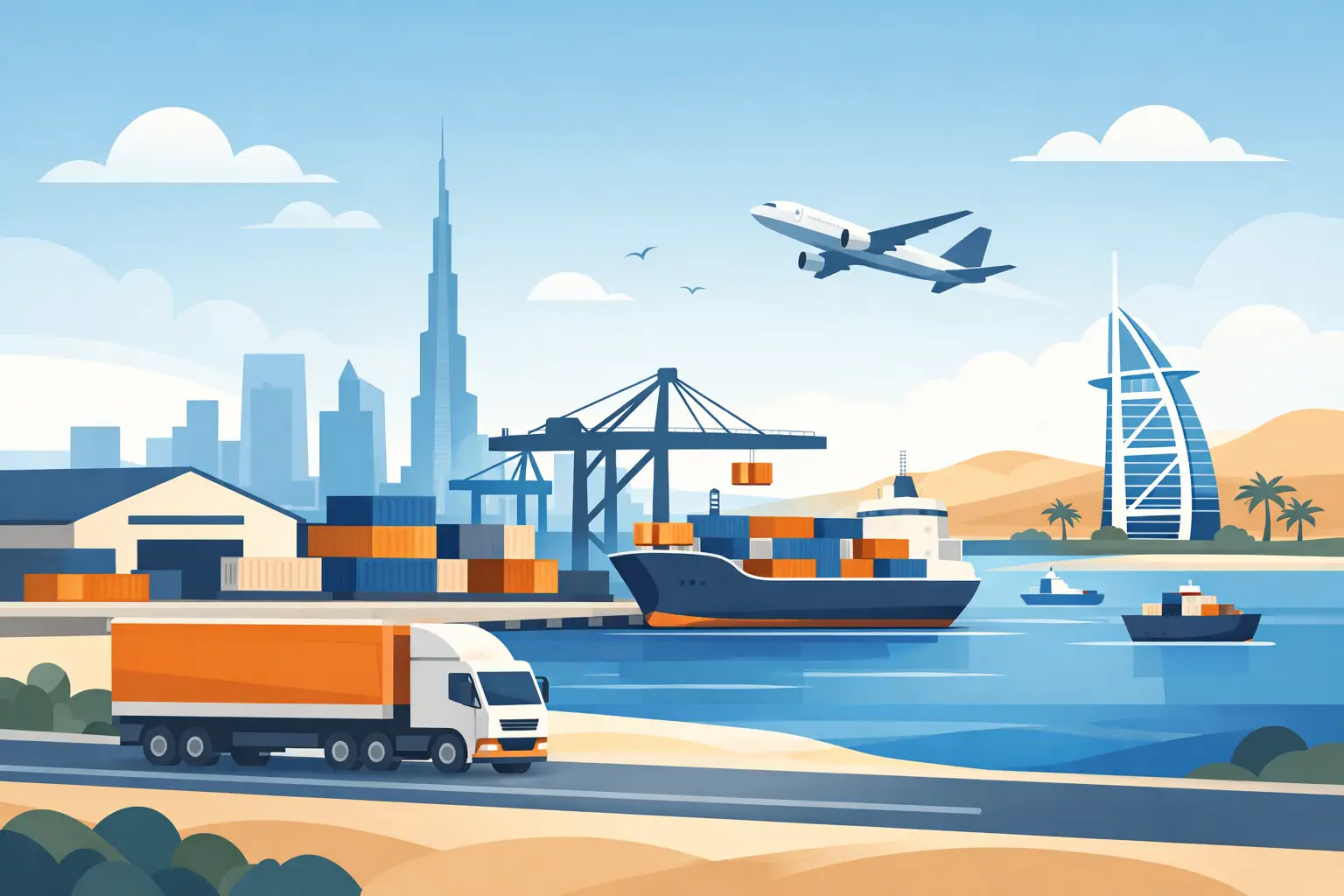
A factory can be world-class on paper and still lose money in motion. Delays at transfer points, long inland drayage, fragmented warehousing, and poor last-mile coordination can erode margins faster than most expansion models assume. For manufacturers entering the Gulf, that is why logistics facilities near UAE ports are not a secondary consideration. They are part of the operating model.
For industrial investors and advanced manufacturers, the real question is not whether port proximity matters. It is what kind of port-adjacent infrastructure actually supports scale, speed, compliance, and long-term cost discipline. In the UAE, the answer depends on how closely logistics assets are integrated with industrial production, trade corridors, labor access, and sector-specific requirements.
Why logistics facilities near UAE ports matter more now
The UAE has moved beyond its role as a transshipment center. It is positioning itself as a manufacturing, processing, and export base for sectors that need precision, resiliency, and reach. Electric mobility, clean energy equipment, aerospace-adjacent components, and semiconductor-linked supply chains do not just need warehouses. They need controlled environments, predictable throughput, customs efficiency, and direct connections to GCC and global markets.
That shifts the role of logistics real estate. The best logistics facilities near UAE ports are no longer simple storage assets designed for generic cargo turnover. They are operational platforms that support inventory staging, multimodal movement, light assembly, bonded operations, spare parts management, cold or controlled storage where needed, and synchronized inbound-outbound planning.
This matters because supply chain pressure has changed. Companies are carrying more strategic inventory than they did a few years ago. Customers expect shorter lead times. Boards are demanding lower operating risk while still pushing for regional growth. In that environment, every unnecessary kilometer between port, plant, and customer becomes a strategic cost.
What serious occupiers should look for
Port proximity on its own can be overrated if the surrounding infrastructure is weak. A facility close to the water but disconnected from production zones, labor pools, and arterial road networks may create as many constraints as it solves. The stronger metric is effective logistics adjacency – how quickly goods move from berth to warehouse, warehouse to factory, and factory to final market.
For manufacturers, this translates into a few practical requirements. First, the facility must be designed for throughput, not just square footage. Clear heights, yard depth, truck circulation, loading efficiency, and expansion flexibility all affect cost per unit moved. Second, the site should support phased growth. Many industrial occupiers start with one line, one customer mix, or one regional export plan, then expand rapidly. A constrained site can force relocation at the exact moment scale should improve profitability.
Third, compliance readiness matters. Companies in clean-tech, electronics, and advanced manufacturing often require specific power profiles, safety controls, environmental standards, and in some cases cleanroom-adjacent capabilities. Generic industrial stock may appear cheaper at lease signing, but retrofitting can become expensive and time-consuming.
The UAE advantage is network depth, not just geography
The UAE benefits from obvious geography, sitting between Asian production centers, African growth markets, and European demand. But geography alone is not the differentiator. The real advantage is network depth: ports, free zones, highways, aviation links, customs infrastructure, and a policy environment designed to attract export-led industry.
That is why logistics facilities near UAE ports are attractive to companies that need both regional distribution and international trade optionality. A business can import components, process or assemble locally, and re-export across the GCC, Africa, and beyond without building its model around a single narrow market. This flexibility is especially valuable in industries where demand patterns shift quickly or procurement sources change.
Ras Al Khaimah deserves particular attention in this conversation. It offers a compelling mix of port access, lower operating costs, available industrial land, and an increasingly strategic position for manufacturers seeking a base that is commercially efficient rather than simply well known. For occupiers balancing capex, labor support, and export capability, that combination can be more valuable than prestige addresses in higher-cost corridors.
Port access is strongest when paired with industrial ecosystem planning
A standalone warehouse can solve a short-term logistics issue. It rarely solves a long-term industrial one. Advanced manufacturing companies need more than cargo handling. They need an environment where logistics, production, workforce support, utilities, R&D, and business continuity reinforce each other.
This is where the market is shifting from industrial parks to industrial ecosystems. When logistics facilities sit inside a broader mixed-use industrial platform, tenants gain more than convenience. They gain operating resilience. Workers can live closer to sites. Suppliers can cluster nearby. Support services become embedded in the same geography. Lead times become easier to control because more of the value chain is physically and institutionally aligned.
For multinational manufacturers, that model reduces friction across the full operating cycle. Recruitment improves when residential and social infrastructure are built into the plan. ESG targets become more credible when development standards, mobility planning, and energy strategy are considered at the master-planning stage rather than added later. In practical terms, ecosystem planning turns logistics from a cost center into a competitive advantage.
Trade-offs investors should weigh carefully
There is no single best answer for every occupier. The right logistics model depends on product profile, shipment frequency, margin structure, and growth horizon.
If a company handles high-volume, lower-value goods, cost per pallet and truck efficiency may dominate the site decision. If it produces high-value technology components, security, controlled environments, and customs predictability may matter more than raw warehouse size. If the business depends on rapid aftermarket fulfillment, access to major road corridors and final-mile reliability may outweigh immediate adjacency to the port itself.
There is also a timing trade-off. Some companies choose ready-built logistics space to accelerate market entry, even if it is not perfectly tailored. Others invest in purpose-built facilities because they expect higher utilization, specialized workflows, or regulatory requirements over time. Neither path is inherently superior. The stronger choice is the one aligned with the company’s production model three to five years out, not just its first twelve months in market.
Why integrated platforms are gaining attention
The next generation of industrial demand in the UAE is not being shaped by generic warehousing users alone. It is being shaped by companies in EV supply chains, hydrogen mobility, advanced materials, renewable energy, and semiconductor-related production. These sectors require infrastructure that can support precision manufacturing and logistics performance at the same time.
That is why integrated platforms such as Erisha Smart Manufacturing Hub are increasingly relevant to board-level site selection. The value is not only in having industrial and logistics capacity in one place. It is in combining purpose-built factories, modular units, cleanroom-ready potential, sector clustering, and community infrastructure within a single strategic environment. For investors and operators, that creates a base designed for growth rather than short-term occupancy.
When this model is positioned near UAE port infrastructure, the advantage compounds. Manufacturers can reduce transfer inefficiencies, support export activity, improve inventory control, and operate in a setting that is more aligned with national industrial priorities and ESG expectations. That alignment matters to institutional capital as much as it matters to operating teams.
What the next decade will reward
The winners in regional manufacturing will not simply be the companies with the lowest lease rate or the closest warehouse to a berth. They will be the companies that choose locations capable of supporting resilient, scalable, and future-ready operations.
In the UAE, that means thinking beyond isolated assets. It means evaluating how logistics facilities near UAE ports connect to production infrastructure, labor ecosystems, energy planning, and cross-border trade strategy. It means asking whether a site can support automation, specialized compliance, and phased industrial expansion without forcing operational redesign every two years.
For decision-makers entering the region, this is a moment to be precise. A logistics address is easy to secure. A strategic industrial platform is much harder to replicate once demand accelerates. The companies that move early on the right infrastructure will not just ship faster. They will build with more control, grow with fewer bottlenecks, and compete from a position of structural advantage.
The most valuable facilities near UAE ports are not just close to trade. They are close to the future of industry – and that is where durable growth gets built.

[…] most obvious argument for the UAE is location, and that is valid. Ports, airports, and trade corridors make the country an efficient base for cross-border industrial activity. But […]
[…] strong park reduces emissions not only through building performance, but through location logic. Proximity to ports, regional transport corridors, and supplier networks can materially reduce freight complexity and […]