
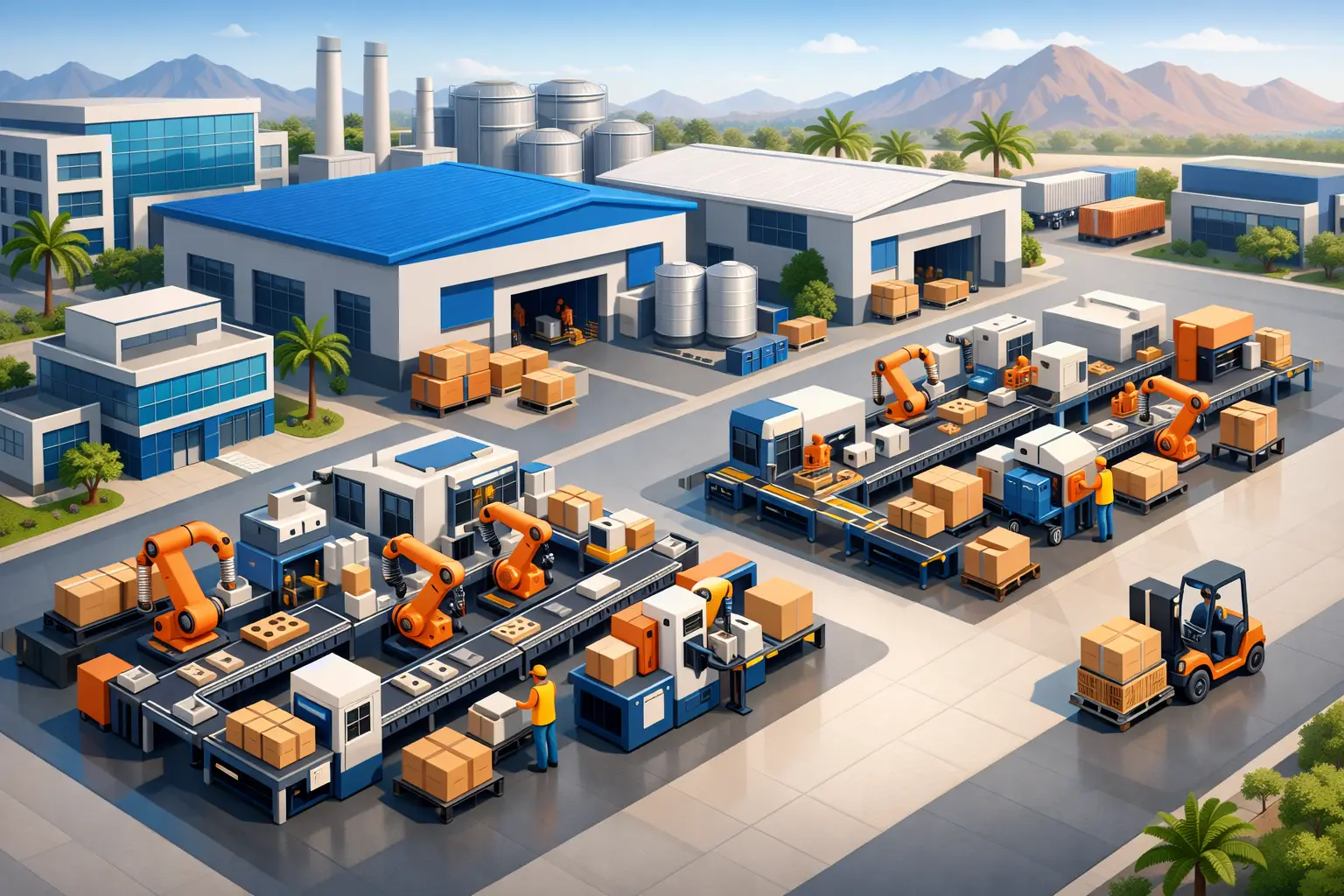
Capacity is no longer the only expansion question. For industrial leaders across Asia and Europe, the harder question is where to place the next production line so it improves cost structure, market access, resilience, and innovation at the same time. That is why Indian, Japanese, South Koreans, Europeans, and Vietnamese companies can have second production line and innovation centres in Erisha Smart Manufacturing Hub RAKEZ – not as a speculative move, but as a strategic operating model for regional growth.
For many manufacturers, a second line in the Gulf is not about duplicating existing output. It is about building a more flexible industrial footprint. A company serving Europe, the GCC, Africa, and South Asia from one distant base eventually hits limits in shipping time, tariff exposure, customer responsiveness, and engineering collaboration. The right second site solves those issues without forcing a fragmented setup.
Erisha Smart Manufacturing Hub in RAKEZ is designed for that next stage. It is not a conventional industrial park built around warehousing logic. It is a mixed-use, sector-focused manufacturing ecosystem created for advanced industry – with industrial infrastructure, R&D capacity, workforce support, logistics access, and live-work amenities planned as one platform.
Why a second production line now makes strategic sense
The last few years have changed how expansion is evaluated. Companies are no longer looking only at labor cost or land cost. They are asking whether a new location can reduce supply chain concentration risk, support ESG goals, shorten lead times into growth markets, and create room for future product development.
That matters for companies from India, Japan, South Korea, Europe, and Vietnam because many are entering a similar phase. Their domestic and existing export bases remain important, but the next wave of growth increasingly depends on proximity to Middle East demand, better access to Africa, and stronger integration with global trade corridors. A second production line in RAKEZ can serve as both a commercial bridge and an operating hedge.
There is also a practical financial logic. Building an additional line in a location with lower operating costs than many legacy industrial centers can protect margins. At the same time, placing that line in the UAE improves regional customer access and can support faster after-sales response, localized assembly, and market-specific customization.
For sectors such as EV components, hydrogen mobility systems, industrial electronics, aerospace-adjacent parts, and clean technology equipment, this model is especially compelling. These are sectors where engineering cycles are shortening, buyers want reliability, and industrial occupiers cannot afford disconnected ecosystems.
Indian, Japanese, South Koreans, Europeans, Vietnamese companies in Erisha Smart Manufacturing Hub RAKEZ
The value proposition is strong precisely because it speaks to different industrial strengths.
Indian companies often look for expansion models that combine manufacturing economics with export reach. For them, Erisha offers the ability to add GCC-facing capacity while remaining connected to wider India-UAE trade and investment momentum. It can also support a staged market-entry strategy, where assembly, final integration, testing, or specialized product lines are added before a full-scale regional manufacturing rollout.
Japanese manufacturers typically place a premium on operational discipline, quality control, supplier reliability, and long-horizon planning. A second production line or innovation center only works if the environment supports process precision and long-term stability. Purpose-built industrial infrastructure, cleanroom-ready options, and a master-planned setting matter here because they reduce adaptation risk.
South Korean companies, particularly in mobility, electronics, battery-adjacent systems, and advanced materials, often scale fast when the ecosystem is right. They need facilities that can accommodate technical production while staying close to emerging market demand. In that context, Erisha is not just about factory space. It is about creating an industrial base where manufacturing, testing, engineering, and future product commercialization can happen in one environment.
European firms bring another priority set. Many are under pressure to localize parts of their supply chain, meet stricter ESG expectations, and improve responsiveness to non-European markets without compromising standards. An ESG-aligned industrial ecosystem in the UAE can help them establish a second line that serves regional demand while reinforcing sustainability positioning.
Vietnamese companies are also entering a new stage of international industrial ambition. As they move beyond contract manufacturing into brand-building, specialized production, and multinational partnerships, having a second production and innovation base in a globally connected jurisdiction can expand credibility as much as output.
More than factory space – why innovation centers belong beside production
A second production line without an innovation function can become a short-term capacity fix. A second line with an innovation center becomes a growth engine.
That distinction matters in advanced manufacturing. Product refinement, materials adaptation, climate-specific engineering, testing, prototyping, and customer co-development increasingly need to happen close to target markets. If every technical adjustment has to move back through headquarters or a distant R&D center, speed is lost and commercial opportunities narrow.
In Erisha, the logic is to colocate production with innovation capability. That could mean application engineering labs, pilot lines, product localization teams, digital manufacturing analytics, or supplier development functions. For multinational firms, it creates a regional platform that can do more than assemble. It can learn, iterate, and improve.
This is particularly relevant in sectors already being shaped inside the Erisha ecosystem. Mobility, hydrogen, clean energy, semiconductors, aerospace-adjacent manufacturing, and smart industrial technologies all benefit when production and engineering are tightly integrated. Companies evaluating technical fit may want to review What Makes Production Advanced at Erisha Hub? and Best Industrial Hubs for Semiconductors, especially if facility readiness and sector specialization are central to the decision.
The RAKEZ advantage is operational, not cosmetic
Too many industrial projects market location as a slogan. Serious manufacturers need more than that. They need to know whether the site reduces friction across land, buildout, logistics, regulation, workforce retention, and future scaling.
RAKEZ matters because it offers an investor-friendly framework in a location that connects efficiently to regional and international trade routes. For companies establishing a second production line, that translates into practical benefits: easier import of components, smoother export to target markets, lower time loss between factory and port, and a regulatory environment built to support commercial growth.
But geography alone does not create manufacturing value. The stronger advantage is how Erisha builds on that location with sector-specific infrastructure. Turnkey factories, modular industrial units, logistics facilities, and cleanroom-ready spaces reduce the delay and uncertainty that often come with entering a new market. That can materially improve the timeline from board approval to production start.
There is another factor that strategic investors increasingly scrutinize: whether the workforce ecosystem is durable. A second production line is not sustainable if talent attraction and retention are weak. Erisha is planned as a full live-work-innovate environment, integrating industrial operations with residential, healthcare, education, hospitality, and retail assets. That is a serious operating advantage, not a lifestyle add-on. Companies that want to understand that broader model can also explore Why Hospitals and Colleges Belong in Erisha Hub.
What kind of second line fits best in Erisha
Not every production transfer should be total, and that is where disciplined expansion strategy matters. The best fit for Erisha is often one of three models.
The first is regional manufacturing for GCC, African, and nearby export markets. This works well when demand is growing fast enough to justify local output but not yet large enough to replicate the entire home-country factory structure.
The second is high-value specialized production. Companies may keep mass-volume lines in an existing base while placing higher-margin, faster-moving, or technically sensitive product families in Erisha. That approach is common when buyers need shorter lead times, customization, or stronger service support.
The third is the innovation-led line. In this model, the production line is paired with pilot manufacturing, validation, prototyping, or market-specific engineering. That is often the strongest route for companies entering new mobility, energy, electronics, or aerospace-adjacent categories.
There are trade-offs, of course. A second line requires supplier mapping, governance clarity, and a realistic view of what should be localized now versus later. Companies that move too little may not gain true regional leverage. Companies that move too much too quickly can create avoidable operational strain. The better path is a phased strategy based on product complexity, demand profile, and partner readiness.
Building a second industrial base with long-term logic
The strongest reason Indian, Japanese, South Koreans, Europeans, and Vietnamese companies can have second production line and innovation centres in Erisha Smart Manufacturing Hub RAKEZ is simple: the hub aligns industrial expansion with how global manufacturing is actually evolving.
The future does not belong to isolated factories. It belongs to connected industrial ecosystems where production, talent, R&D, logistics, and market access reinforce each other. That is the difference between adding capacity and building strategic presence.
For multinational manufacturers thinking beyond the next quarter, a second line in Erisha is not merely an overseas plant. It is a regional operating platform designed for resilience, speed, and higher-value growth. The companies that move early will not just serve new markets faster. They will shape how next-generation industry is built across them.

[…] the site cannot accommodate adjacent expansion, warehouse growth, dedicated flight-test support, or a second line, the manufacturer may face disruption at the exact moment demand improves. Scalable land strategy […]