
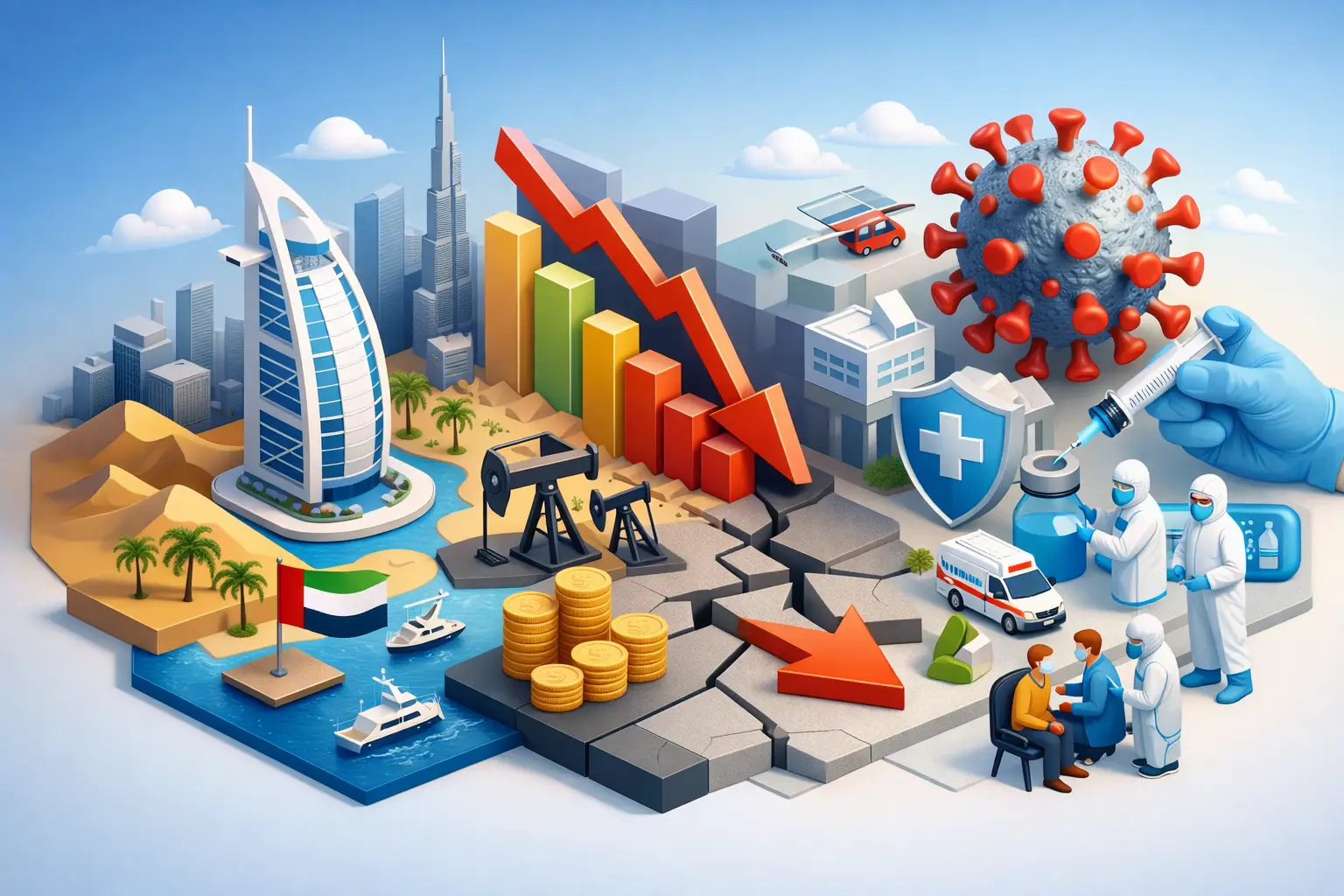
A manufacturing base is only as strong as the country behind it. That is why the way UAE has handled the situation of recession, covid 2019 and present gulf situation matters far beyond headlines. For industrial investors, advanced manufacturers, and strategic partners, this is not a political talking point. It is a hard operating question: where can capital stay productive through shocks, where can supply chains keep moving, and where can expansion plans survive uncertainty.
The answer matters even more for long-cycle sectors such as EVs, hydrogen mobility, semiconductors, aerospace-adjacent production, and renewable energy systems. These industries do not choose locations for one good quarter. They choose jurisdictions that can absorb disruption, protect business continuity, and keep building through volatility. On that measure, the UAE has separated itself from many competing markets.
The way UAE handled recession, Covid 2019, and the present Gulf situation
The UAE’s advantage is not that it avoided global shocks. No serious economy did. Its advantage is that it responded with speed, policy clarity, and continued infrastructure ambition. During periods of recessionary pressure, many countries slowed approvals, deferred projects, or became harder to navigate. The UAE largely did the opposite. It stayed legible to investors.
That matters because industrial expansion depends on confidence in execution. Companies investing in factories, utilities, logistics capacity, testing environments, or workforce ecosystems need more than incentives. They need assurance that public systems will remain functional when markets tighten. The UAE reinforced that assurance through regulatory responsiveness, logistics continuity, and a visible commitment to economic diversification even when external conditions were difficult.
Covid exposed the difference between economies that could adapt operationally and those that could not. The UAE moved quickly on health management, mobility controls, digital government access, and business reopening frameworks. For manufacturers and supply chain operators, that translated into something concrete: less ambiguity. Investors could model scenarios, reopen operations, move staff, and maintain planning cycles with more confidence than in many other regions.
Today’s Gulf situation adds another layer. Regional tensions, shipping disruptions, commodity swings, and shifting trade alignments have increased the premium on stable, well-connected operating environments. The UAE has maintained its role as a regional connector rather than becoming a point of paralysis. Ports remain strategic assets. Trade corridors remain active. Free zone structures remain investor-friendly. For companies choosing a Gulf base, that continuity is not a minor edge. It is central to risk management.
Why this makes the UAE the right country for industrial scale
The case for the UAE is not built on one crisis response. It is built on repeatability. When a country shows resilience across recessionary cycles, a public health shock, and a volatile regional environment, investors start to read that as institutional capability.
That capability shows up in four ways. First, policy direction has remained aligned with industrial growth and diversification, rather than overdependence on a single sector. Second, infrastructure investment has continued instead of being treated as optional. Third, the business environment remains internationally legible, which matters to multinationals managing cross-border boards, auditors, and compliance teams. Fourth, the UAE understands that future manufacturing depends on talent, livability, logistics, and sustainability, not just industrial land.
This is where the conversation becomes more strategic. Advanced manufacturing no longer chooses sites based only on cheap space. It chooses ecosystems. A semiconductor supplier, hydrogen mobility platform, or clean-tech assembler needs specialized facilities, room for second production lines, efficient port access, proximity to growth markets, and a location where technical teams can actually live and stay. That is why integrated industrial environments are gaining ground over isolated industrial estates.
Why Erisha Smart Manufacturing Hub is placed in the right country
The way UAE has handled the situation of recession, covid 2019 and present gulf situation supports a larger conclusion: Erisha Smart Manufacturing Hub is placed in the right country because the national environment matches the project’s industrial ambition.
A hub built for advanced production cannot sit inside an economy that reacts slowly, deprioritizes infrastructure, or treats manufacturing as secondary. It needs a country that understands long-term industrial positioning. The UAE does. It has spent years building itself as a platform for trade, production, logistics, and innovation. That is exactly the kind of national backdrop required for a smart manufacturing ecosystem with sector-specific clusters, cleanroom-ready capacity, logistics integration, and live-work support assets.
For investors, this is about strategic fit. A project can be technically impressive and still fail if the surrounding country context is weak. The opposite is also true: when an industrial platform is matched with a stable, investor-oriented, globally connected jurisdiction, its execution potential rises sharply. That is the advantage here.
In Ras Al Khaimah, that fit becomes even more practical. Operating economics are more favorable than in many competing industrial locations, while connectivity to ports and regional markets remains strong. For occupiers balancing cost discipline with export access, that combination is hard to ignore. It allows manufacturers to protect margins without sacrificing market reach.
What sophisticated investors should read beneath the surface
The smartest site selection decisions are rarely based on headline growth rates alone. They come from reading the operating system underneath the economy. In the UAE, that operating system has shown unusual consistency.
When recession risk rises, the country remains open to capital formation and industrial development. When a health crisis hits, public systems adapt quickly enough to preserve confidence. When the Gulf environment becomes more complex, logistics and commercial frameworks continue to function. That pattern reduces location risk for manufacturers with long payback periods.
There are, of course, trade-offs. The UAE is not the lowest-cost jurisdiction in every input category, and no market is immune to global demand shifts. Energy pricing, trade flows, and freight dynamics still move with international conditions. But advanced manufacturers are not selecting a location based on the cheapest single variable. They are selecting for total operating resilience. In that calculation, the UAE performs well because it combines cost competitiveness in the right places with political steadiness, regulatory clarity, and infrastructure depth.
That is particularly relevant for sectors where downtime is expensive and ecosystem quality matters. EV assembly, hydrogen systems, aerospace components, and semiconductor-related production all depend on precision, specialized utilities, supplier coordination, and workforce retention. A fragmented industrial location creates friction. A planned ecosystem inside a resilient country reduces it.
Industrial resilience is now a board-level metric
Ten years ago, location strategy often centered on labor costs and tax treatment. Today, boardrooms ask different questions. Can this site keep operating during external shocks? Can our people relocate there? Can we build in phases? Can we scale logistics without rebuilding the model? Can this location support ESG targets and future technologies, not just current output?
Those questions point directly toward ecosystems designed for industrial continuity. That is one reason integrated platforms are receiving more attention from multinational manufacturers and institutional partners. The value is not only in square footage. It is in reducing fragmentation across production, supply chain movement, talent retention, and partner collaboration.
For readers evaluating this through a regional lens, the article on Will Gulf Situation Affect Erisha Hub in RAKEZ? adds useful context on why the project’s positioning remains durable even when broader Gulf conditions become more uncertain. The same logic applies to industrial scale. Economic resilience at the country level strengthens project resilience at the hub level.
There is also a broader development case. A serious manufacturing platform should generate more than tenancy. It should create economic depth, jobs, supplier networks, and innovation spillovers. That is why ecosystem-led industrial planning matters. As outlined in Erisha Hub Adds $5-6B in Ras Al Khaimah, the long-term value proposition is tied to regional economic impact, not just real estate absorption.
For occupiers in advanced sectors, the production logic is equally important. Facilities must support technological progression, modular scaling, and increasingly sophisticated operations. That is addressed in What Makes Production Advanced at Erisha Hub?, where the focus moves from location theory to operational readiness.
The deeper point is simple. Countries are now judged by how they perform under pressure, not how they market themselves in stable periods. The UAE has built a record of maintaining business continuity, preserving investor confidence, and pushing forward with strategic infrastructure even when global conditions turned difficult.
For industrial leaders deciding where the future works, that record is not background noise. It is the foundation. And when an advanced manufacturing ecosystem is anchored in a country that has already proven its resilience through recession, Covid 2019, and the present Gulf situation, the site decision becomes clearer: placement is not accidental. It is strategic.
