
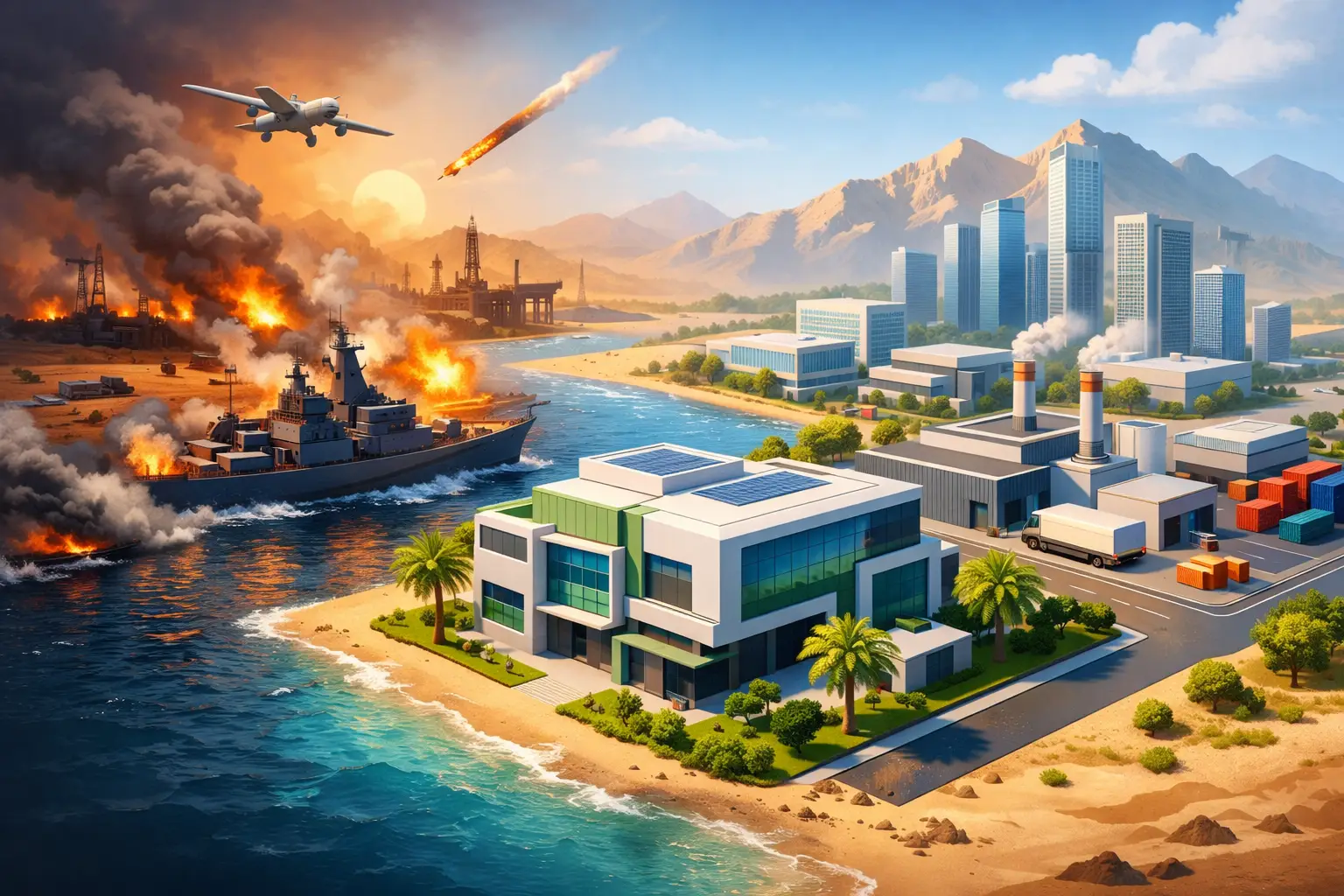
Regional volatility changes investment decisions fast. For industrial operators, the real question is not whether headlines matter, but whether the present situation in Gulf will effect for Erisha Smart Manufacturing Hub in RAKEZ in a way that changes cost, continuity, and long-term returns. That answer is more nuanced than a simple yes or no.
For serious manufacturers, geopolitical conditions in the Gulf affect three things first: confidence, logistics, and capital deployment. But industrial platforms are not judged by headlines alone. They are judged by whether they reduce exposure, maintain operating continuity, and position tenants closer to demand growth. In that context, Erisha Smart Manufacturing Hub in RAKEZ sits in a category that deserves strategic attention rather than reactive concern.
How the present situation in Gulf affects industrial decisions
The Gulf is not a single risk environment. Investors often make the mistake of reading the region as one block, when in practice operating conditions vary sharply by jurisdiction, free zone structure, regulatory clarity, and infrastructure maturity. For advanced manufacturers, the present Gulf situation affects site selection mainly through shipping patterns, energy confidence, insurance assumptions, cross-border trade flows, and executive willingness to accelerate expansion.
Periods of regional tension can delay board approvals. They can also push companies to consolidate production into locations with stronger institutional predictability. That is the first strategic distinction. Volatility does not always reduce manufacturing investment. In many cases, it redirects it toward environments that offer more control, lower costs, and more integrated operating conditions.
That matters for companies evaluating RAKEZ. Ras Al Khaimah is not competing as a speculative story. It is competing as an execution platform for industrial growth. When the wider region faces uncertainty, platforms that offer ready infrastructure, investor-friendly regulation, and port-linked connectivity often become more attractive, not less.
Why RAKEZ changes the risk equation
A conventional industrial park leaves tenants to solve the hard parts on their own – housing, workforce retention, supplier proximity, service access, and scaling flexibility. That model works in stable periods, but it becomes fragile when supply chains tighten or executive teams need faster deployment.
Erisha Smart Manufacturing Hub is positioned differently. Its value is not only land or factory space. Its value is ecosystem design. By integrating production infrastructure with residential, healthcare, education, retail, hospitality, logistics, and R&D functions, it addresses one of the biggest hidden vulnerabilities in industrial expansion: operational fragmentation.
In uncertain regional periods, fragmentation becomes expensive. Labor turnover rises. Supplier coordination slows. Leadership teams spend time solving peripheral problems instead of scaling output. An integrated hub reduces those pressures. For advanced manufacturers in EVs, hydrogen mobility, semiconductors, clean tech, and aerospace-adjacent production, that kind of planning has direct commercial value.
This is also where the economics of Ras Al Khaimah matter. Manufacturers entering the UAE often compare prestige locations first, then realize their margin structure works better in cost-efficient jurisdictions with strong logistics access and supportive industrial policy. RAKEZ offers that shift in logic. It supports expansion without forcing tenants into unnecessary overhead.
Will present situation in Gulf effect for Erisha Smart Manufacturing hub in RAKEZ?
Yes, but not in the simplistic way many assume.
The present situation in Gulf can affect Erisha Smart Manufacturing Hub in RAKEZ through investor sentiment, freight timing, commodity pricing, and the pace of decision-making by global manufacturers. Those are real variables. If shipping routes tighten or regional headlines intensify, companies may review launch timelines, inventory assumptions, and supplier diversification plans.
But the stronger effect may be the opposite. When companies reassess concentration risk, they look for industrial bases that offer stability, scalability, and regional reach. That is where a master-planned hub in RAKEZ can gain relevance. A platform built for advanced manufacturing, supported by compliant infrastructure and lower operating costs, gives manufacturers a way to stay in the Gulf growth story without overexposing themselves to disjointed operating environments.
So the issue is not whether the Gulf situation creates pressure. It does. The issue is whether Erisha is structured to absorb that pressure better than less integrated alternatives. On that question, the fundamentals are strong.
The sectors most likely to stay resilient
Not every manufacturing category reacts the same way to regional instability. Consumer discretionary segments may slow if capital becomes cautious. Large commodity-linked projects may become more sensitive to price swings. But strategic sectors tied to energy transition, national industrial policy, mobility systems, and supply chain security often continue moving forward.
That supports the investment case for Erisha’s sector focus. Electric mobility, hydrogen ecosystems, semiconductor-ready production space, renewable energy manufacturing, and eVTOL-related activity are not fringe categories. They sit inside long-cycle structural demand. Governments, institutional investors, and multinational operators continue backing them because they connect to national competitiveness, decarbonization, and industrial sovereignty.
A location that is already aligned with those sectors is better positioned than a generic industrial development. Erisha is not trying to serve every possible occupier equally. It is building around industries that will define the next phase of manufacturing value creation. That sector discipline matters more when regional conditions become uneven.
For readers looking at where this broader industrial thesis is already reflected, 10 Top Reasons to Set Up in Erisha Hub provides a useful view of how infrastructure, cost, and sector specialization come together.
What investors should actually watch
The wrong way to assess risk is to rely on generalized political narratives. The right way is to track operating indicators.
First, watch trade continuity. If ports, customs movement, and regional distribution remain functional, industrial activity retains momentum even during noisy periods. Second, watch energy and utility reliability. Advanced manufacturing cannot tolerate ambiguity there. Third, watch the speed of tenant onboarding and facility delivery. In uncertain markets, time-to-operation becomes a decisive advantage. Fourth, watch labor ecosystem strength. The best industrial platform is weakened if workforce life outside the factory is poorly designed.
These are not abstract issues. They directly shape yield, uptime, and expansion confidence. An ecosystem approach is valuable because it addresses several of them at once. It is the difference between offering space and offering industrial continuity.
That continuity also supports second-stage growth. Companies rarely make a regional platform decision for one line only. They ask whether the location can support expansion, supplier clustering, and future product adjacencies. That is one reason Second Production Lines in Erisha Hub RAKEZ is relevant to operators thinking beyond an initial launch.
Why integrated industrial ecosystems outperform in uncertain periods
Industrial tenants are no longer choosing sites on rent alone. They are choosing environments that reduce hidden friction across the full life of the investment. This is where many legacy industrial zones fall short. They may offer licensing benefits, but not the full conditions required for innovation-led manufacturing to scale.
Erisha’s mixed-use model responds to that reality. If executive teams can place factories, technical teams, workforce housing, logistics functions, and innovation partners into one connected environment, they lower transition time and improve resilience. They also create a stronger case internally when taking an expansion proposal to a board or investment committee.
That is especially relevant in the Gulf today. Regional opportunity remains large, but decision-makers want proof that growth platforms are built for complexity. A live-work-innovate model sends a stronger signal than a land parcel with basic utilities. It suggests that the hub was designed for sustained industrial occupation, not short-cycle leasing.
The economic implications are significant. Clustered industrial models tend to create stronger supplier density, more dependable workforce retention, and better spillover into services, technical education, and R&D. That broader logic is reflected in Industrial Cluster Development Example That Works, which shows why ecosystem design is becoming a serious strategic advantage rather than a branding phrase.
A realistic view of the downside
No credible industrial analysis should pretend there is zero risk. If the present Gulf situation worsens materially, shipping costs can rise, executive travel can become more complicated, and procurement cycles may slow. Some investors will pause simply because internal governance becomes more conservative under uncertainty.
There is also a timing issue. Even strong projects can face slower commitment cycles when multinational boards are reviewing regional exposure. That does not mean the platform is weak. It means capital takes longer to move.
The key distinction is between temporary friction and structural weakness. Temporary friction affects almost every regional investment option. Structural weakness is specific to platforms that lack logistics access, policy clarity, scalable infrastructure, or a coherent tenant strategy. Erisha’s position in RAKEZ is more aligned with the first category than the second.
That is why sophisticated investors should read the current environment as a filtering mechanism. It rewards industrial platforms that can show readiness, not just ambition. It favors projects that can support long-term manufacturing economics, not just land transactions. And it strengthens the case for hubs designed around the next generation of industrial sectors rather than yesterday’s generic warehousing logic.
For manufacturers and strategic partners evaluating the region, the smarter question is not whether Gulf conditions create noise. They do. The smarter question is whether your chosen platform turns that noise into a reason to delay – or into a reason to choose a more resilient base for growth.
