
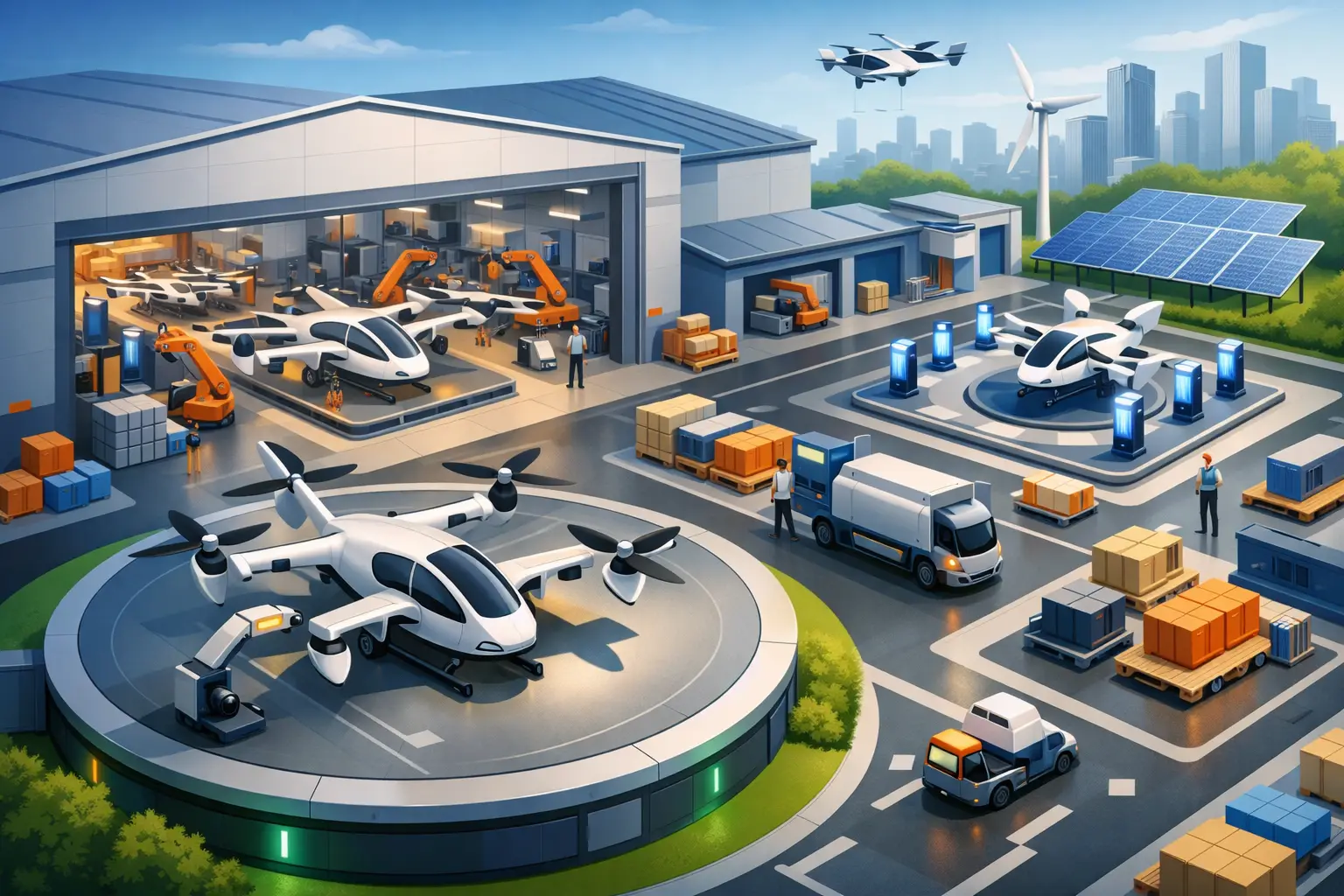
eVTOL manufacturing will not scale on vision alone. The companies most likely to win this market are not simply designing better aircraft. They are building industrial systems that can support certification, repeatability, supplier integration, workforce readiness, and cost control from day one. That is why EVTOL Production Infrastructure Requirements deserve board-level attention long before the first commercial delivery.
For investors and manufacturers, the core question is not whether the sector has momentum. It does. The real question is whether a proposed site can support aerospace-grade production while also accommodating the speed, flexibility, and capital discipline expected in next-generation mobility. In practice, that means production infrastructure must do far more than provide floorspace. It must enable an operating model.
What EVTOL production infrastructure really includes
Too many site discussions start and end with building size. For eVTOL programs, that is a costly simplification. Production infrastructure includes the physical plant, but it also includes utility stability, logistics access, testing capacity, digital systems, quality environments, workforce support, and room for supplier co-location.
An eVTOL aircraft combines aerospace tolerances with automotive-style pressure for volume, throughput, and cost reduction. That creates a hybrid production challenge. Manufacturers need high-spec assembly environments, traceable material flows, battery handling protocols, composite fabrication capability, avionics integration areas, and disciplined final inspection processes. A standard industrial unit may cover basic occupancy needs, but it rarely addresses the operating conditions that make production bankable.
This is where industrial ecosystems begin to matter more than standalone sites. A facility may look viable on paper, yet still fail under the pressure of ramp-up if power quality is unstable, inbound freight routes are inefficient, or skilled labor cannot be retained. Infrastructure quality shows up in yield, downtime, insurance exposure, and time to certification.
Site selection starts with power, land, and expansion logic
eVTOL production is energy-intensive, quality-sensitive, and expansion-driven. A site that works for prototype assembly may become a constraint once pre-serial production begins. Decision-makers therefore need to assess infrastructure in phases, not just at launch.
Power availability is usually the first hard filter. Composite manufacturing, climate-controlled assembly, precision tooling, test equipment, and battery-related processes all require reliable electricity and load planning. Interruption risk is not a minor inconvenience in this sector. It affects process stability, equipment utilization, and schedule confidence. That is why manufacturers evaluating locations often focus early on utility depth and resilience, not just lease economics. Reliable industrial capacity is a foundational requirement, as discussed in Why World-Class Infrastructure and Power Matter.
Land planning is just as important. eVTOL programs rarely stay static. Production footprints evolve as assembly lines mature, suppliers move closer, and testing requirements become more structured. If the site cannot accommodate adjacent expansion, warehouse growth, dedicated flight-test support, or a second line, the manufacturer may face disruption at the exact moment demand improves. Scalable land strategy protects future economics.
Building specifications must support aerospace discipline
eVTOL facilities need more than generic warehouse conversion. Ceiling heights, floor loading, vibration control, HVAC performance, ESD protections in electronics areas, and segmented workflows all affect production integrity. Composite work, battery integration, and avionics installation do not belong in the same environmental conditions.
The building should allow clear separation between raw material storage, subassembly, sensitive electronics integration, paint or finishing processes, battery-safe zones, quality control, and final assembly. For some programs, cleanroom-ready areas or tightly controlled environments may also be required for high-value electronics, sensors, or semiconductor-linked components. These are not premium extras. They are part of a credible industrial design.
Fire suppression and safety planning also rise in importance. Battery systems, resins, solvents, and advanced materials introduce specialized risks. Insurance providers, regulators, and operating teams will all scrutinize whether the site was designed for those realities or retrofitted after the fact. The difference affects both compliance and long-term operating cost.
Testing, certification, and logistics cannot be afterthoughts
Aircraft manufacturing infrastructure must support the path to certification. That means the production environment should connect logically to inspection, systems testing, ground runs, component validation, and secure movement of finished structures. If testing functions are fragmented across distant sites, time and risk increase.
This does not mean every facility needs a full aviation campus on day one. It does mean leaders should evaluate proximity to air access, specialized logistics handling, customs efficiency, and routes for high-value components. eVTOL programs depend on tightly managed inbound and outbound flows. Large battery packs, precision electronics, lightweight structures, and imported subsystems all require careful transportation planning.
That is why multimodal access is not a side issue. Port connectivity, road efficiency, and airport access influence supplier reliability, export capability, and working capital performance. The strategic value of integrated transport links is outlined well in Why Rail, Road, Port and Airport Connectivity Matter.
There is also a timing issue. Early-stage companies often underestimate the drag created by weak logistics. During low-volume phases, teams can compensate manually. Once production cadence rises, poor connectivity becomes a structural handicap.
Supply chain clustering reduces risk and time to scale
No serious eVTOL production strategy should assume long-term efficiency from a fragmented supplier base spread across multiple jurisdictions without local support. The closer key suppliers are to final assembly, the easier it becomes to manage inventory, engineering changes, quality escapes, and schedule volatility.
This is one reason clustered industrial development is gaining strategic importance. If battery specialists, lightweight materials processors, precision fabricators, electronics integrators, and testing partners can operate in the same ecosystem, the manufacturer gains more than convenience. It gains speed, tighter feedback loops, and lower coordination friction.
That is especially valuable in sectors where design iteration remains active during early production. A supplier community that can respond quickly to engineering updates materially improves ramp performance. The broader case for ecosystem-led industrial strategy is explored in the Integrated Industrial Ecosystem Guide.
There is a trade-off, of course. Clustering can narrow location options and raise expectations for master-planned infrastructure. But for capital-intensive advanced manufacturing, that trade is often rational. Cheap space in the wrong ecosystem usually becomes expensive space over time.
Workforce infrastructure is part of production infrastructure
eVTOL manufacturers need technicians, quality specialists, industrial engineers, electronics talent, supply chain managers, and compliance-focused operations leaders. Recruiting them is one challenge. Keeping them is another.
This is where many industrial projects fall short. They treat labor as an external market variable rather than an infrastructure variable. In reality, workforce support has direct impact on productivity, absenteeism, training continuity, and operational resilience. If employees face long commutes, weak community amenities, or limited quality-of-life support, retention costs rise and output suffers.
For advanced manufacturers, live-work integration is not a branding concept. It is an operating advantage. Industrial ecosystems that combine production space with housing, services, education, healthcare, and everyday convenience create a more stable labor base for long-horizon sectors. That retention dynamic is reflected in Best Factory Communities For [Workforce Retention](/best-factory-communities-workforce-retention).
The implication for investors is clear. A production site should be evaluated not only for capex efficiency, but also for its ability to support a durable workforce model over the life of the program.
ESG and regulatory readiness are now part of the investment case
eVTOL sits at the intersection of advanced manufacturing, clean mobility, and national innovation agendas. That creates opportunity, but it also raises expectations. Investors, partners, and public stakeholders increasingly expect manufacturing platforms to align with ESG standards, responsible energy use, and transparent governance.
For production infrastructure, this translates into practical requirements: energy-efficient buildings, responsible waste handling, water management, safe materials protocols, reporting discipline, and long-term resilience planning. These elements can improve financing quality, customer confidence, and public-sector alignment. They also matter in procurement discussions with global OEMs and institutional partners.
Regulatory clarity matters just as much. Aerospace-adjacent manufacturing cannot afford uncertainty around permits, customs treatment, industrial licensing, or environmental compliance. Locations that combine industrial readiness with a predictable policy environment hold a real competitive edge. For companies evaluating a Middle East manufacturing base, this is one reason integrated, future-focused platforms such as Rana Group’s ecosystem model have growing strategic relevance.
The winning model is not a factory. It is a platform.
The next phase of eVTOL industrialization will favor manufacturers that think beyond a single building. The strongest position comes from developing a platform that supports qualification today and scaled production tomorrow. That platform includes reliable utilities, specialized facilities, testing support, supply chain adjacency, logistics access, ESG alignment, and a workforce environment built for retention.
That may sound like a high bar. It is. But the sector itself sets that bar. eVTOL is not a light industrial category that can be dropped into any available unit and optimized later. It is a precision manufacturing challenge with aerospace consequences and mobility market expectations.
For leaders making location and infrastructure decisions now, the smartest question is simple: can this site support the entire production journey, not just the first phase? If the answer is uncertain, the risk is not abstract. It will appear later in delays, cost overruns, and constrained scale. If the answer is yes, infrastructure stops being a cost center and becomes a competitive asset.
