
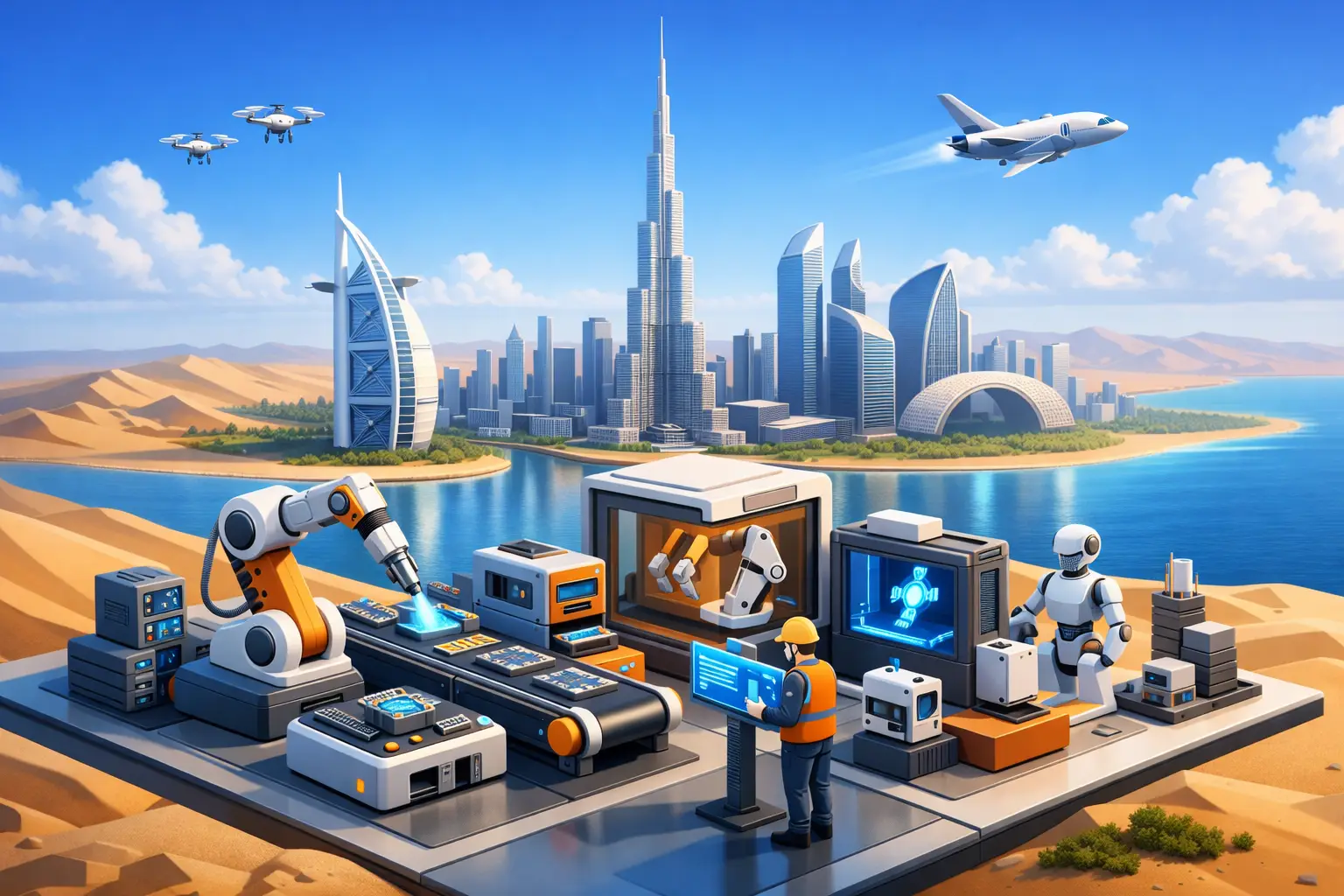
Capital is mobile. Advanced manufacturing is not.
That is the central reason serious industrial investors are reassessing geography. New-technology production depends on far more than factory space. It requires policy certainty, export access, power resilience, workforce retention, ESG alignment, and room to scale without operational friction. When decision-makers ask, “Why UAE is a more strategic country for innovation and manufacturing of new technologies?” the answer is not a single incentive or headline. It is the way multiple strategic advantages work together in one operating environment.
For companies building in electric mobility, semiconductors, hydrogen systems, aerospace-adjacent production, and renewable energy equipment, the UAE has moved beyond being a regional commercial hub. It is becoming a production platform designed for industrial growth.
Why UAE is a more strategic country for innovation and manufacturing of new technologies
The strongest case for the UAE is not based on ambition alone. It is based on execution. Many countries can promote innovation. Far fewer can connect innovation policy to industrial land, utilities, customs efficiency, cross-border trade, financing confidence, and globally relevant infrastructure.
That difference matters because new-technology industries are unusually sensitive to delay. A semiconductor-adjacent operation cannot tolerate facility retrofits that drag on for years. An EV components manufacturer cannot build a supply chain around uncertain port movement. A hydrogen mobility company cannot scale in a location where regulatory direction is fragmented or long-term infrastructure planning is weak.
The UAE offers a more strategic position because it reduces these points of failure. It gives manufacturers a base where government direction, logistics, industrial development, and capital attraction are aligned around economic diversification and future sectors. That alignment lowers execution risk, which is often more valuable than a lower headline cost in a less coordinated market.
Geography that functions like an operating advantage
The UAE sits in a position many countries would like to claim and few can operationalize. It is not simply between East and West. It is commercially connected to the Gulf, Africa, South Asia, and Europe through trade corridors that already move high-value goods at speed.
For advanced manufacturers, geography only matters if infrastructure converts it into throughput. The UAE does that through ports, airports, road networks, and free zone ecosystems designed around trade. This is especially relevant for businesses that import specialist inputs, export finished systems, and need reliable access to multiple end markets rather than dependence on a single domestic base.
That regional reach is one reason the UAE increasingly serves companies targeting more than one demand center at once. Businesses supplying the Gulf while maintaining commercial routes into Africa and Europe gain flexibility that is difficult to reproduce elsewhere. The strategic logic is covered further in Why UAE Is Best for Industries Serving 3 Regions.
Industrial policy is now tied to real sectors
One of the UAE’s most important shifts has been the move from broad diversification messaging to sector-specific industrial positioning. That matters to institutional investors and manufacturers because future industries need more than a pro-business label. They need evidence that national priorities and local infrastructure are moving in the same direction.
In the UAE, advanced manufacturing, energy transition technologies, mobility systems, and high-value industrial capabilities are increasingly part of a larger national competitiveness agenda. This creates a stronger environment for long-cycle investment. Companies entering a market want to know whether the country is structurally serious about industrialization or merely supportive when conditions are favorable.
The UAE signals seriousness through infrastructure expansion, industrial licensing frameworks, energy planning, and sustained interest in technology-led sectors. It is not a guarantee that every project will succeed, but it does mean manufacturers are building inside a policy environment that recognizes industrial depth as a national asset.
Lower friction from land to launch
For many manufacturers, the biggest expansion problem is not whether a country is attractive. It is whether a project can move from planning to production without death by delay.
This is where the UAE has become unusually competitive. Investor-friendly regulation, established industrial zones, and faster setup pathways can compress timelines that would stretch considerably in more cumbersome jurisdictions. For a multinational entering the region, speed to occupancy is not a convenience. It affects capital efficiency, customer commitments, hiring plans, and supply contracts.
The real advantage is when speed is matched by facility readiness. New-technology manufacturing often needs purpose-built environments rather than generic sheds – cleanroom-ready configurations, high-load power planning, logistics integration, specialized clustering, and modular expansion options. A market that combines regulatory clarity with real industrial readiness has an edge because it reduces redesign, duplication, and stranded investment.
Cost strategy is broader than cheap labor or cheap land
Sophisticated investors do not choose manufacturing locations based on a single cost line. They look at total operating economics over time.
The UAE is not always the lowest-cost jurisdiction on paper. That is an important nuance. If a business is pursuing labor-intensive, low-margin production with minimal technology requirements, other markets may appear cheaper. But advanced manufacturing is judged differently. The relevant question is whether the full operating model is more efficient and more resilient.
In the UAE, savings can emerge through shorter lead times, lower logistics friction, reduced customs complexity, stronger infrastructure reliability, lower disruption risk, and proximity to customers across multiple markets. Add in the ability to build in specialized industrial ecosystems rather than isolated sites, and the economics often become more attractive over the life of the asset.
This is especially true where power quality, transport links, and expansion optionality directly affect output. The relationship between infrastructure reliability and industrial performance is not theoretical. It is operational. Why World-Class Infrastructure and Power Matter and Why Rail, Road, Port and Airport Connectivity Matter both speak to this reality.
ESG is becoming part of location strategy
Manufacturers in new technologies are under pressure from regulators, investors, customers, and boards to align growth with ESG standards. That pressure is no longer confined to European reporting rules or public-market disclosure. It is shaping where companies build and whom they partner with.
The UAE is increasingly strategic because it can support industrial growth within a more sustainability-aware development model. This is particularly relevant for clean-tech, mobility, and energy-transition industries, where credibility matters. A company manufacturing EV systems or hydrogen components from an infrastructure base that ignores environmental performance creates a strategic contradiction.
That is why ESG-compliant industrial environments are gaining importance. They improve investor confidence, support future reporting obligations, and strengthen tenant appeal to global partners. The opportunity is not only reputational. It affects financing, procurement eligibility, and long-term asset value. This broader shift is reflected in UAE Needs More ESG-Compliant Industries.
Innovation needs ecosystems, not isolated facilities
There is a persistent mistake in industrial development: treating manufacturing as a standalone real estate problem. For traditional industries, that model may still function. For frontier sectors, it is increasingly inadequate.
Innovation scales faster when production, R&D, suppliers, logistics, workforce amenities, and strategic partners can operate within one ecosystem. New technologies move through iteration. Engineering teams need proximity to pilot lines. Suppliers need physical and commercial access. Skilled workers need reasons to stay. Global partners need confidence that a location can support long-term expansion, not just initial occupancy.
This is why integrated industrial communities are gaining strategic relevance. They are better suited to sectors where innovation and manufacturing overlap. They reduce fragmentation between where people work, live, train, collaborate, and solve operational problems. For advanced industries facing talent competition and execution pressure, that integrated model is becoming a real advantage, as discussed in Future of Integrated Factory Communities.
The UAE fits sectors that need room to mature
Not every advanced industry scales in the same way. EV manufacturing has different infrastructure needs from semiconductor packaging. Hydrogen mobility requires a different ecosystem from eVTOL assembly. Aerospace-adjacent supply chains have certification and quality-control demands that are distinct from renewable-energy component production.
What makes the UAE strategically valuable is its ability to host multiple future sectors without forcing them into a one-size-fits-all industrial template. Sector specialization matters. So does phased development, modular buildout, and the capacity to support companies from early market entry to large-scale production.
For investors and occupiers, that flexibility lowers a common expansion risk: choosing a site that works for phase one but fails at phase two. The better industrial platform is the one that can grow with the tenant, accommodate technical requirements, and support collaboration across adjacent sectors.
That is the logic behind next-generation manufacturing hubs being planned as ecosystems rather than conventional industrial parks. Rana Group has taken that position seriously through its infrastructure-led approach to the Erisha Smart Manufacturing Hub, designed for advanced sectors that need integrated operations, workforce support, and scalable industrial capacity.
Strategic countries are defined by what happens next
The UAE’s advantage is not that it has already finished building its industrial future. It is that the direction of travel is clear, investable, and increasingly difficult to ignore.
For companies deciding where to place the next plant, pilot line, or regional manufacturing base, strategy is about more than tax treatment or marketing narratives. It is about choosing a country that can support industrial depth, not just commercial presence. The UAE is making that case with policy alignment, infrastructure readiness, multi-market access, and a stronger model for innovation-led manufacturing.
The winners in new technologies will not be the firms that simply find space. They will be the ones that choose environments built for scale, speed, and long-term industrial relevance.
