
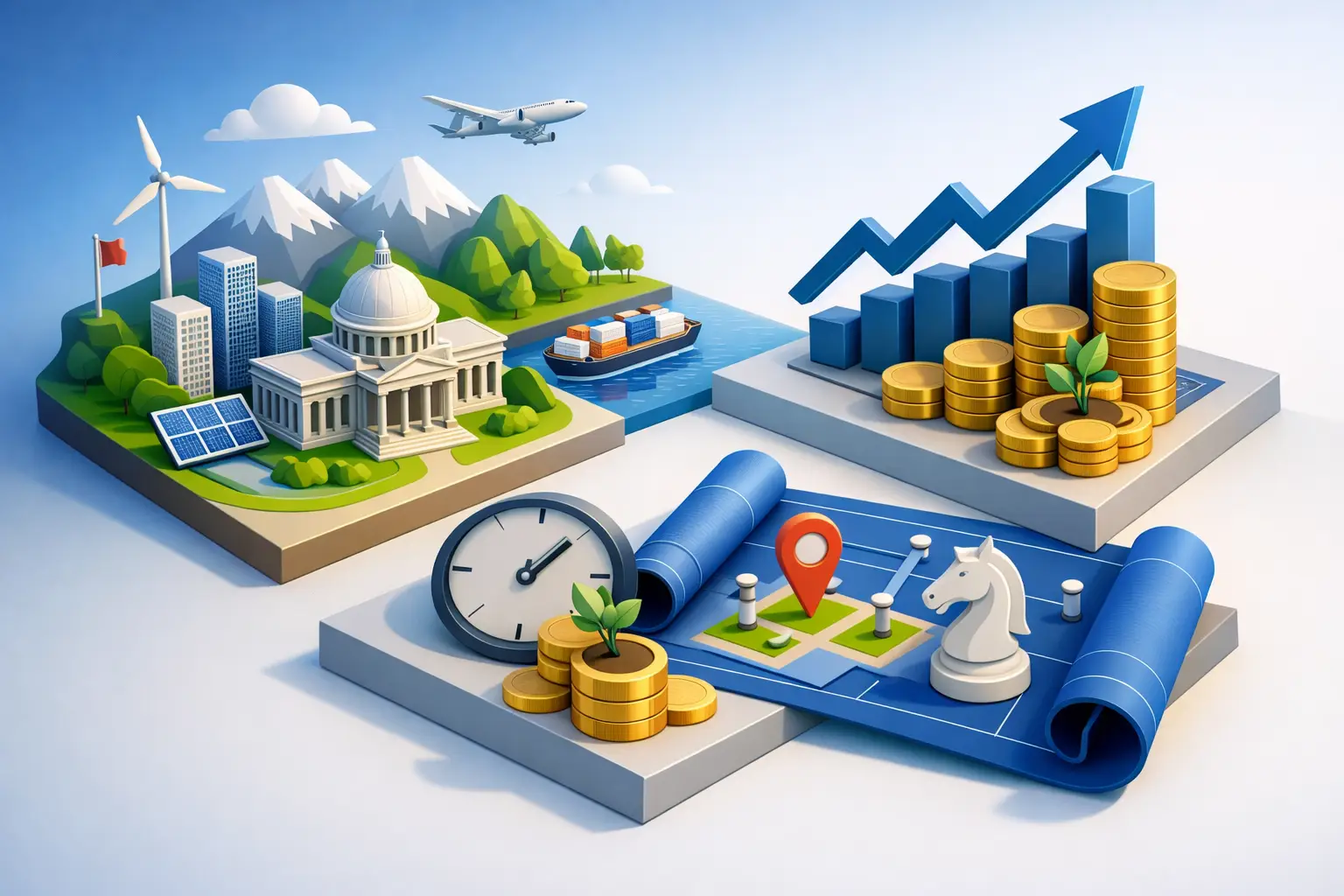
Capital rarely moves on optimism alone. Industrial capital moves when confidence can be measured – in policy continuity, infrastructure readiness, operating predictability, and a national commitment that extends beyond one business cycle. That is why investor see the stable country and long term plans as more than a comforting narrative. They see them as the foundation for lower execution risk, stronger asset performance, and a more durable path to scale.
For manufacturers, institutional investors, and advanced technology firms, this matters even more. A consumer brand can test a market with limited exposure. A semiconductor supplier, EV component producer, hydrogen mobility venture, or aerospace-adjacent manufacturer cannot. These businesses commit to land, power, logistics, compliance, workforce pipelines, and multiyear capex schedules. They need a location where the rules are clear, the direction is coherent, and the public and private sectors are building toward the same horizon.
Why investors see stable countries and long-term plans first
Stability is often misunderstood as a political talking point. In industrial investment, it is an operating condition. Stable countries give investors confidence that regulations will not swing unpredictably, infrastructure investment will continue, and strategic sectors will receive sustained support rather than short-lived incentives.
Long-term planning adds a second layer of confidence. It signals that growth is being organized, not improvised. When a country aligns industrial policy, logistics, workforce development, ESG frameworks, and sector-specific infrastructure, investors can model returns with greater clarity. That does not eliminate risk, but it makes risk more intelligible.
This is especially relevant in manufacturing, where payback periods are longer and facility requirements are more specialized. A cleanroom-ready production environment, heavy power loads, multimodal access, and sector clustering are not assets that can be relocated casually. Investors need to know that the surrounding ecosystem will mature alongside the facility, not lag behind it.
Stability reduces the hidden costs of expansion
The visible cost of entering a market is only part of the equation. Land, construction, utilities, and labor are easy to compare. The harder costs to model are delay, fragmentation, permitting uncertainty, supply chain friction, and workforce churn.
Stable countries reduce these hidden costs because the business environment is easier to navigate over time. Decision-makers can plan approvals, build timelines, customer commitments, and production ramps with more confidence. That translates into fewer surprises across the life of the asset.
For industrial operators, predictability is often more valuable than headline incentives. A tax benefit can improve a spreadsheet in year one. Reliable execution protects margins in years two through fifteen. That is why serious investors do not just ask what a market offers today. They ask whether the same market will still support expansion, talent retention, and capital efficiency ten years from now.
This is one reason the UAE continues to gain strategic attention from industrial investors. The market is not simply offering access. It is offering direction. For a closer look at the geographic and commercial logic behind that shift, see Why the UAE Is Strategic for New Tech Manufacturing.
Long-term plans create investable industrial ecosystems
A country can be stable without being truly investment-ready for advanced industry. The difference lies in planning depth.
Long-term industrial plans create investable ecosystems by connecting what manufacturers actually need: land use strategy, energy capacity, logistics corridors, regulatory clarity, talent systems, supplier adjacency, and livability. When those pieces are developed in isolation, growth becomes expensive and slow. When they are planned as one system, expansion becomes easier to finance and faster to execute.
That distinction matters for sectors such as semiconductors, EVs, hydrogen mobility, and advanced materials. These industries depend on specialized inputs, controlled operating environments, and a workforce that must be recruited and retained over time. They do not thrive in disconnected industrial zones where production is separated from housing, education, healthcare, and R&D support.
The strongest long-term plans recognize that industrial competitiveness is no longer about factories alone. It is about whether the surrounding environment can support innovation, operational continuity, and a skilled workforce over decades. That is why integrated models are gaining ground. If you are evaluating how this shift is changing site selection, Future of Integrated Factory Communities offers a useful perspective.
What sophisticated investors actually look for
Investors do not reward stability in the abstract. They reward stable countries that translate ambition into infrastructure and execution.
First, they look for policy continuity. Not just favorable announcements, but a track record of following through on industrial priorities. Countries that align their economic diversification goals with manufacturing, clean technology, logistics, and innovation build stronger investor trust.
Second, they look for infrastructure that already supports industrial use cases. Port access, airport connectivity, road and rail integration, utility resilience, digital connectivity, and scalable power capacity are not secondary details. They are the operating spine of long-term industrial value. This is where many markets underperform. They promote manufacturing growth before the underlying systems are ready.
Third, investors assess whether the location can support workforce permanence. High-value manufacturing needs engineers, technicians, operators, and leadership teams who can build lives around the enterprise. If the surrounding environment cannot support families, services, education, and quality of life, labor instability becomes a recurring business problem rather than an HR issue.
Fourth, they examine sector fit. A broad industrial promise is less persuasive than targeted readiness. Investors want to know whether a location understands the technical, regulatory, and supply chain needs of their industry. A market prepared for general warehousing is not automatically prepared for semiconductor packaging, eVTOL assembly, or hydrogen systems manufacturing.
Why this matters more in the current global cycle
Industrial strategy has entered a different era. Supply chains are being redesigned around resilience, geopolitical diversification, ESG compliance, and regional access. Capital is no longer chasing only the cheapest location. It is prioritizing environments that can deliver continuity.
That is why stable countries with credible long-term plans are becoming magnets for advanced industry. They offer a practical answer to several pressures at once: de-risking concentration, shortening routes to growth markets, improving compliance alignment, and creating more reliable operating conditions.
There is still a trade-off. Stable markets are not always the lowest-cost markets on paper. Some emerging locations may promise lower labor or land costs. But if those savings are offset by infrastructure gaps, slower approvals, talent shortages, or policy inconsistency, the advantage weakens quickly. Sophisticated investors understand this. They compare total operating confidence, not just entry price.
In the Middle East, that lens is especially important. The region is not being evaluated only as a sales market anymore. It is being evaluated as a production base, a logistics platform, and a strategic bridge across Europe, Africa, and Asia. That shift rewards countries and projects that are planned with industrial depth rather than speculative speed.
Stable countries signal seriousness to global manufacturers
Global manufacturers do not scale into uncertainty unless the upside is extraordinary. Most prefer locations that send clear signals: we know which sectors we are building for, we are investing ahead of demand, and we are creating conditions that support long-duration industrial growth.
That signaling effect matters in boardrooms. It shapes whether a location is viewed as opportunistic or strategic. Stable countries with visible long-term plans are easier to defend internally because the case is not based on sentiment. It is based on operational logic.
This is where ecosystem design becomes decisive. Industrial platforms that combine production space with logistics, utilities, R&D capability, and community infrastructure are more aligned with how manufacturers now evaluate expansion. The question is no longer just, Can we build here? It is, Can we scale here without rebuilding our assumptions every three years?
For investors considering the UAE, the answer increasingly depends on infrastructure quality and integrated planning. Why World-Class Infrastructure and Power Matter and Why Rail, Road, Port and Airport Connectivity Matter both speak directly to the operational conditions that make long-term industrial investment more credible.
The real signal behind investor confidence
When investors choose stable countries with long-term plans, they are not choosing comfort. They are choosing compounding advantage. Predictable regulation supports financing. Infrastructure readiness shortens time to market. Sector alignment improves cluster effects. Integrated communities support labor stability. Over time, these advantages reinforce one another.
That is the difference between a market that attracts transactions and one that attracts industrial permanence. The first can fill plots. The second can build a manufacturing future.
For ecosystem builders such as Rana Group, this is the strategic center of the opportunity. Industrial growth is strongest where national ambition, infrastructure planning, and investor logic point in the same direction. When they do, capital does not just arrive. It stays, expands, and builds the next phase of economic value.
The smartest investors are not asking where the excitement is loudest. They are asking where the long view is already under construction.
