
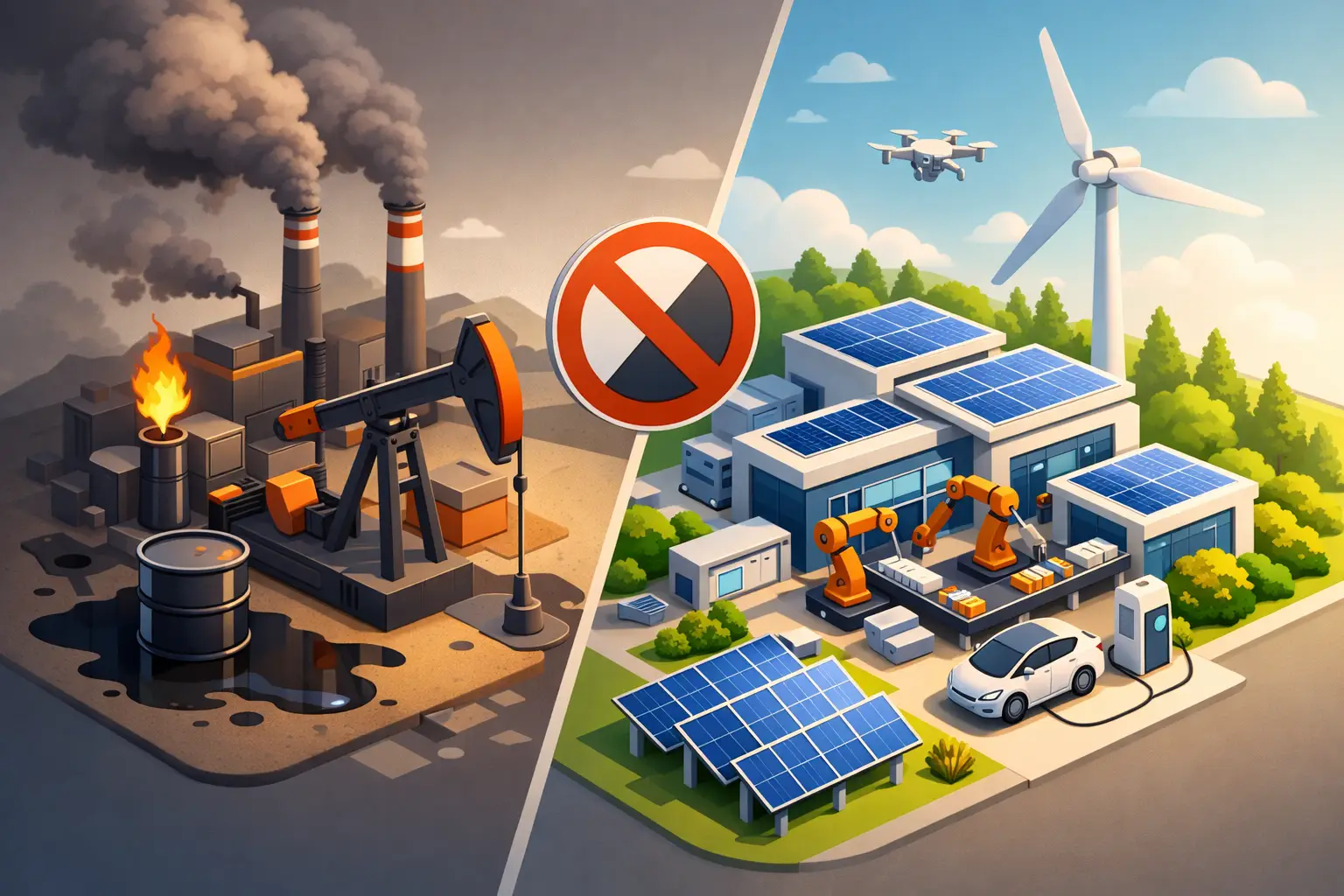
Industrial platforms that plan for the next 30 years cannot be built around yesterday’s energy logic. That is the real answer to why Erisha Smart Manufacturing Hub is not allowing fossil fuel based technology companies. This is not a branding exercise or a symbolic ESG gesture. It is a strategic operating model designed to protect asset value, attract future-facing manufacturers, align with policy direction, and create an industrial ecosystem that remains competitive as capital, regulation, and customer demand move decisively toward low-carbon production.
For investors and advanced manufacturers, the question is not whether the transition is happening. The question is where to place capital so that infrastructure, tenant mix, and long-term compliance work in your favor instead of against you. Erisha Smart Manufacturing Hub has taken a clear position: sectors built on fossil fuel dependency create structural drag inside a next-generation manufacturing environment.
Why Erisha Smart Manufacturing Hub is not allowing fossil fuel based technology companies
A serious industrial hub is shaped by compounding effects. One tenant profile influences the next. One infrastructure choice determines utility demand, permitting complexity, emissions profile, insurance risk, and financing options across the whole development. Once a hub opens the door to fossil fuel based technology companies, it does not just add one category of tenant. It imports a chain of long-term constraints.
That matters because Erisha Smart Manufacturing Hub is built as an integrated ecosystem, not a conventional industrial park. It combines advanced manufacturing space with logistics, R&D potential, workforce-supportive amenities, and sector-specific infrastructure for industries such as EVs, hydrogen mobility, semiconductors, renewable energy, and aerospace-adjacent manufacturing. In that environment, fossil fuel dependent operations create misalignment at the platform level.
The issue is not ideology. It is system design. If the destination is a clean-tech, precision-manufacturing, high-value industrial cluster, then tenant selection has to reinforce that destination from the beginning.
The tenant mix defines the hub’s future value
Industrial real estate is no longer judged only by land, sheds, and utility connections. Sophisticated occupiers evaluate who their neighbors are, what the energy profile of the site looks like, whether the ecosystem supports talent retention, and how the location will be perceived by regulators, institutional capital, and global customers.
A mixed tenant base that includes fossil fuel based technology companies can weaken the strategic clarity of the hub. It complicates ESG positioning. It can discourage clean-tech manufacturers that want a like-minded industrial cluster. It can also create hesitation among multinational firms that need to report Scope emissions, maintain green procurement standards, or secure board approval for long-duration expansion commitments.
By excluding fossil fuel based technology companies, the hub protects its identity as a destination for next-generation production. That clarity matters. Capital is more likely to move into platforms with a defined industrial thesis than into sites trying to serve incompatible sectors at the same time.
This logic is closely tied to broader market positioning. As discussed in Why the UAE Is Strategic for New Tech Manufacturing, future industrial growth increasingly favors locations that can support technology-led production with policy alignment and export relevance. A hub that wants to lead in that environment cannot dilute its proposition.
ESG compliance is no longer optional infrastructure
Many developers still treat sustainability as a layer added after the core industrial model is designed. That approach is already outdated. For institutional investors, OEMs, global suppliers, and advanced manufacturing tenants, ESG compliance is becoming embedded in site selection, financing, procurement, and reporting.
That changes how industrial hubs must think. Allowing fossil fuel based technology companies may generate short-term occupancy, but it can weaken long-term access to premium tenants and strategic capital. Banks, funds, and multinational boards are paying closer attention to carbon exposure, transition risk, and the quality of industrial ecosystems they back.
An ESG-compliant manufacturing environment has to be credible at the tenant level, not just in the master plan brochure. If a hub claims to support clean industry while hosting fossil-dependent industrial models, the market sees the contradiction immediately.
That is one reason the exclusion policy is commercially rational. It protects the trustworthiness of the platform. It also supports the kind of first-mover positioning that matters in emerging industrial corridors, especially where countries are competing to attract advanced manufacturing flows. There is a related argument in UAE Needs More ESG-Compliant Industries, which points to a wider structural need rather than a narrow sustainability preference.
Infrastructure planning works better when energy direction is clear
Infrastructure efficiency improves when a hub knows exactly what kinds of industries it is building for. Advanced manufacturing tenants in semiconductors, EVs, hydrogen mobility, battery systems, renewable components, and eVTOL supply chains have specific requirements around power quality, cleanroom readiness, logistics, digital monitoring, safety design, and environmental controls.
Fossil fuel based technology companies often bring a very different operating profile. Their utility loads, storage risks, process emissions, transport patterns, and compliance frameworks can require parallel infrastructure logic. That creates friction in planning and cost allocation. Instead of optimizing for the industries of the future, the hub ends up accommodating legacy requirements that reduce efficiency for its target sectors.
A focused industrial ecosystem can allocate capital more intelligently. It can plan utilities around cleaner production pathways. It can support specialized clusters. It can develop complementary facilities that shorten ramp-up times for incoming tenants. It can also preserve land and design flexibility for sectors with stronger long-term growth trajectories.
This is especially relevant in hubs that intend to support technically demanding industries. Semiconductor Cluster Planning in the UAE illustrates how specialized infrastructure becomes more valuable when cluster strategy is disciplined from the start.
The global policy and capital cycle is moving away from fossil dependence
There is still a market for legacy energy-linked industries, and some of them will remain active for years. But long-horizon infrastructure decisions should not be based on residual demand. They should be based on where policy, capital, procurement, and industrial strategy are going.
Governments are backing cleaner mobility, energy diversification, domestic manufacturing resilience, and strategic technologies. Large buyers are under pressure to clean up supply chains. Export-oriented manufacturers must increasingly satisfy environmental standards in multiple jurisdictions. Institutional capital is favoring transition-aligned assets. Those trends do not move in a straight line, but the direction is clear.
Against that backdrop, allowing fossil fuel based technology companies into a next-generation hub introduces transition risk into the heart of the asset. Ten years from now, the wrong tenant mix can look like stranded positioning. The right tenant mix can look like disciplined foresight.
This is not about predicting the total disappearance of fossil fuels overnight. It is about understanding which industrial categories will gain policy support, attract incentives, win talent, and command stronger valuation multiples over time.
Clean-tech clustering creates network effects fossil sectors cannot
The strongest industrial hubs do not merely rent space. They create strategic density. When EV manufacturers, component suppliers, hydrogen mobility players, renewable systems producers, advanced materials firms, logistics operators, and R&D actors co-locate, they reduce transaction costs and speed up innovation.
That kind of clustering becomes harder when part of the ecosystem is built around fossil fuel based technologies. Partnerships become less natural. Shared branding weakens. Joint R&D opportunities narrow. Supply chain synergies are reduced. Even talent attraction can suffer, especially among engineers and technical professionals who prefer to work in sectors aligned with future mobility, energy transition, and advanced manufacturing.
A hub designed as a live-work-innovate environment has to think beyond tenancy. It has to consider what kind of community, employer base, and industrial identity it is creating. Clean-tech clustering supports a stronger narrative for investors, institutions, and workforce planning. Fossil-linked clustering points in the opposite direction.
That broader ecosystem model is part of what makes integrated industrial development more defensible than standard warehousing-led expansion. The idea is explored further in Future of Integrated Factory Communities, where industrial performance is tied directly to community and ecosystem design.
There are trade-offs, but the strategy is still stronger
A policy like this does involve trade-offs. It narrows the immediate pool of potential tenants. In some market cycles, fossil-linked occupiers may offer quick absorption or near-term revenue. Turning them away requires confidence in the long game.
But strategic industrial development should not optimize for the fastest lease if that lease compromises the platform. A hub that is intended to host advanced production over decades has to choose alignment over convenience. That is especially true for developments seeking to attract multinational manufacturers and strategic partners that value consistency, policy fit, and future-ready infrastructure.
There is also a practical distinction worth making. Excluding fossil fuel based technology companies does not mean excluding every company that currently operates in an economy where fossil fuels still exist. The real line is whether the company’s core technology model is anchored to fossil fuel dependence or whether it is building toward cleaner industrial value creation. That nuance matters for serious investors. Transition pathways are real, but so is the need for hard standards.
For decision-makers evaluating industrial expansion, the takeaway is straightforward. Erisha Smart Manufacturing Hub is not closing doors out of ideology. It is selecting for strategic coherence. It is building an environment where infrastructure, tenant mix, capital appeal, and national economic direction reinforce one another.
That is how future-defining industrial ecosystems are built. Not by accepting every occupier, but by choosing the ones that make the whole platform stronger.
