
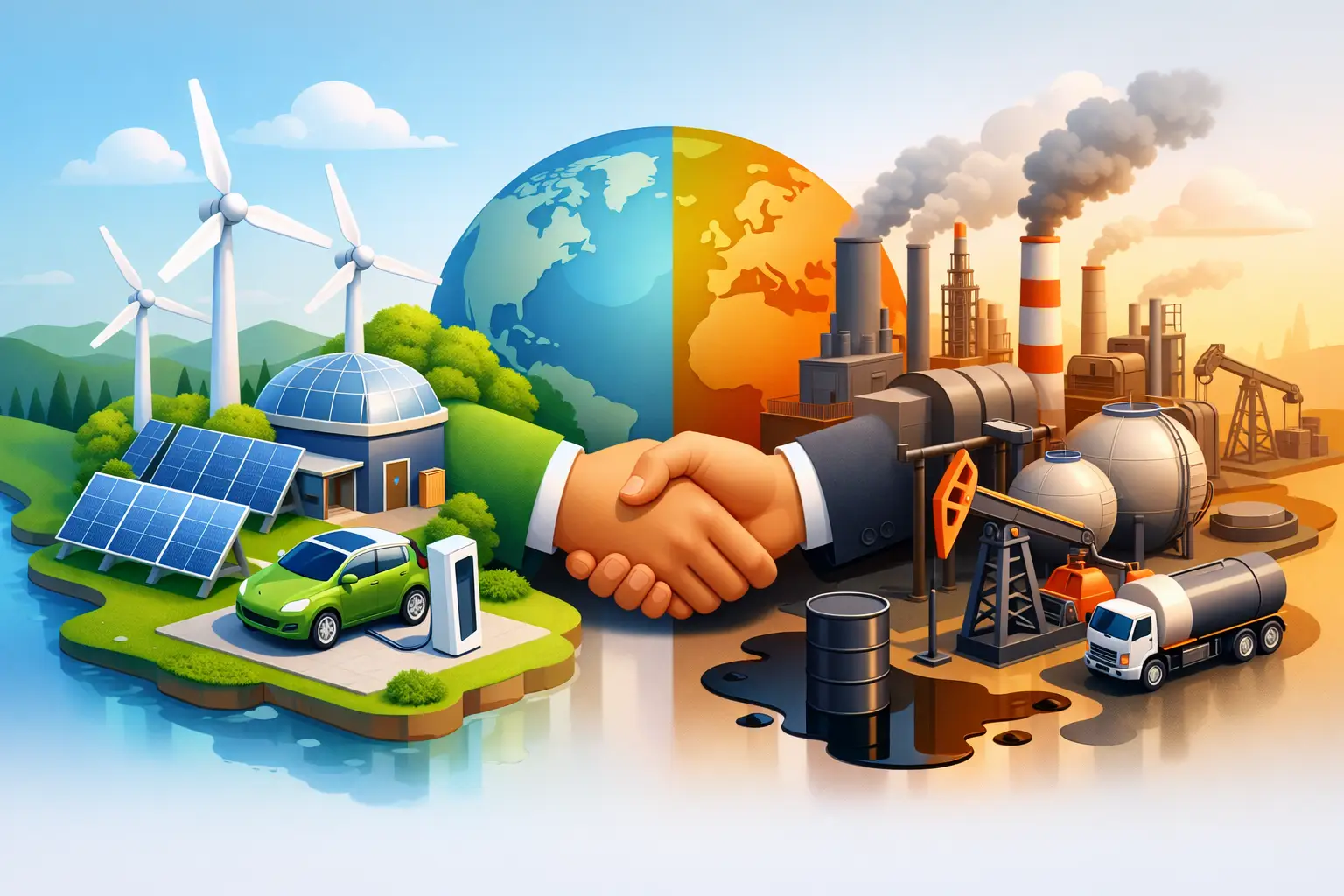

Industrial policy gets weaker when it confuses transition with exclusion. That is the real answer to why Erisha Smart Manufacturing Hub is now allowing fossil fuel based technology companies to set up industries. If the goal is to build a serious manufacturing base, attract global capital, and accelerate regional industrial capacity, the right question is not whether legacy energy-linked companies should be present. The right question is whether they can operate inside a framework that drives efficiency, compliance, emissions discipline, and long-term transformation.
For investors and manufacturers, this shift is not a retreat from sustainability. It is a move toward industrial realism. Major supply chains still depend on fossil-fuel-linked inputs, process technologies, logistics systems, thermal applications, heavy equipment, and transitional energy infrastructure. Excluding every company connected to that reality may sound principled, but it often slows localization, limits ecosystem density, and pushes industrial activity into less regulated environments.
Why Erisha Smart Manufacturing Hub is not allowing fossil fuel based technology companies
The decision reflects how modern industrial ecosystems are actually built. Large-scale manufacturing zones do not become globally relevant by serving only one narrow category of tenant. They become durable by creating sector adjacency – where advanced manufacturing, mobility, energy systems, logistics, materials processing, and industrial services can coexist under clear standards.
That matters because many companies working in cleaner industries still rely on conventional energy-linked technologies somewhere in their value chain. A battery producer may need thermal processing systems. A mobility supplier may depend on petrochemical-derived components. A heavy industry operator may be reducing emissions through carbon management, process redesign, or fuel switching, but it is not yet fully detached from fossil infrastructure. Industrial transformation happens in stages, not slogans.
For a smart hub, the stronger strategy is to shape that transition from within. Bringing these companies into a planned, ESG-compliant environment creates more leverage than leaving them outside the system. It allows infrastructure standards, reporting discipline, utility planning, land-use control, and industrial symbiosis to do what blunt exclusion cannot.
This is about transition economics, not ideological reversal
There is a difference between endorsing the old industrial model and managing the path toward the next one. Serious industrial developers understand that transition economies require both destination sectors and bridge sectors. EVs, hydrogen mobility, semiconductor manufacturing, advanced materials, aerospace-adjacent production, and renewable technologies are the future. But future sectors do not scale in isolation. They require fabrication capacity, chemical inputs, transport systems, backup power structures, industrial heat, and suppliers that often sit somewhere along the legacy-to-transition spectrum.
Allowing fossil fuel based technology companies into the ecosystem can therefore improve, not dilute, industrial readiness. The key is tenant selection. Not every company belongs in a future-facing manufacturing hub. The companies that fit are those investing in cleaner processes, emissions controls, advanced equipment, circularity, energy productivity, and regional manufacturing localization.
That distinction is essential for institutional investors. A hub that rejects industrial complexity may look clean on paper while remaining commercially shallow. A hub that accepts complexity – but governs it with discipline – is far more likely to become a long-term platform for value creation.
Strategic reasons this move makes sense for investors
The first reason is supply chain completeness. Manufacturing tenants do not choose locations based only on branding or incentives. They choose places where upstream and downstream dependencies can be solved. A hub that includes selected fossil-linked technology companies can support feedstock access, utility stability, specialized industrial services, maintenance ecosystems, and process integration. That reduces setup friction and shortens time to operation.
The second reason is capital attraction. Global industrial capital is still being deployed by companies in transition, not only by companies that have already reached net-zero maturity. Many of the largest engineering groups, process technology firms, materials manufacturers, and industrial equipment players are actively decarbonizing while still carrying exposure to conventional energy systems. Excluding them entirely would narrow the tenant universe at exactly the wrong moment.
The third reason is regional competitiveness. The UAE has positioned itself as a serious platform for industrial diversification, not a symbolic one. If industrial hubs in the region want to serve Europe, Africa, the Gulf, and Asian trade corridors, they must offer realistic operating conditions for complex manufacturers. That includes energy-intensive and transition-stage industries operating under stricter environmental and infrastructure frameworks. We addressed the broader location logic in Why the UAE Is Strategic for New Tech Manufacturing.
What changes when these companies are brought into a planned ecosystem
The biggest change is control. Unplanned industrial growth creates externalities. Planned industrial growth creates standards. Inside an integrated hub, companies can be placed in the right clusters, supported by the right utilities, and required to meet the right environmental performance thresholds. Waste streams can be managed. Logistics movements can be optimized. Workforce access can be structured around a real live-work environment rather than fragmented industrial sprawl.
That is especially important for companies in transition-heavy sectors. If they are going to modernize, they need more than land. They need a setting that supports process upgrades, compliance systems, talent retention, and access to adjacent innovation capabilities. The integrated factory-community model matters here because industrial competitiveness is no longer just about rent or power tariffs. It is about whether the location can support the full operating life of a business. That is why the long-term case for mixed-use industrial development is gaining ground, as discussed in Future of Integrated Factory Communities.
The ESG question investors will ask – and should ask
Allowing fossil fuel based technology companies into a smart manufacturing hub raises a legitimate concern. Does this weaken ESG credibility?
It can, if the model is careless. It does not have to, if the model is selective and standards-led.
ESG strength is not measured by marketing language. It is measured by how assets are planned, how tenants are screened, how utilities are managed, how emissions and waste are governed, and whether the ecosystem pushes companies toward better industrial behavior over time. An industrial hub can maintain ESG alignment while accommodating transition-stage companies if it sets non-negotiable thresholds around environmental performance, infrastructure compatibility, reporting expectations, and improvement pathways.
In many cases, bringing these firms into a disciplined environment creates a stronger ESG outcome than forcing them into lower-standard jurisdictions. This is one of the less discussed truths in industrial development. Progress is often achieved by upgrading real industry, not by pretending it can be skipped.
Why this matters in Ras Al Khaimah and the wider region
Ras Al Khaimah offers a strong industrial logic: cost efficiency, export access, investor-friendly operating conditions, and proximity to regional growth corridors. Those advantages become more powerful when paired with infrastructure that can support a broad but curated tenant mix. A future-defining hub cannot be too narrow to scale or too loose to govern. It needs industrial breadth with strategic discipline.
That is the context in which this policy choice should be understood. It is not about opening the gates to any carbon-intensive operator. It is about recognizing that industrial ecosystems serving the Middle East and global markets need a realistic transition architecture. Companies modernizing industrial heat systems, fuel efficiency technologies, advanced combustion controls, carbon management equipment, petrochemical-adjacent components, or legacy energy-linked manufacturing tools may all play a role in the next phase of regional industrial growth.
Connectivity strengthens that case further. Industrial tenants increasingly evaluate not only site readiness but also multimodal movement of goods, components, and personnel. A hub that combines internal planning with external market access becomes far more attractive to both strategic operators and financial backers. That logistics dimension is central to long-horizon decision-making, as outlined in Why Rail, Road, Port and Airport Connectivity Matter.
What sophisticated manufacturers should take from this decision
They should see it as a sign of maturity. Industrial ecosystems built for the next two decades cannot be governed by simplistic binaries. Clean tech versus conventional tech is not how real factories operate. The deeper distinction is between industries that are structurally incompatible with a future-ready manufacturing environment and industries that are part of the transition toward it.
For multinational manufacturers, the message is clear: the hub is being shaped to support real industrial scale, not just thematic positioning. For investors, the message is equally clear: a more complete ecosystem generally produces stronger occupancy, better supplier depth, greater resilience, and more defensible long-term value.
That is the strategic lens behind this decision. The future of manufacturing will not be built by isolating ideal sectors from real-world supply chains. It will be built by bringing complex industries into environments that can improve how they operate, who they connect with, and how quickly they move from legacy systems to next-generation production.
