
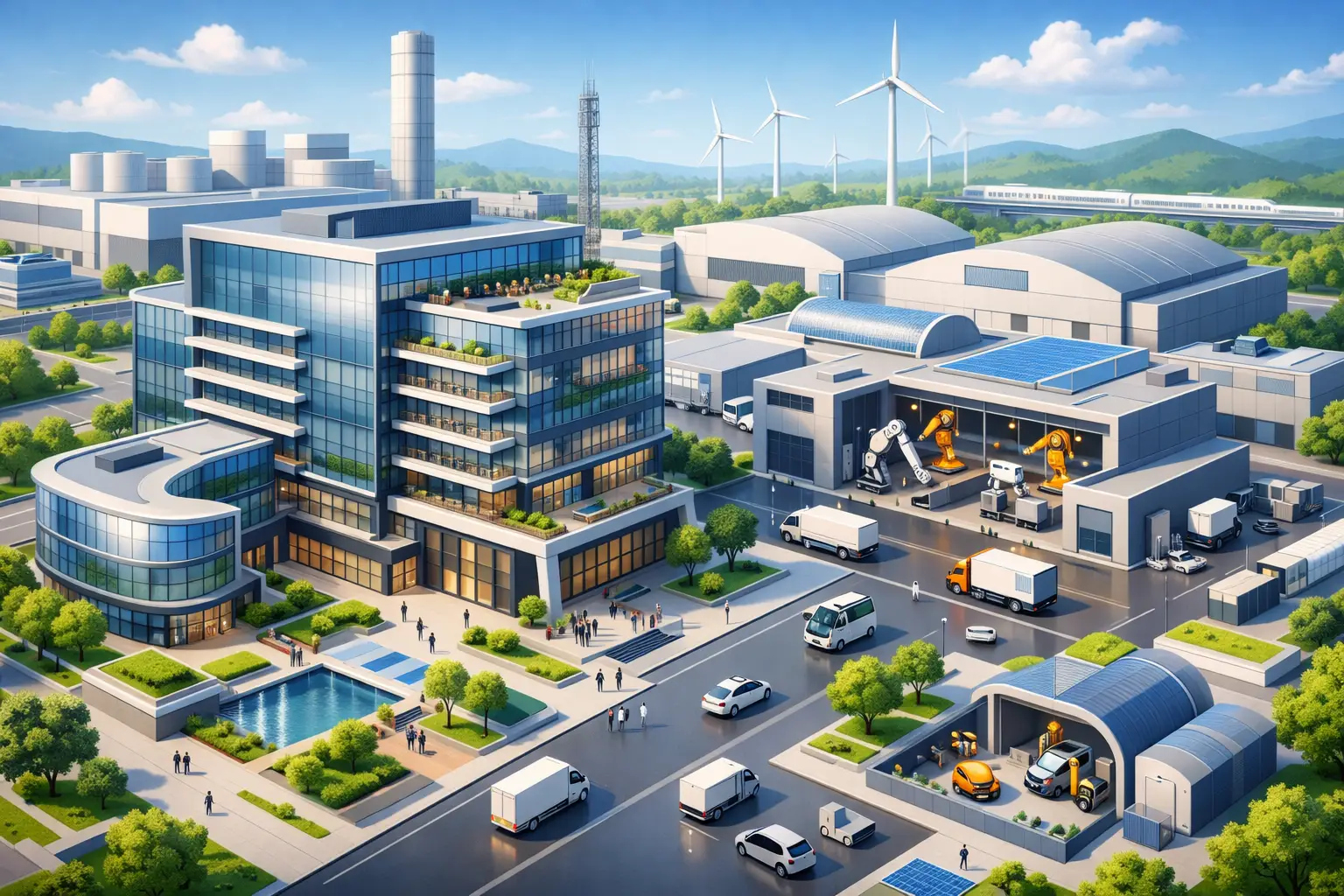
A leadership team can spot the difference within minutes. In a conventional industrial zone, the office sits apart from production, logistics, suppliers, and workforce services. Decisions slow down because the people driving strategy are physically removed from the systems that determine output. An office complex in a smart manufacturing hub changes that equation. It places executive leadership, engineering, operations, procurement, and customer-facing teams inside the same ecosystem that powers industrial growth.
For manufacturers scaling into new markets, that is not a design preference. It is an operating advantage.
Why the office matters more in advanced manufacturing
The office is often treated as support space, secondary to factories, warehouses, and utility infrastructure. That view no longer matches how high-value manufacturing works. In sectors such as EVs, semiconductors, hydrogen mobility, renewable energy, and aerospace-adjacent production, the office is where commercialization, quality control, technical collaboration, regulatory planning, and partner coordination happen.
When those functions are detached from manufacturing activity, friction builds quickly. Plant teams wait for approvals. Engineers lose time moving between sites. Customers and investors get shown isolated assets instead of a complete industrial platform. Expansion planning becomes fragmented because strategy is happening in one building while production constraints are unfolding somewhere else.
An office complex inside a start manufacturing hub, or more naturally, an office complex in a smart manufacturing hub, brings those decision cycles closer to the factory floor without forcing every team into industrial space. That balance matters. Senior management needs proximity to operations, but it also needs professional environments for governance, finance, design review, investor meetings, and strategic partnerships.
What an office complex in a smart manufacturing hub actually delivers
The value starts with speed. When leadership, technical teams, and plant operations are co-located within a master-planned industrial environment, communication shortens. Problems surface faster. Approvals move faster. New product introductions become easier to coordinate because engineering and production teams are not working across disconnected campuses.
The second advantage is credibility. For global manufacturers entering a new geography, the office is often the first point of contact for regulators, customers, suppliers, strategic partners, and institutional investors. A well-positioned office complex signals permanence, organizational maturity, and readiness to scale. It tells the market this is not a speculative footprint. It is a long-term operating base.
The third advantage is workforce performance. Advanced manufacturing requires more than machine operators. It depends on process engineers, compliance teams, supply chain planners, digital systems specialists, finance leaders, and commercial managers. Those professionals expect an environment that supports collaboration, connectivity, and access to surrounding services. If the office environment feels temporary or detached, talent retention becomes harder.
This is where integrated hubs outperform isolated industrial estates. When office space sits within a broader ecosystem that includes manufacturing, logistics, R&D, and daily-life infrastructure, employers are better positioned to attract the kind of multidisciplinary teams modern industry demands.
The shift from industrial park to industrial ecosystem
Not every office complex creates strategic value. If it is simply an administrative block beside a warehouse, the upside is limited. The real shift is happening in mixed-use industrial ecosystems designed for sector-specific growth.
In that model, office space is part of a larger industrial logic. It supports factories, cleanroom-ready facilities, testing environments, logistics corridors, supplier networks, and innovation activity. It also connects to the human side of industrial expansion – housing, healthcare, education, retail, and hospitality that help companies recruit and keep skilled employees.
That distinction matters for companies making long-horizon investments. A tenant may begin with a regional headquarters and one production line, then expand into adjacent units, specialized labs, pilot manufacturing, and full-scale output. If the office complex is embedded in a scalable hub, that growth path is easier to execute. If not, companies often end up managing multiple sites, fragmented vendor relationships, and avoidable transport inefficiencies.
Office complex in start manufacturing hub: what investors should assess
For investors and occupiers, the office component should be evaluated with the same rigor as factory space. The right question is not whether office space is available. The right question is whether the office complex strengthens industrial performance.
One factor is adjacency. How close is the office to manufacturing assets, logistics facilities, testing spaces, and decision-critical teams? Too far away and the office becomes symbolic rather than useful. Too embedded in heavy operations and it may lose the professional environment required for leadership functions and external engagement.
Another factor is flexibility. Industrial growth rarely follows a perfectly linear path. Companies may need project offices before full production, temporary space for integration teams, or regional management offices that expand alongside manufacturing phases. An office complex should support that progression rather than lock tenants into an inflexible footprint.
Infrastructure quality is equally important. Advanced manufacturers need resilient power, digital connectivity, security, transport access, and environments suitable for high-value meetings and technical collaboration. Office space in a serious industrial hub should reflect the same standards as the production facilities it supports.
Then there is ecosystem fit. A smart manufacturing hub should not place unrelated occupiers together and call it innovation. Sector clustering has real value when companies benefit from shared suppliers, talent pools, logistics synergies, regulatory familiarity, and innovation partnerships. In that context, the office complex becomes a platform for commercial acceleration, not just administration.
Why integrated office space supports capital efficiency
Expansion leaders are under pressure to reduce complexity while preserving optionality. That is one reason integrated office and industrial environments are gaining attention. They can lower coordination costs that rarely appear clearly in a lease comparison but show up in execution delays, duplicated functions, and fragmented management structures.
Consider the alternative. A manufacturer leases production space in one location, office space in another, testing capacity elsewhere, and relies on external networks for workforce amenities. On paper, that can look manageable. In practice, it often creates hidden operating drag. Travel time accumulates. Communication weakens. Site management becomes more complicated. Culture becomes harder to unify across technical and commercial teams.
An office complex in a smart manufacturing hub can reduce that drag by concentrating critical functions within one strategic environment. This does not eliminate every challenge. Cost structures, lease models, and scaling requirements still vary by company. But for businesses building regional or global manufacturing platforms, integrated environments tend to offer better operating visibility and stronger control over expansion timelines.
A better setting for customers, partners, and regulators
Manufacturing growth is not driven by production alone. It also depends on trust. Customers want confidence in delivery capability. Partners want evidence of scale and seriousness. Regulators want clarity, compliance, and long-term commitment.
That is where the office environment plays a visible role. A purpose-built office complex inside an advanced manufacturing hub creates a stronger setting for board-level meetings, supplier negotiations, technical reviews, and customer visits. Stakeholders can move from strategy rooms to operating facilities without leaving the ecosystem. They can see the relationship between management capability, industrial infrastructure, and future expansion potential.
For sectors with strict quality, safety, or certification expectations, that integrated experience matters. It reduces the gap between what a company says and what its site demonstrates.
The long view: building where the future works
The most effective industrial developments are no longer organized around land alone. They are organized around performance. That means creating environments where factories operate efficiently, talent can build careers, leadership can make faster decisions, and investors can see a credible path to scale.
An office complex is a central part of that formula when it is planned correctly. It gives manufacturing businesses a place to direct strategy while staying connected to execution. It supports the teams that translate industrial capacity into commercial growth. And it helps turn a site from a collection of buildings into a functioning economic platform.
That is the larger opportunity in places like Erisha Smart Manufacturing Hub. The goal is not simply to provide space. It is to build an environment where industrial ambition, infrastructure readiness, and long-term value creation operate from the same address.
For any manufacturer planning its next move, the better question is not whether you need office space. It is whether your office is positioned to accelerate everything your industrial platform is supposed to achieve.
