
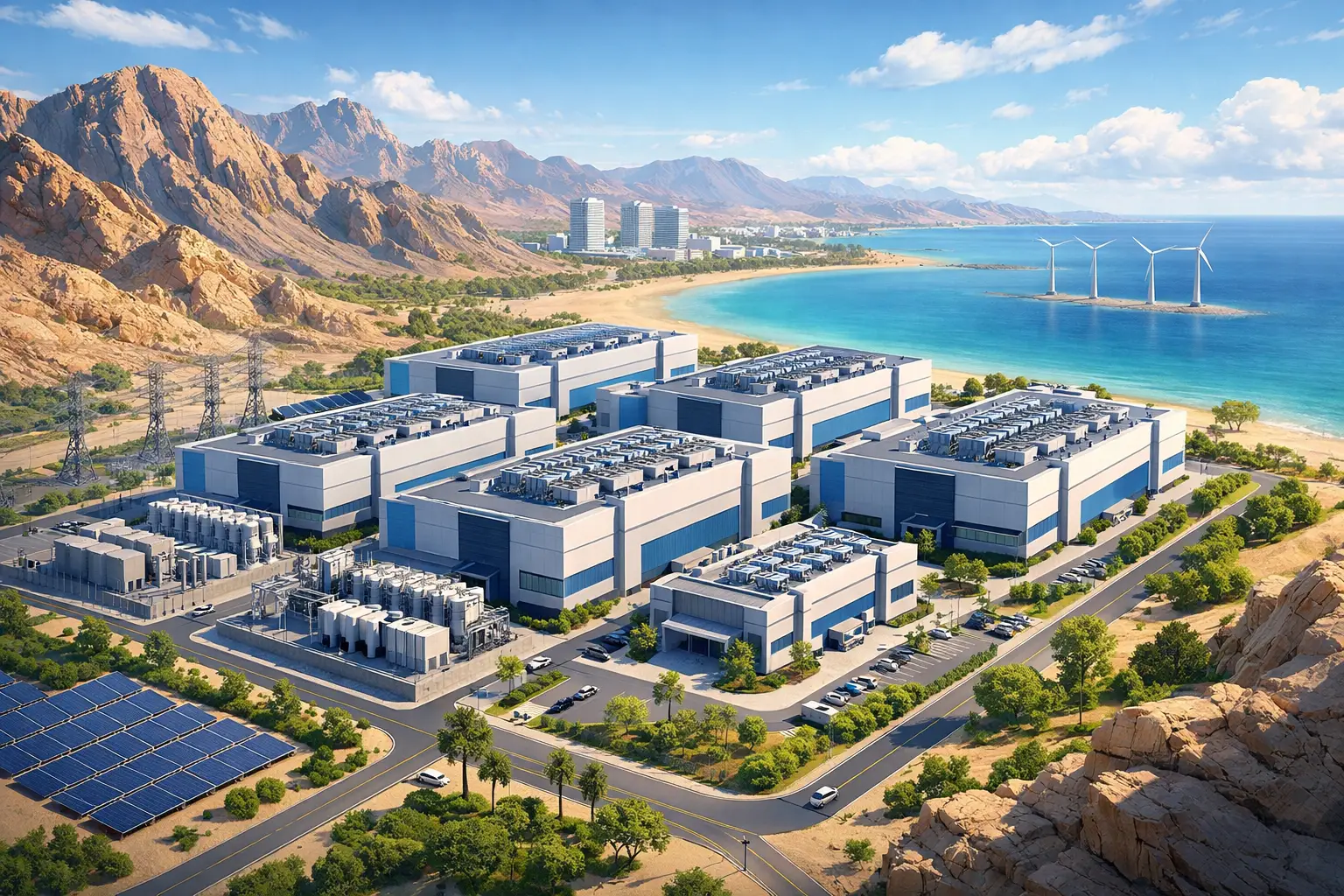
A 200 mw data center can be placed in Ras Al Khaimah as strategic location because the question is no longer whether the Gulf needs more digital capacity. It is where hyperscale-grade infrastructure can scale without running into land, energy, permitting, and operating cost constraints too early. For investors, operators, and industrial technology leaders, Ras Al Khaimah deserves serious attention.
This is not a speculative argument built on geography alone. A 200 MW deployment demands a rare combination of power planning, developable land, logistics access, regulatory practicality, and room for future ecosystem growth. Many markets can offer one or two of those conditions. Far fewer can support all of them at utility scale.
Why a 200 MW data center can be placed in Ras Al Khaimah as strategic location
At 200 MW, a data center is not a real estate play. It is a long-duration infrastructure platform. That changes the site selection logic.
A project of this size needs a location that can absorb phased development over years, not just permit a first building. It needs industrial-grade land with expansion flexibility, reliable transmission planning, road connectivity for heavy equipment, and enough policy stability to justify major capital deployment. Ras Al Khaimah enters that conversation because it combines lower operating pressure than more saturated regional hubs with direct relevance to GCC market access.
For operators serving cloud, AI, enterprise colocation, sovereign workloads, and industrial compute demand, a 200 MW campus in Ras Al Khaimah can create a useful middle ground. It offers proximity to the UAE’s commercial and industrial backbone while reducing some of the cost and congestion issues that emerge in more crowded locations.
That matters because hyperscale economics are increasingly shaped by what happens outside the server hall. Grid connection timelines, land assembly, labor housing, logistics routes, and utility resilience now influence returns as much as rack density.
Power is the first gate
No serious discussion about a 200 MW facility starts with aesthetics, incentives, or branding. It starts with power.
A campus at this scale must be planned around long-term utility availability, substation strategy, redundancy design, and staged energization. Ras Al Khaimah’s value is not that power appears automatically at 200 MW on day one. Few markets can honestly promise that. Its value is that it offers a more realistic environment for utility-aligned industrial planning, especially when the project is structured in phases.
That distinction matters. Most 200 MW projects are built in tranches. An operator might launch with 20 MW to 40 MW, secure anchor demand, then scale through successive modules as power infrastructure, customer commitments, and cooling systems expand in sync. Ras Al Khaimah is strategically relevant because this kind of phased industrial growth is more feasible in a market that still has room to plan, allocate, and build with intent.
It also fits the region’s broader direction. As AI workloads grow and digital sovereignty becomes a national priority, power-intensive digital infrastructure will increasingly sit alongside advanced manufacturing, logistics, and energy-transition assets. That convergence favors locations that think like industrial platforms, not just office-driven digital markets.
Land availability changes the economics
A 200 MW data center campus needs more than a plot. It needs a controllable development envelope.
That means room for data halls, substations, backup systems, water or alternative cooling infrastructure, secure perimeter setbacks, staging areas, and future expansion parcels. In land-constrained urban markets, those requirements quickly inflate acquisition costs and complicate design. In a strategically planned industrial environment, the economics improve.
Ras Al Khaimah’s advantage is that large-format industrial development is part of its identity. For data center investors, that translates into a practical benefit: a better chance of building a campus as a campus rather than a compromised sequence of disconnected facilities.
This has downstream value. A well-planned site lowers the cost of future phases, improves mechanical and electrical standardization, and makes it easier to respond to customer demand without redesigning the entire operating model. For hyperscale and wholesale colocation players, that flexibility is often worth more than a short-term headline incentive.
Operating costs matter more at 200 MW
At smaller sizes, location premiums can be absorbed. At 200 MW, every recurring cost line becomes material.
Land pricing, labor support, contractor access, security, fleet movement, accommodation ecosystems, and maintenance logistics all affect total cost of operation. Ras Al Khaimah has strategic weight because it can support a lower-cost operating environment than many high-profile urban alternatives in the region while still keeping operators connected to the UAE market and GCC demand corridors.
This is especially relevant for tenants whose economics depend on long-duration compute contracts. AI training, cloud zones, enterprise disaster recovery, and industrial data processing all require predictable operating structures. If a location offers prestige but creates cost drag across utilities, construction, staffing, and expansion, the long-term model weakens.
By contrast, a market that supports industrial-scale execution with more cost discipline can improve project bankability. That is the kind of advantage boards and infrastructure funds pay attention to.
Logistics and access are not secondary issues
Data centers are digital assets, but they are built through physical supply chains.
Transformers, switchgear, cooling equipment, generators, batteries, steel, fire suppression systems, and IT hardware must all arrive on time, in sequence, and at scale. Port access, road connectivity, customs efficiency, and proximity to regional transport networks therefore matter from the first day of construction through every refresh cycle after commissioning.
Ras Al Khaimah’s industrial logic supports this well. Its connectivity to UAE and GCC markets strengthens both construction logistics and ongoing operational support. For multinational operators, that means fewer blind spots between site selection and real delivery capability.
There is also a less obvious benefit. Locations built around industrial and export activity tend to understand heavy infrastructure better than purely commercial zones do. That administrative familiarity can shorten the distance between concept approval and executable build-out.
The right ecosystem can de-risk the asset
A 200 MW data center does not exist in isolation. It performs better inside a wider ecosystem that can support workforce needs, supplier presence, technical services, and adjacent demand generation.
This is where Ras Al Khaimah becomes more than an alternative site. In the right master-planned industrial setting, data infrastructure can sit alongside advanced manufacturing, semiconductor-ready facilities, logistics operations, and clean-tech tenants that generate high-value digital demand. That creates a stronger local case for low-latency compute, edge processing, industrial AI, and secure enterprise hosting.
For strategic developers like Rana Group, the opportunity is larger than a single asset class. The future belongs to integrated environments where production, R&D, logistics, and digital infrastructure reinforce each other. A data center in that context is not just a utility-intensive building. It becomes part of the operating backbone for a next-generation industrial economy.
Risks and trade-offs investors should weigh
Strategic location does not mean automatic execution. A 200 MW project in Ras Al Khaimah still requires disciplined due diligence.
The first question is utility certainty. Investors need clarity on grid capacity, upgrade timelines, redundancy pathways, and the commercial structure of power delivery. The second is customer strategy. A 200 MW campus should not be built on generic optimism. It needs a demand model tied to real cloud, AI, enterprise, or sovereign workloads.
Cooling strategy is another variable. The Gulf climate requires precise thinking on energy efficiency, water use, and technology selection. There is no one-size-fits-all answer. Air-cooled, hybrid, and liquid-cooling-ready designs each carry different capital and operational implications.
Regulatory alignment also matters. Data governance, permitting sequence, security requirements, and telecom interconnection frameworks must support the intended customer base. For some operators, especially those serving regulated sectors, this can be as important as land and power.
None of these issues weaken the Ras Al Khaimah case. They simply separate strategic intent from investable execution.
Who should be looking at Ras Al Khaimah now
The strongest fit is not every data center operator. It is the group thinking beyond a single building.
Hyperscalers evaluating regional expansion, wholesale colocation providers seeking a scalable UAE base, infrastructure funds targeting long-life digital assets, and industrial technology players with growing compute demand all have reason to assess Ras Al Khaimah closely. The location is particularly compelling for organizations that value phased growth, industrial adjacency, and lower long-term operating friction.
It is also relevant to advanced manufacturing ecosystems. As factories become more automated and AI-led, the distinction between industrial infrastructure and digital infrastructure keeps shrinking. Places that can host both at scale will gain an enduring advantage.
That is the larger strategic point. A 200 MW data center is not just about racks and megawatts. It is about choosing the market where digital capacity, industrial growth, and infrastructure economics can move in the same direction. Ras Al Khaimah has the ingredients to make that case credible, and credibility is where serious projects begin.
