
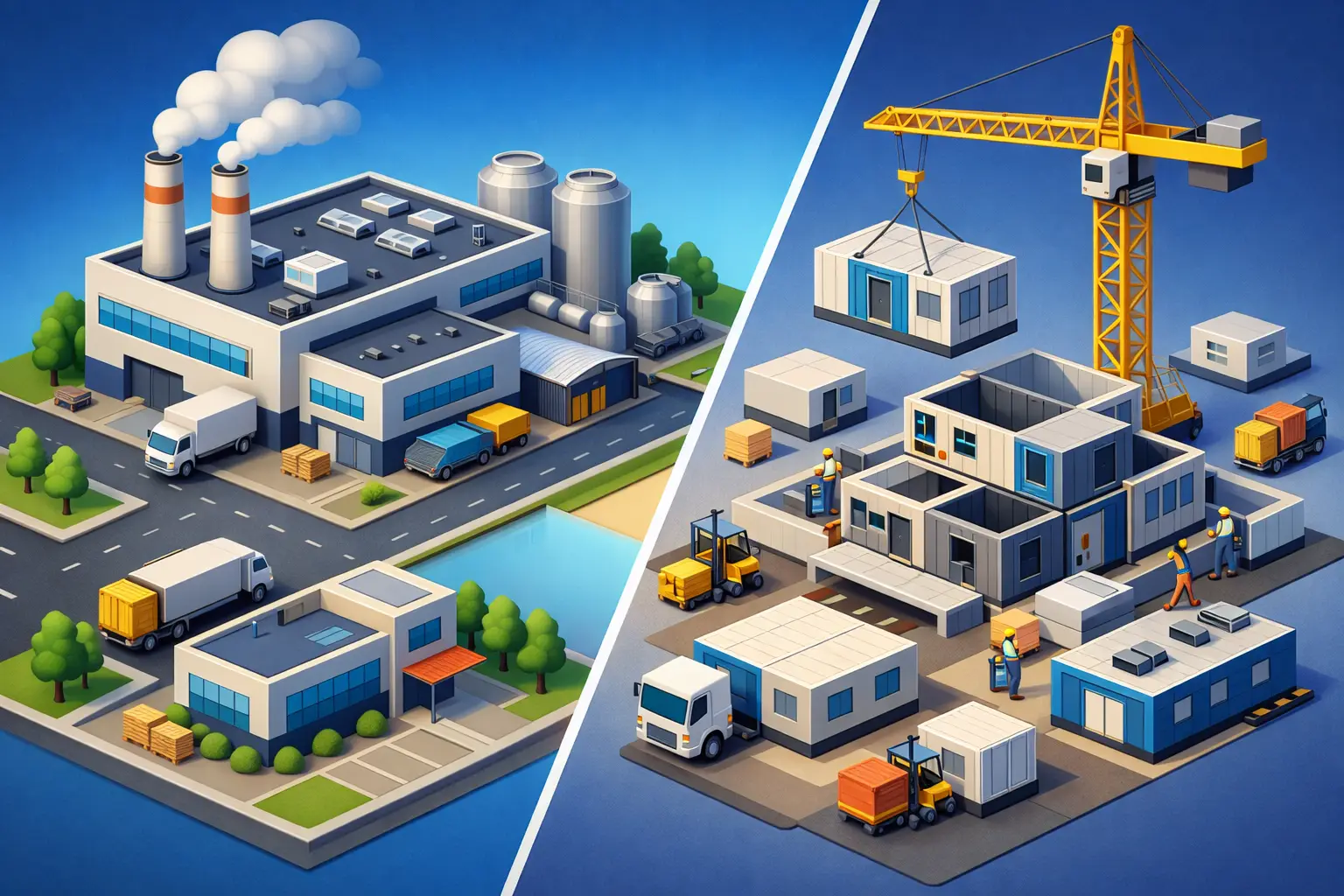
The wrong factory decision can slow market entry, strain capital, and lock a business into the wrong operating model for years. That is why the Build To Suit Vs Modular Factories debate matters far beyond real estate. For industrial leaders planning expansion, this is a strategic decision about speed, control, risk, and long-term competitiveness.
Both models can support advanced manufacturing. Both can be financially attractive in the right context. But they solve different problems. A company launching a precision electronics line, a hydrogen systems assembly operation, or an EV components plant should not evaluate these options through a generic property lens. The real question is which model supports production requirements, regulatory obligations, workforce needs, and future scaling with the least friction.
What Build To Suit Vs Modular Factories really means
Build-to-suit factories are designed and developed around a specific occupier’s operational brief. The facility is configured for the production process, utility load, compliance requirements, circulation patterns, storage needs, and future expansion assumptions of a particular manufacturer. This can include everything from heavy floor loading and crane systems to cleanroom readiness, controlled environments, hazardous material zoning, or specialized logistics yards.
Modular factories, by contrast, are delivered through standardized or semi-standardized industrial units that can be deployed faster and configured within a more defined framework. They are not necessarily low quality or simplistic. In many industrial ecosystems, modular units are increasingly sophisticated and well suited for light manufacturing, assembly, pilot production, warehousing, or phased growth. Their value comes from repeatability, reduced development timelines, and lower upfront complexity.
The distinction is not custom versus capable. It is precision versus speed, and in many cases, commitment versus optionality.
When build-to-suit creates stronger long-term value
Build-to-suit is often the better choice when manufacturing requirements are difficult to retrofit into a standard shell. If a facility needs highly specific power density, process cooling, clean utilities, vibration control, compartmentalized production zones, or specialized environmental controls, designing from the outset usually produces better operational outcomes than adapting a modular footprint later.
For multinational manufacturers, build-to-suit also supports strategic consistency. It allows a business to replicate global production standards, internal EH&S protocols, automation layouts, and quality systems in a new market without compromising around the limitations of an existing unit. That matters when uptime, certification, and yield have direct implications for enterprise value.
There is also a stronger case for build-to-suit when the factory itself is part of the competitive advantage. In sectors such as semiconductors, advanced mobility, battery systems, aerospace-adjacent manufacturing, and renewable energy equipment, the facility is not just a container for operations. It is part of process control, compliance, and brand credibility.
The trade-off is obvious. Build-to-suit takes longer to plan, approve, and deliver. It often requires deeper coordination across engineering, operations, compliance, and finance teams. Depending on the deal structure, it can also involve a higher level of long-term commitment. For companies still testing demand or refining their regional strategy, that commitment may feel premature.
Where modular factories outperform
Modular factories are powerful when speed is the priority. If a business needs to enter a market quickly, start assembly operations, localize part of a supply chain, or create an initial regional production base, modular space can remove months from the deployment timeline.
That speed is not only about construction. It reduces decision drag. Standardized units usually come with known specifications, simpler planning assumptions, and a clearer path to occupancy. For operations directors under pressure to launch production, that can be the difference between capturing market demand and missing it.
Modular factories also preserve flexibility. Companies can begin with a smaller footprint, validate local demand, assess labor availability, and expand in phases rather than overcommitting from day one. In uncertain sectors or fast-moving technologies, that phased approach can be financially smarter than building a large bespoke facility too early.
This model works particularly well for light industrial users, component assembly, contract manufacturing, R&D-linked production, and companies creating a beachhead in a new geography. It can also suit firms that expect product mix to evolve quickly and do not want to design around a production model that may change within three years.
The limits appear when process complexity rises. The more specialized the operation, the more likely it is that a modular unit will need costly adaptation or operational compromise. What looks cheaper at entry can become expensive over time if the building constrains output, automation, or compliance.
Cost is more nuanced than rental rate
Many executives approach this decision through headline occupancy cost. That is too narrow. The real comparison should include total operating impact over the expected life of the facility.
A modular factory may have lower initial cost and faster revenue activation. Those are significant advantages. But if ceiling height restricts equipment, utilities cap throughput, loading areas create bottlenecks, or layout inefficiencies add labor steps, the operational penalty can erode those savings quickly.
Build-to-suit often demands more planning and can imply a higher long-term commitment, yet it may reduce production friction, maintenance inefficiency, compliance retrofits, and future relocation costs. For high-value manufacturing, even small gains in process flow or utility design can materially improve margin.
This is why the best decision is rarely the cheapest building. It is the facility model that supports the strongest business case over time.
Speed to market vs fit for purpose
This is the central tension in Build To Suit Vs Modular Factories. Speed matters because industrial windows do not stay open forever. Incentives change, customer demand shifts, and supply chains reconfigure fast. A company that delays market entry for the perfect building may lose its first-mover position.
At the same time, fit for purpose matters because industrial underperformance compounds. A poorly matched facility affects output, safety, quality, energy consumption, staffing efficiency, and expansion potential. Those costs are harder to see during site selection, but they become very visible once production begins.
The right answer depends on whether your current challenge is urgency or precision. If the market opportunity is immediate and operational requirements are still evolving, modular can be the more strategic move. If process stability is high and the production environment is critical to success, build-to-suit usually creates a stronger foundation.
The sectors where each model tends to win
Build-to-suit is generally stronger for advanced manufacturing operations with specialized infrastructure needs. That includes semiconductor-adjacent processes, battery systems, hydrogen technologies, aerospace components, and heavy or high-spec industrial lines where utilities, compliance, and process engineering shape the facility from day one.
Modular factories are often better aligned with electronics assembly, modular clean-tech production, warehousing with light industrial integration, aftermarket operations, pilot lines, and region-entry strategies where scalability matters more than complete customization at launch.
There is also a middle ground. Some occupiers start in modular space to establish workforce, supply chain presence, and customer access, then transition into a build-to-suit facility once volumes, process requirements, and local demand are proven. In a well-planned industrial ecosystem, that progression can be an advantage rather than a compromise.
The ecosystem question most companies overlook
A factory decision should not be isolated from the surrounding industrial environment. Even the best building underperforms if talent access is weak, logistics are fragmented, supplier proximity is poor, or daily operations are disconnected from housing, services, and R&D support.
That is where the property conversation becomes an industrial strategy conversation. A modular unit inside a strong manufacturing ecosystem may outperform a custom facility in a disconnected location. Likewise, a build-to-suit project inside a master-planned hub can create far more value because infrastructure, mobility, utilities, and future growth are already integrated into the larger platform.
For companies expanding into the Middle East, this matters significantly. Access to ports, investor-friendly regulation, scalable industrial land, and an environment that supports workforce retention can influence total project success as much as the factory model itself. Rana Group has positioned this as an ecosystem decision, not simply a site decision, which is the right frame for serious industrial occupiers.
How to choose with confidence
The best decision usually comes from five practical questions. How fixed is the production process? How quickly must operations start? What infrastructure is non-negotiable? How much demand uncertainty remains? And how likely is phased expansion over the next three to five years?
If your answers point to stable process requirements, high infrastructure specificity, and a long-term regional commitment, build-to-suit is likely the stronger path. If your priorities are speed, lower entry risk, and phased flexibility, modular may be the smarter platform.
What matters most is choosing a facility model that fits the business you are building, not the one you are imagining in abstract. Industrial growth is won by alignment – between production, infrastructure, capital, and market timing. Get that alignment right, and the factory becomes more than a place to operate. It becomes a strategic asset.
