
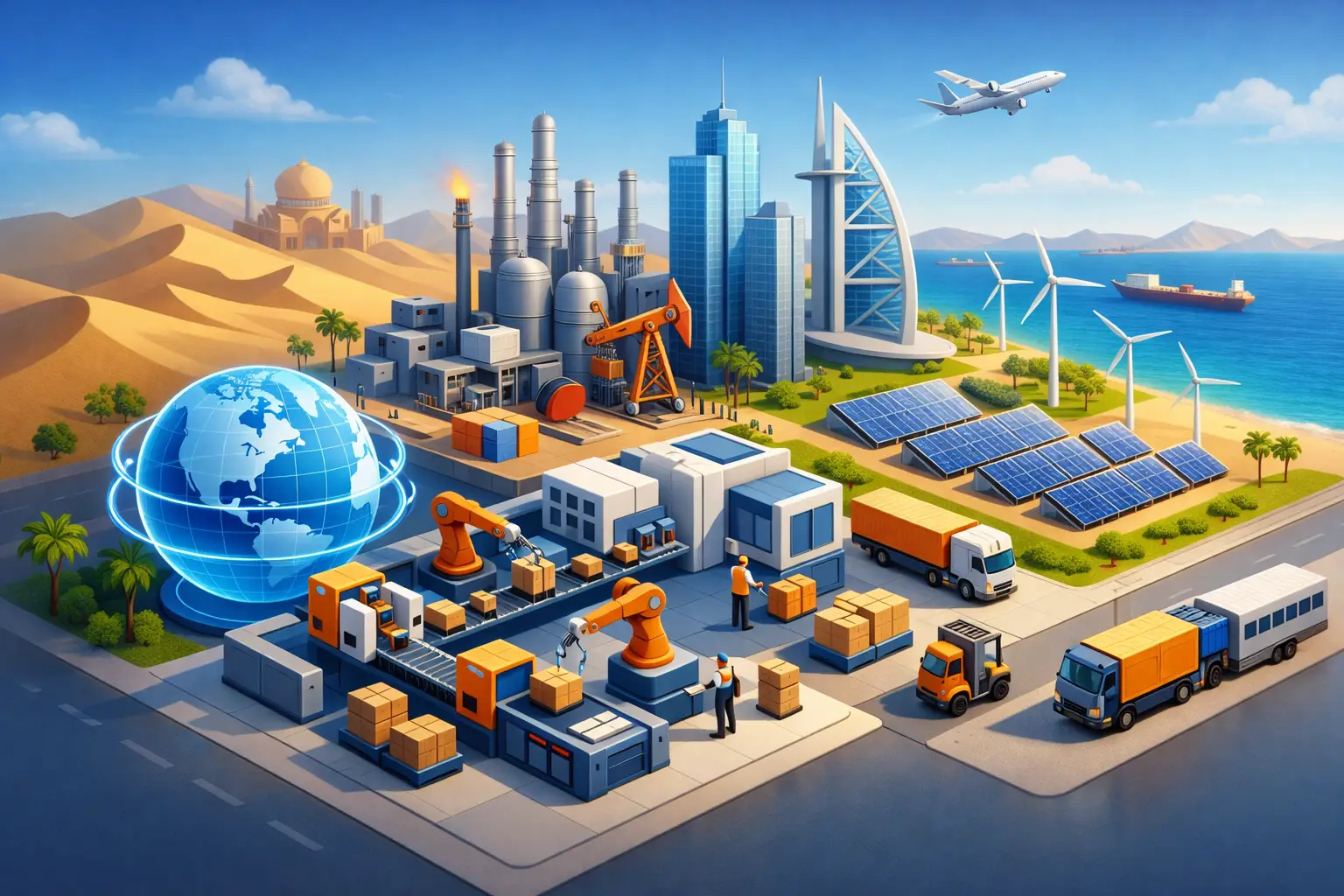
A factory launch in the Middle East can gain speed quickly or lose months before the first machine is installed. The difference usually comes down to one thing: whether your Middle East manufacturing expansion guide starts with strategy or with site tours. For advanced manufacturers, the region offers serious upside, but only if expansion is built around operating logic, not headline appeal.
This is no longer a market entered on instinct alone. The Middle East has become a contest of industrial platforms, logistics corridors, policy incentives, energy strategies, and sector-specific ecosystems. For manufacturers in EV supply chains, hydrogen mobility, semiconductors, aerospace-adjacent production, and renewable energy systems, the real question is not whether the region is attractive. It is which model of entry will still make sense five, ten, and fifteen years from now.
What this Middle East manufacturing expansion guide should solve
An expansion decision at this level is rarely about a single plant. It is about creating a regional operating base that can serve multiple markets, protect margins, and support future capacity. That makes the Middle East compelling for a different reason than it was a decade ago. It is no longer just a distribution point between East and West. In the strongest locations, it is becoming a production environment designed for high-value, export-oriented industry.
That distinction matters. If your business depends on low complexity assembly and imported labor with limited retention, one type of industrial zone may be enough. If you are building clean-tech systems, precision components, battery modules, power electronics, or cleanroom-sensitive processes, the threshold is much higher. You need infrastructure that was planned for advanced manufacturing, not retrofitted to market itself that way.
The strongest expansion plans solve five issues at once: cost structure, regulatory clarity, logistics reach, workforce sustainability, and room to scale. Most failed entries solve only one or two.
Start with sector fit, not geography alone
Executives often begin with the map. Ports, airports, and market access matter, but geography without sector fit creates expensive friction. A site can be well located and still be wrong for your production model.
The practical starting point is to define what your operation requires in year one and what it is likely to require in year five. A facility for precision electronics has a different utility profile than a hydrogen mobility component plant. An EV systems manufacturer may prioritize power reliability, modular expansion, and supplier adjacency. A renewable energy equipment producer may prioritize heavy cargo movement, laydown space, and export efficiency.
That is why industrial clustering deserves close attention. When the ecosystem is designed around sectors such as advanced mobility, semiconductors, and clean energy, expansion becomes more efficient. Service providers become more specialized. Talent pipelines become more stable. Regulatory conversations become faster because authorities are not trying to understand your industry from scratch.
The cost advantage is real, but it depends on the full operating model
Many market entry teams focus too heavily on lease rates or headline incentives. Those matter, but they are only one line in the operating model. A cheaper site can become a more expensive plant if logistics are fragmented, labor turnover is high, utilities are constrained, or expansion requires a second relocation.
A serious cost review should compare the full landed operating environment. That includes energy pricing, customs processes, transportation efficiency, build-out time, staffing costs, accommodation access, and the hidden cost of managing disconnected facilities. For many manufacturers, the biggest financial drag is not rent. It is fragmentation between factory, warehouse, staff housing, training, healthcare, and management mobility.
This is where integrated industrial ecosystems create a structural advantage. When manufacturing infrastructure is planned alongside residential, education, healthcare, retail, and R&D functions, the value is not cosmetic. It reduces operational friction, improves workforce retention, and supports continuity as production scales. That becomes especially relevant for industries competing globally for technical talent and process stability.
Infrastructure readiness is the line between ambition and output
Industrial leaders do not need another brochure promising flexibility. They need to know whether infrastructure is ready for actual throughput. Can the site support phased growth? Are utilities sized for high-value production? Is there cleanroom readiness where relevant? Can heavy logistics move efficiently? Is there room for suppliers, testing, storage, and future lines?
This is where many Middle East opportunities separate into two categories. Some are still land stories. Others are operating platforms.
The difference is decisive. Land gives you optionality. An operating platform gives you speed, predictability, and lower execution risk. For multinationals and capital-intensive manufacturers, that gap can be worth far more than an initial headline incentive. Delays in power readiness, permitting, facility customization, or logistics routing can erase the economics of expansion surprisingly fast.
The better question is not, “Can we build here?” It is, “How much uncertainty are we buying with the build?”
Regulation matters most when the business starts moving
Every jurisdiction promotes investor friendliness. The real test comes after incorporation, when equipment starts shipping, hiring begins, environmental obligations take shape, and customers need certainty on lead times.
Regulatory clarity should be assessed as an operational issue, not a legal checkbox. How predictable are approvals? How transparent are customs procedures? How straightforward is foreign ownership? How well do local authorities understand advanced industrial processes? If you are producing in sectors tied to energy transition, mobility, or electronics, policy alignment can materially improve the speed of execution.
The UAE has gained traction in this area because it combines infrastructure investment, pro-industry positioning, and a clear national focus on diversification and advanced production. That does not mean every location within the country offers the same outcome. It means buyers should evaluate where policy support and physical readiness are actually aligned.
Why location strategy is becoming more selective
Not every manufacturer needs a flagship address. Many need efficient access to ports, lower operating costs, scalable land, and a jurisdiction that will still support expansion when demand doubles. That is why secondary industrial centers are gaining credibility with serious operators.
Ras Al Khaimah is a good example of this shift. Its appeal is not based on image. It is based on economics and industrial logic: lower operating costs, access to key logistics routes, investor-friendly frameworks, and the ability to plan at scale rather than squeeze into constrained urban industrial footprints. For manufacturers that need room to grow without sacrificing connectivity, that combination is increasingly hard to ignore.
At the high end of industrial planning, the winning locations are not the loudest. They are the ones that can accommodate advanced facilities, future phases, supplier ecosystems, and workforce needs within a coherent master plan. That is where an ecosystem-led model such as Rana Group’s Erisha Smart Manufacturing Hub becomes strategically relevant – not as a real estate proposition, but as industrial infrastructure built for long-horizon growth.
ESG is no longer a side requirement
For manufacturers raising capital, supplying global OEMs, or working within regulated sectors, ESG performance now affects competitiveness. This is especially true in clean-tech, mobility, and advanced materials, where customers increasingly examine energy sourcing, reporting capability, land use, and workforce conditions.
A Middle East expansion can support ESG goals, but only if the underlying platform was designed with those standards in mind. An industrial park that treats sustainability as a marketing layer is not the same as an ecosystem planned around compliant infrastructure, efficient logistics, and livable workforce environments.
There is also a strategic angle here. The more your site supports energy efficiency, logistics consolidation, and labor retention, the more resilient your operation becomes under future reporting and procurement pressure. ESG should be read as a margin protection issue as much as a reputational one.
A smarter way to evaluate entry options
The strongest expansion teams do not ask which site looks best today. They ask which location will perform best under pressure. What happens if demand accelerates? If supplier networks need to localize? If engineers must be recruited internationally? If customers begin asking for deeper compliance data? If a second product line is added?
Those questions tend to favor industrial ecosystems over standalone facilities. They also favor locations where infrastructure, policy, logistics, and talent support have been planned together.
The Middle East is entering a new industrial chapter. For the right manufacturer, this is not just a market access play. It is a chance to build a regional production base with global relevance. But expansion rewards discipline. The best decisions will come from leaders who treat site selection as a long-term industrial architecture decision, not a procurement exercise.
Build where capacity, credibility, and future readiness already move in the same direction.

[…] matters even more for companies entering new markets. A manufacturer expanding into the Middle East, for example, is not only evaluating utility costs or customs access. It is also assessing whether […]