
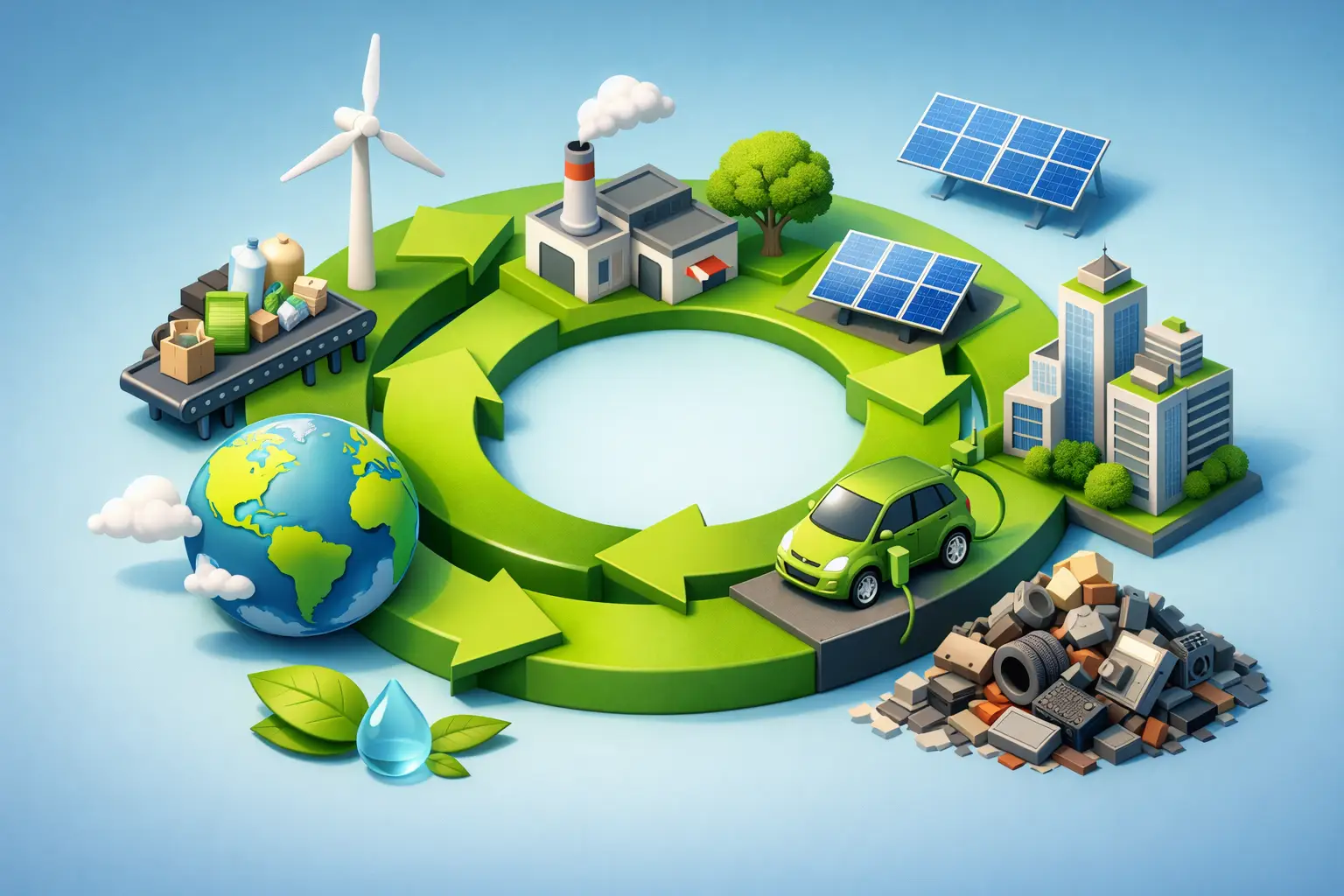
Industrial growth is entering a new era. The old model – extract, produce, consume, discard – is becoming economically weaker by the year. Energy volatility, carbon regulation, raw material pressure, and investor scrutiny are forcing manufacturers to rethink how value is created and protected. That is where circular economy through green energy and why its important becomes a serious strategic question, not a branding exercise.
For industrial leaders, this is no longer about adding a sustainability layer to a conventional operating model. It is about redesigning production systems so energy, materials, water, and infrastructure stay in productive use for longer, at lower cost, and with less exposure to external shocks. The companies that move early are not simply reducing emissions. They are building stronger industrial economics.
What circular economy through green energy really means
A circular economy is often reduced to recycling. That misses the point. In industrial terms, circularity means designing out waste, recovering value from byproducts, extending asset life, and keeping materials in circulation at the highest possible utility.
Green energy changes the equation because it removes one of the largest hidden inefficiencies in manufacturing: dependence on fossil-based power systems that are exposed to price instability, carbon costs, and infrastructure constraints. When renewable power, energy storage, smart grids, waste-to-value systems, and electrified industrial processes are integrated into the operating environment, circularity becomes more practical and more profitable.
This matters especially in advanced manufacturing. Sectors such as electric vehicles, hydrogen mobility, semiconductors, aerospace-adjacent production, and renewable energy equipment manufacturing depend on precision, resilience, and long planning horizons. They cannot afford waste-heavy systems with unstable energy inputs.
A circular model powered by green energy does three things at once. It lowers operational friction, reduces environmental impact, and improves long-term asset performance. That is why forward-looking industrial ecosystems are now being planned around both resource circularity and clean power from the start.
Why this matters to investors and manufacturers
The most important reason is simple: linear industrial systems are getting more expensive to run.
Energy is now a strategic variable, not just a utility bill. Manufacturers face rising expectations around emissions reporting, embodied carbon, supplier transparency, and resource productivity. At the same time, supply chains remain vulnerable to disruption, from commodity shortages to geopolitical shifts. A circular energy model helps address all of those pressures in one framework.
For investors, this improves the quality of industrial assets. Facilities designed to operate with renewable energy integration, heat recovery, material reuse, water efficiency, and flexible utility systems are better positioned for future regulation and tenant demand. They are not just compliant today. They are more likely to remain competitive over the next decade.
For operators, the upside is practical. Lower energy costs, more stable production planning, reduced waste disposal fees, and better recovery of valuable inputs all contribute to margin protection. In energy-intensive sectors, even moderate gains in efficiency and resource recovery can have a major effect on total operating cost.
There is also a market signal here. Customers, governments, and capital providers increasingly favor manufacturers that can prove cleaner production and stronger lifecycle accountability. Circularity supported by green energy is becoming part of industrial credibility.
The shift from isolated factories to integrated ecosystems
Circularity is difficult to scale in isolation. A single factory can improve efficiency, install rooftop solar, electrify some equipment, and reduce waste. But the larger gains usually come from ecosystem design.
When industrial facilities are clustered in a master-planned environment, energy and material flows can be managed across multiple users. Waste heat from one operation can support another. Shared renewable energy infrastructure can improve economics. Logistics can be optimized to reduce transport emissions and cost. Water treatment and reuse systems can serve an entire industrial district rather than one site at a time.
This is where next-generation industrial hubs have a structural advantage. They can embed circular logic into land planning, infrastructure design, utility networks, workforce support, and sector clustering. That creates conditions where sustainability is not an added burden on tenants. It becomes part of the operating platform.
For manufacturers entering new markets or expanding production, that distinction matters. A conventional industrial park may offer land and power. A future-ready industrial ecosystem offers operational alignment with where global manufacturing is heading.
Circular economy through green energy in practice
The concept becomes real when it changes how factories are built and run.
A renewable energy manufacturer, for example, may source clean electricity from on-site solar supported by battery storage, reducing dependence on peak-priced grid power. Production scrap can be recovered and reprocessed rather than discarded. Packaging systems can be standardized for reuse across suppliers. Smart energy management can shift non-critical loads to lower-cost periods. Water used in cooling or cleaning can be treated and cycled back into operations.
In an EV or battery-related cluster, circularity may also include second-life use of battery systems for stationary storage, localized recycling of critical materials, and electrified logistics within the industrial zone. In semiconductor or precision manufacturing, the focus may lean more heavily toward ultra-efficient cleanroom energy systems, water recirculation, and recovery of high-value materials from process waste.
Not every industrial process can become fully circular, and not every site can run on 100 percent green power immediately. That is the trade-off serious operators understand. The goal is not perfection on day one. The goal is measurable improvement built into infrastructure, procurement, and production planning.
Why green energy is the enabler, not just the headline
Many circular economy conversations focus on materials and forget energy. That is a mistake.
Energy sits at the center of manufacturing performance. It shapes cost structures, emissions profiles, equipment choices, and even site selection. If energy remains carbon-intensive, volatile, and disconnected from the rest of the production system, circular initiatives can only go so far.
Green energy strengthens circularity in several ways. It makes electrification more valuable. It supports decentralized production models. It improves the business case for digital optimization. And it allows waste recovery systems, storage infrastructure, and smart utilities to operate in a cleaner and more coordinated way.
It also changes risk exposure. Manufacturers with access to diversified renewable energy systems are less vulnerable to fuel price swings and future carbon penalties. That resilience matters for long-term contracts, export competitiveness, and board-level planning.
For industrial developments built around advanced sectors, green energy is not a symbolic feature. It is part of the core operating logic.
The policy and market context is moving fast
Global industry is not waiting. Governments are tying industrial growth to decarbonization. Procurement standards are becoming stricter. Financial institutions are applying deeper ESG screens. Major manufacturers are pushing sustainability expectations down through their supplier networks.
In the Gulf and broader Middle East, this shift is especially significant. Countries are investing in energy transition, industrial diversification, and high-value manufacturing as part of long-term national economic strategy. Businesses that align with these priorities will be better positioned to access incentives, partnerships, and growth opportunities.
That is one reason integrated industrial platforms are gaining traction. They meet market demand for scale and efficiency, but they also answer a policy need: how to build industrial capacity that is globally competitive, lower-carbon, and resilient by design. In that context, ecosystem developers such as Rana Group are not simply delivering real estate. They are shaping the physical framework for future industrial performance.
What decision-makers should assess now
For executives evaluating expansion or relocation, the question is not whether circularity and green energy matter. The question is how deeply those principles are embedded in the operating environment.
A useful test is to look beyond headline claims. Can the site support renewable integration at scale? Are utility systems designed for efficiency, recovery, and future upgrades? Is there sector clustering that creates synergies in materials, logistics, and talent? Does the surrounding environment support workforce retention and business continuity? Are ESG goals easier to achieve because the infrastructure was planned that way from the beginning?
These factors influence more than sustainability reporting. They shape occupancy cost, speed to operation, investor confidence, and the ability to compete in sectors where compliance and performance increasingly move together.
The strongest industrial growth stories over the next decade will come from places that treat circular economy through green energy as an operating system for manufacturing. That is why it matters. It protects margins, improves resilience, strengthens market access, and creates industrial assets built for the economy that is actually emerging.
