
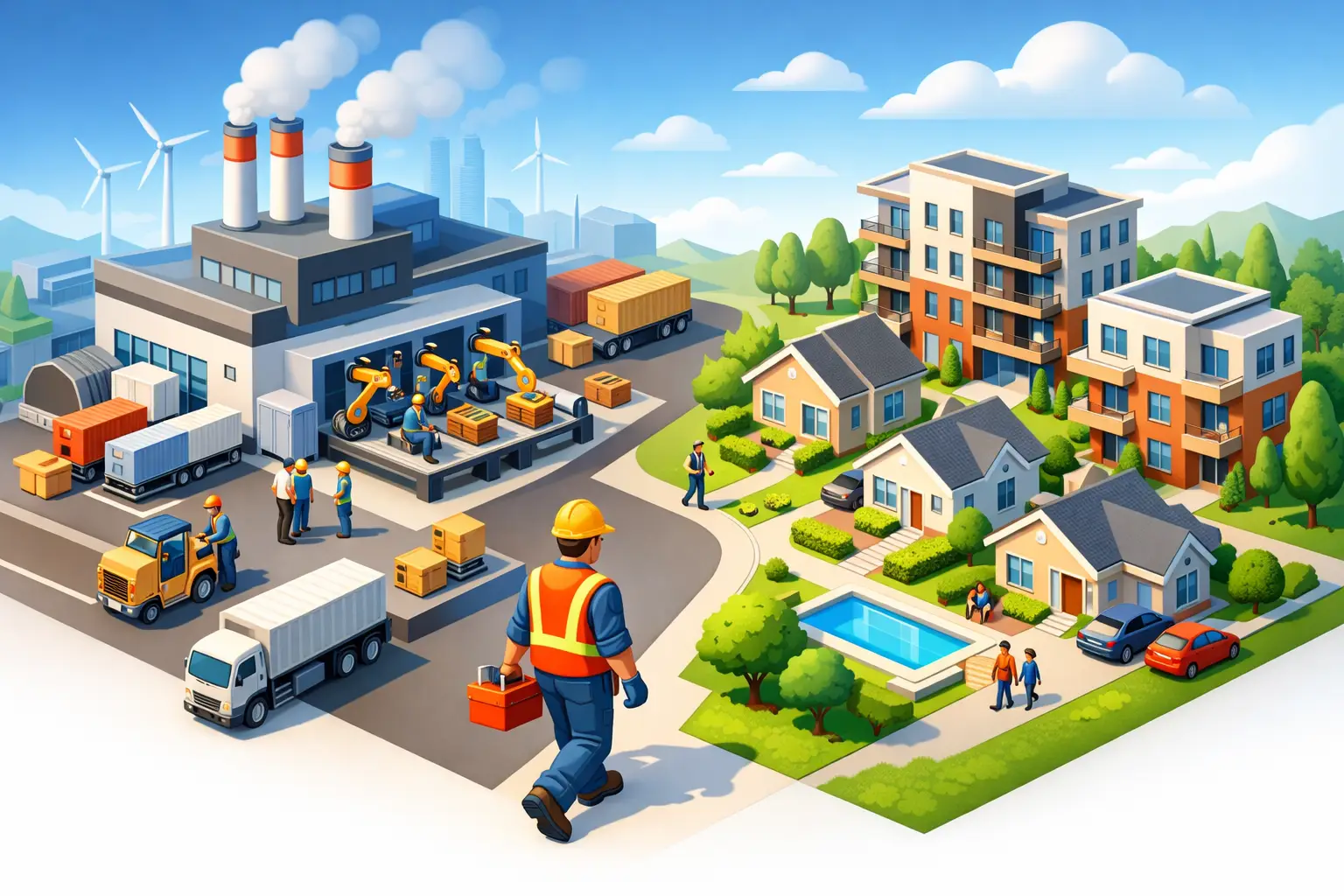
A factory can have the right land, the right power supply, and the right export access – and still struggle to perform if its workforce has nowhere practical to live. That is the real answer to the question, Why Do Manufacturers Need Workforce Housing. For industrial operators scaling advanced production, housing is not a social add-on. It is core operating infrastructure.
Manufacturing leaders already understand the cost of supply chain friction. Workforce friction is no different. When employees face long commutes, unstable rental options, or poor living conditions, the impact shows up fast in absenteeism, turnover, delayed shift coverage, safety incidents, and weaker productivity. In high-value sectors such as EVs, semiconductors, hydrogen mobility, and precision engineering, those disruptions are expensive.
Why Do Manufacturers Need Workforce Housing for Performance?
The simple reason is operational continuity. Manufacturing depends on consistency. Production lines, maintenance schedules, quality systems, and delivery commitments all rely on people showing up reliably and performing at a high standard.
When housing is close to the industrial base, manufacturers reduce transit risk and improve shift dependability. That matters even more in facilities running multiple shifts, cleanroom environments, or time-sensitive processes where a missed handover can affect output for hours. Housing also supports faster response during equipment issues, planned shutdowns, and ramp-up periods.
There is also a retention advantage. Skilled technicians, line supervisors, engineers, and support staff are more likely to stay when their daily life is stable. In competitive labor markets, compensation alone is rarely enough. A workforce ecosystem that includes accessible housing creates a stronger employer value proposition and reduces the hidden costs of constant recruitment and retraining.
Workforce housing is an industrial competitiveness issue
Too many industrial developments treat housing as separate from manufacturing strategy. That approach belongs to an older model of industrial planning. Today, the strongest manufacturing ecosystems are designed around the full operating environment: production, logistics, utilities, compliance, talent, and quality of life.
For investors and occupiers, this changes the site selection equation. A location may offer low land costs, tax advantages, or port connectivity, but if workers cannot live nearby at a reasonable standard, those advantages begin to erode. Labor instability can quietly inflate costs through overtime, lower utilization, recruitment pressure, transportation subsidies, and slower expansion.
This is especially relevant for sectors requiring specialized labor. Advanced manufacturing does not scale well on a fragmented workforce model. If a facility depends on precision operators, cleanroom technicians, robotics specialists, or energy systems engineers, then housing becomes part of the talent strategy. It helps attract people, keep them engaged, and support the disciplined routines that high-spec production requires.
What workforce housing solves beyond accommodation
The value of workforce housing goes beyond putting beds near factories. Done properly, it strengthens the entire industrial ecosystem.
First, it improves labor access across role types. A manufacturing operation needs more than engineers. It also needs technicians, drivers, warehouse staff, facilities teams, security personnel, and service workers. If each group struggles with separate housing constraints, the whole site becomes harder to run.
Second, it supports speed to scale. New facilities often underestimate how quickly labor bottlenecks emerge during commissioning and growth phases. Purpose-planned housing gives operators more confidence that workforce expansion will not be limited by surrounding residential shortages.
Third, it strengthens ESG performance. Responsible manufacturers are under increasing pressure to demonstrate acceptable living standards, worker welfare, and community impact. Workforce housing can help align industrial growth with those expectations, provided it is integrated with healthcare, mobility, retail access, and social infrastructure rather than treated as bare-minimum accommodation.
Why integrated industrial ecosystems outperform isolated sites
The strongest model is not factory space plus housing in separate silos. It is a live-work industrial ecosystem where residential, healthcare, education, logistics, and commercial functions support production at scale.
That model creates resilience. Workers gain a more stable daily environment. Employers gain a more dependable labor base. Investors gain an asset platform with stronger long-term demand fundamentals. Public stakeholders gain a form of development that aligns industrial growth with livability and economic diversification.
This is where mixed-use industrial hubs become strategically significant. In markets seeking to attract global manufacturers, the question is no longer whether housing matters. The question is whether the industrial platform has been designed to support the full life cycle of production and workforce growth.
For example, an ecosystem approach such as the one advanced by Rana Group recognizes that future-ready manufacturing needs more than factory shells. It needs infrastructure that supports people as seriously as it supports machinery.
The trade-off manufacturers should not ignore
Of course, workforce housing requires planning, capital, and governance. It adds complexity to industrial development. Poorly executed housing can also create reputational and operational risk if standards slip or community services are inadequate.
But the alternative is usually more costly. Manufacturers that rely on fragmented off-site housing often inherit unstable commute patterns, weaker retention, and limited control over workforce conditions. Those issues may not appear in the initial land deal, but they surface later in operating performance.
For decision-makers evaluating expansion, workforce housing should be assessed the same way they assess power reliability, logistics efficiency, and regulatory clarity. It is part of what makes a manufacturing location truly investable.
The future of industrial growth belongs to ecosystems that understand one clear principle: when the workforce is planned for, production performs better.
