
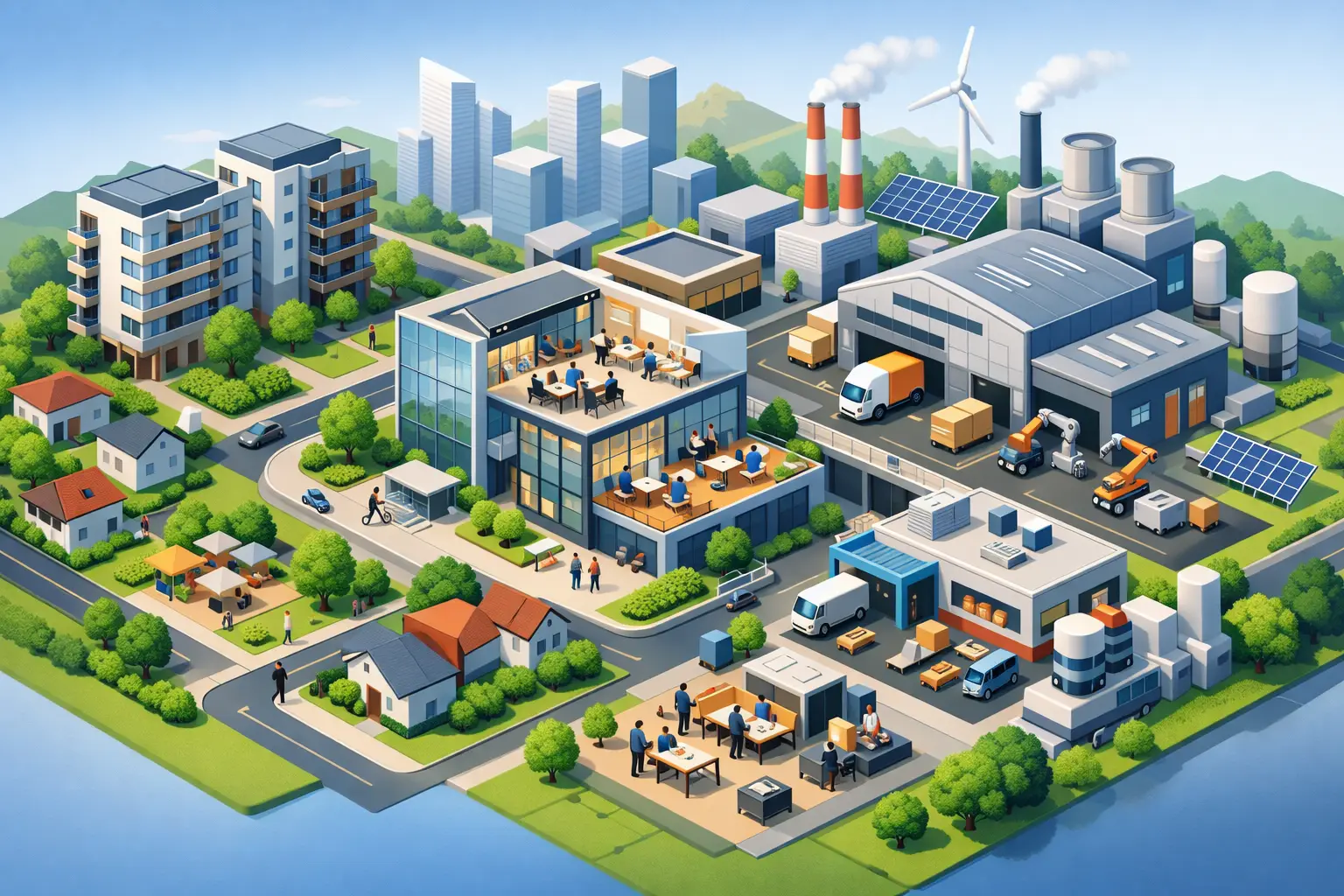
When a manufacturer says it needs land, utilities, labor access, logistics, supplier proximity, and executive housing in one expansion decision, that is not a wish list. It is the real operating logic behind a live work industrial ecosystem example. The old model – factory first, everything else somewhere else – creates friction at every stage of growth. The newer model treats industrial production as part of a complete economic environment.
For investors and operators, that shift matters because industrial performance is no longer judged only by rent, power, and transport links. It is also shaped by talent retention, ecosystem depth, ESG performance, speed to commissioning, and whether a site can support the next decade of production rather than just the next lease term. A true live-work industrial platform is built to answer those questions before they become constraints.
What a live work industrial ecosystem example actually includes
A real live work industrial ecosystem example is not an industrial park with a few convenience services nearby. It is a master-planned environment where production, logistics, research, workforce support, and daily life are intentionally connected. That means advanced manufacturing facilities sit alongside the systems that keep those facilities competitive.
In practical terms, the industrial core may include turnkey factories, modular production units, cleanroom-ready space, warehousing, testing environments, and specialized clusters for sectors such as EVs, semiconductors, hydrogen mobility, renewable energy, or aerospace-adjacent manufacturing. But the ecosystem only becomes meaningful when those assets are reinforced by residential options, healthcare access, education and training capacity, retail services, hospitality, and R&D infrastructure.
This distinction matters. Many developments claim mixed-use value, but few are designed around the operational needs of manufacturers. If workers face long commutes, if technical talent cannot be housed nearby, if visiting partners lack business accommodation, or if suppliers and logistics operators are scattered across multiple locations, the site is not integrated in any serious industrial sense.
Why the model is gaining strategic value
Industrial expansion has become more demanding. Companies are balancing cost pressure with decarbonization commitments. They are localizing supply chains while trying to remain globally connected. They are investing in automation and high-value production, yet they still need skilled labor ecosystems around those facilities. A fragmented industrial site creates drag on all of that.
The live-work model reduces that drag. It shortens travel times between work, training, and daily life. It improves coordination across production, warehousing, and R&D. It also supports workforce stability in sectors where technical talent has choices and mobility. For high-growth manufacturers, that can directly affect output reliability and ramp-up speed.
There is also a capital markets angle. Institutional investors and strategic partners increasingly look beyond a single asset and assess whether a location can sustain industry at scale. An integrated ecosystem signals long-term planning, infrastructure maturity, and a stronger basis for tenant retention. That does not remove execution risk, but it does change the quality of the proposition.
The operating advantages behind the concept
The strongest case for this model is operational, not aesthetic. Advanced manufacturing performs better when critical dependencies are planned into the site from the beginning. That includes utility readiness, road and port connectivity, sector-specific infrastructure, and enough surrounding support to attract both production staff and senior leadership.
A company entering a new market rarely wants to solve ten separate problems across ten separate locations. It wants one coordinated base where factory delivery, workforce access, logistics movement, compliance standards, and future expansion can be managed within a single strategic framework. That is where a live-work ecosystem moves from branding language to business value.
Workforce retention becomes an infrastructure question
Industrial real estate is often discussed as if people are secondary to buildings. In reality, labor availability and retention are central to site performance. If technicians, engineers, and managers cannot build a stable life near the workplace, turnover rises and operating continuity weakens.
An integrated model addresses that by placing housing, healthcare, education, and everyday services within the same broader environment as the industrial base. This does not mean every worker lives on-site, and it does not eliminate all labor challenges. But it creates a stronger talent proposition, especially for sectors where specialized skills are scarce and production quality depends on consistency.
Speed to market improves when infrastructure is coordinated
Expansion leaders care about time. Delays in permitting, utilities, fit-out, workforce onboarding, and supplier setup can erode the advantage of entering a new market. In a well-planned ecosystem, those elements are anticipated rather than patched together after the fact.
Purpose-built facilities, modular industrial units, specialized technical space, and integrated logistics can compress the timeline from decision to operation. The exact gain depends on sector and regulatory pathway, but the principle is clear: coordinated infrastructure reduces avoidable delay.
ESG performance becomes more credible
Many industrial occupiers now face pressure from customers, investors, and regulators to demonstrate measurable sustainability performance. That is harder to achieve in a disconnected environment where transport inefficiencies, duplicated services, and weak planning increase the footprint of operations.
A live-work industrial ecosystem can support a more credible ESG case through smarter land use, reduced commuting burden, better infrastructure planning, and alignment with cleaner industrial sectors. Of course, not every mixed-use hub is automatically sustainable. The value depends on design, energy strategy, compliance standards, and how seriously operators treat environmental performance in practice.
What separates a serious ecosystem from a marketing label
This is where many projects fall short. The phrase sounds compelling, but execution decides whether the model delivers. A serious industrial ecosystem has sector logic. It is designed around identifiable tenant needs, not generic commercial real estate assumptions.
That means asking harder questions. Are the facilities suitable for advanced manufacturing, or just standard shells with upgraded language? Is there capacity for logistics, testing, and specialized production? Are there education and training links that can support future hiring? Can the development scale with tenant growth, or does it only work at an early phase? Does the location offer real cost and market access advantages, or just a map pin with ambition attached?
A credible answer usually includes large-scale planning, specialized industrial clusters, a clear infrastructure roadmap, and proximity to ports, trade corridors, and investor-friendly regulations. It also includes the non-industrial assets that make the workforce ecosystem viable over time. Without that combination, the model remains partial.
Why this matters in the Middle East growth story
The Middle East is becoming a more serious platform for advanced industry, particularly in sectors tied to energy transition, mobility, electronics, and strategic manufacturing. For companies evaluating regional entry, the question is no longer whether there is market potential. The question is where they can build durable operations with the right cost structure and growth conditions.
That is why integrated industrial hubs are gaining attention. They align with national diversification agendas, support export-oriented manufacturing, and create environments where industrial production is reinforced by talent systems and community infrastructure. In that context, a development such as the Erisha Smart Manufacturing Hub reflects a broader shift in how industrial growth is being planned – not as isolated real estate, but as economic infrastructure built for scale.
There are still trade-offs. Large master-planned ecosystems require strong execution, patient capital, and phased delivery discipline. Some manufacturers may prefer a narrower footprint if their workforce model is limited or if they need only basic logistics and warehouse functionality. But for companies building regional platforms, specialized production bases, or long-term technology operations, integration increasingly looks less like a premium feature and more like a practical requirement.
The investment case behind the model
For strategic investors, the appeal of this model is tied to resilience. Integrated ecosystems can create stronger tenant stickiness, broader revenue layers, and more defensible long-term value than single-purpose industrial assets. When industrial, logistics, R&D, and community functions reinforce each other, the platform becomes harder to replicate and more relevant to future occupier needs.
That does not mean every ecosystem will outperform. Success depends on governance, infrastructure quality, tenant mix, and the ability to attract sectors with genuine growth potential. But when the model is executed well, it supports both operating efficiency and investment durability.
The strongest live-work industrial ecosystem example is not the one with the most amenities. It is the one that removes the most friction from industrial growth while creating room for the next generation of manufacturing to scale. That is where the future works – not in isolated facilities, but in ecosystems built to carry industry forward.

[…] healthcare, education, retail, hospitality, and research functions are integrated into the same broader environment. That changes the labor equation. It becomes easier to attract engineers, technicians, operators, […]
[…] Erisha Smart Manufacturing Hub, these assets fit because the project is designed as a live-work-innovate environment rather than a stand-alone industrial estate. That distinction changes the role of social […]