
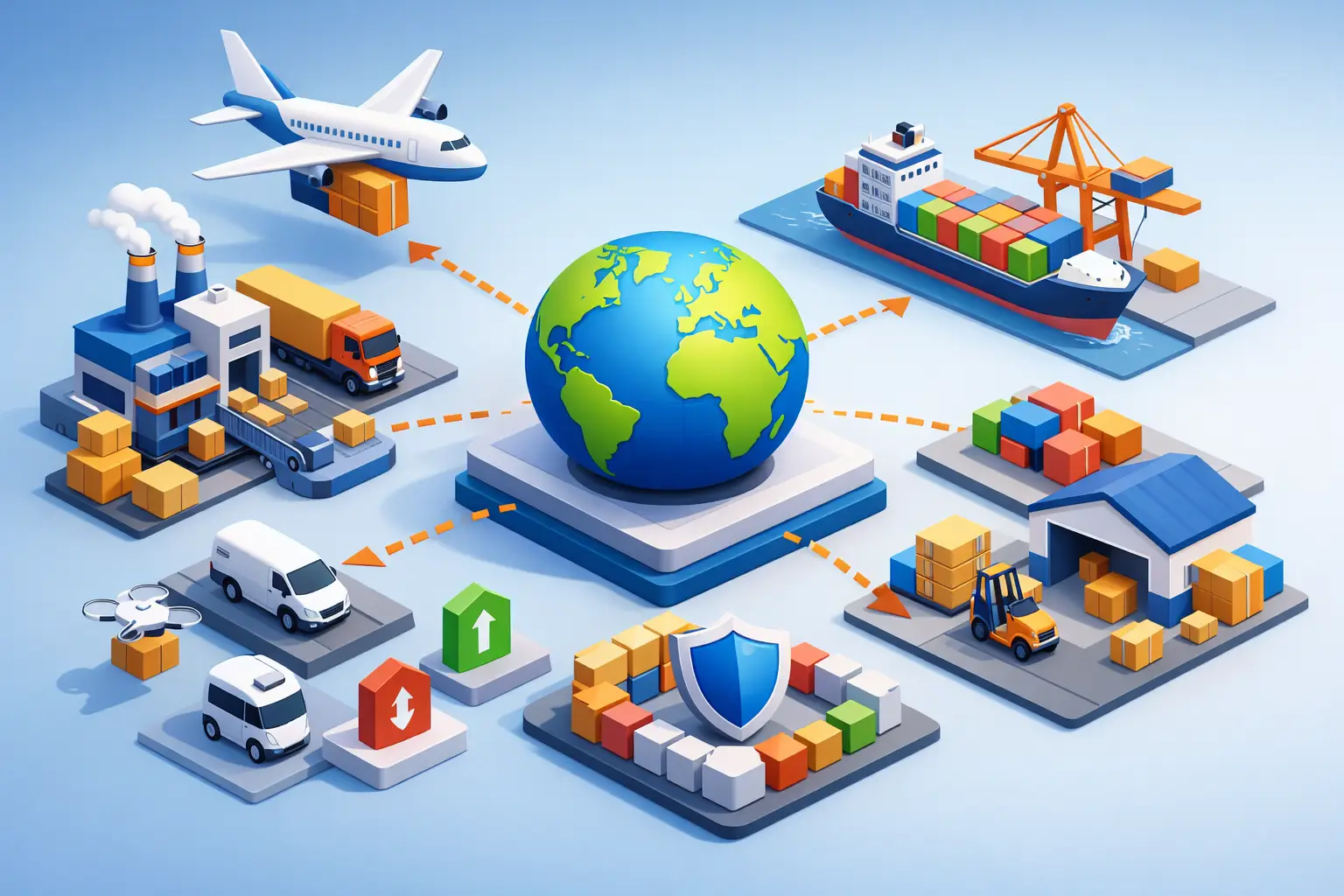
A supply chain rarely fails all at once. It weakens at the margins first – one port delay, one sole-source component, one labor gap, one customs bottleneck, one facility that cannot scale when demand shifts. For manufacturers planning long-term expansion, that is the real question behind how to build resilient supply chains: not how to avoid disruption entirely, but how to design operations that can absorb shocks without losing momentum.
For industrial leaders, resilience is no longer a defensive concept. It is a growth capability. The companies that outperform in volatile markets are usually not the ones with the lowest nominal cost at a single point in time. They are the ones with the best operating architecture across sourcing, production, logistics, talent, energy, and market access. That distinction matters even more in advanced manufacturing, where a missed input can idle high-value production lines and delay market entry across entire regions.
What resilient supply chains actually require
Resilience is often confused with redundancy. They are related, but they are not the same. Redundancy can mean extra inventory, backup suppliers, or spare capacity. Those measures can help, but they also carry cost. True resilience is broader. It means building a network that remains commercially viable under pressure, adapts faster than competitors, and supports expansion without constant redesign.
That starts with accepting a simple operational truth: efficiency and resilience must be engineered together. A supply chain optimized only for lowest landed cost will often become fragile. A supply chain designed only for maximum risk protection can become too expensive or too slow. The strongest model usually sits in the middle, where cost discipline is preserved but critical dependencies are reduced.
In practice, that means leaders need to evaluate supply chain design through five lenses: supplier concentration, production flexibility, logistics access, data visibility, and ecosystem support. If one of those areas is structurally weak, the rest of the network will eventually feel it.
How to build resilient supply chains from the ground up
The first priority is to map critical dependencies, not just direct suppliers. Many organizations understand tier-one relationships but have limited visibility into tier-two and tier-three exposure. That gap becomes expensive during disruption. A business may think it has supplier diversity, only to discover that multiple vendors rely on the same upstream processor, rare material source, or shipping corridor.
This mapping exercise should focus on business-critical inputs first. Which materials or components can stop production? Which have long qualification cycles? Which are tied to export controls, volatile energy prices, or constrained global capacity? Once those choke points are visible, the resilience strategy becomes more precise.
The second priority is dual sourcing where it matters most. Not every part needs multiple suppliers. That approach can add complexity without much value. The better move is selective diversification around the inputs that carry the highest operational or revenue risk. For a semiconductor-adjacent manufacturer, that may be specialty gases or cleanroom-compatible systems. For an EV or hydrogen mobility business, it may be battery materials, power electronics, or precision fabricated parts. The decision should be based on impact, not theory.
A third priority is regionalizing parts of the network. Global supply chains are not disappearing, but many are being redesigned around regional production clusters. This is not about abandoning international trade. It is about reducing the number of failure points between source, factory, and end market. Production footprints closer to target demand centers can reduce transit volatility, improve response times, and create more room for customization.
That shift has become especially relevant for companies serving GCC, South Asian, African, and European trade flows from a Middle East base. Regional positioning can improve resilience when it is paired with port access, investor-friendly regulation, and industrial infrastructure built for advanced manufacturing rather than retrofitted around it.
Infrastructure is a resilience strategy
Supply chain resilience is often discussed as if it lives only in procurement software or logistics contracts. In reality, physical infrastructure shapes resilience every day. A facility that lacks utility reliability, specialized fit-out capacity, storage flexibility, or room for phased expansion is a supply chain risk even before disruption begins.
That is why site selection deserves more strategic attention than it usually gets. Industrial occupiers should ask harder questions early. Can the location support process-specific requirements such as cleanrooms, hazardous materials handling, temperature control, or high-load power? Is there integrated logistics capacity nearby? Can the site scale without forcing a full operational move in three years? Are housing, healthcare, and workforce services available in a way that supports retention?
These are not secondary planning issues. They affect uptime, labor continuity, supplier responsiveness, and total operating cost. For companies building long-horizon manufacturing platforms, ecosystem quality can be as important as lease economics.
In this context, industrial hubs designed as full operating environments offer a structural advantage. A master-planned model that combines production space, logistics, workforce support, and innovation assets can reduce friction across the value chain. That is particularly important for sectors where speed to qualification, talent stability, and specialized infrastructure determine competitiveness.
Visibility matters, but response capacity matters more
Digital visibility is now a basic requirement. Leaders need real-time understanding of inventory positions, inbound shipments, supplier performance, and production constraints. But visibility alone does not create resilience. Seeing a problem faster is only useful if the business has predefined options.
That is where many supply chain programs fall short. Companies invest in dashboards but do not establish decision rules for disruption scenarios. If a critical supplier misses delivery by ten days, what shifts first? If a port lane slows, what is the alternate routing? If demand spikes in one market, which plant has authority and capacity to respond? The organizations that recover fastest are usually the ones that have made these decisions before the crisis arrives.
Scenario planning should therefore be operational, not theoretical. Test the network against plausible shocks: geopolitical restrictions, freight cost spikes, energy interruptions, labor shortages, raw material scarcity, and sudden demand concentration. Then quantify the impact. How much revenue is exposed? How many days of downtime are possible? What mitigation options exist, and what do they cost?
This process often reveals that the most valuable resilience investments are not the most expensive ones. A second qualified supplier, a regional buffer stock for one critical component, or a facility layout that supports mixed-model production can outperform broad and costly overbuilding.
The workforce and policy layer cannot be ignored
Even the best-designed supply chain can stall if the surrounding operating environment is weak. Manufacturers need more than land and buildings. They need access to labor, training pathways, permitting clarity, and a regulatory framework that supports industrial growth.
This is one reason integrated industrial ecosystems are gaining strategic relevance. When workforce housing, education, healthcare, R&D support, and logistics assets are part of the same broader environment, resilience improves in practical ways. Hiring becomes easier. Retention improves. Ramp-up periods shorten. External coordination costs fall.
For multinational firms entering new markets, policy alignment also matters. Stable regulation, customs efficiency, ESG compatibility, and clear foreign investment structures can reduce operational uncertainty as much as any inventory policy. A supply chain is only as resilient as the business environment around it.
That is why resilience should be considered at the platform level, not only at the shipment level. Companies that choose expansion locations based solely on short-term occupancy cost may save early, but they often inherit long-term complexity. Businesses that choose locations built for sector-specific manufacturing, scalable logistics, and regional market access are in a better position to sustain growth through disruption.
Rana Group’s approach reflects that broader thesis: resilience is built when industrial infrastructure, logistics readiness, sector clustering, and workforce-supportive environments are planned as one system rather than assembled in fragments.
The best resilient supply chains are built for growth
A resilient supply chain should not be judged only by how it performs during crisis. It should also be judged by how well it supports expansion, customer commitments, and capital efficiency over time. If the network can survive disruption but cannot scale profitably, it is not ready for the next industrial cycle.
That is the real standard for how to build resilient supply chains. Build networks with enough flexibility to absorb shocks, enough infrastructure to support advanced production, and enough regional logic to stay close to growth markets. The future belongs to manufacturers that treat resilience not as insurance, but as operating strategy.

The idea that a supply chain “weakens at the margins first” really resonated with me, as it’s similar to how a reef can be compromised by small, cumulative damage. As someone who’s spent time snorkeling and scuba diving, I’ve seen how a reef’s health can be affected by subtle changes in its environment. In building resilient supply chains, it’s essential to consider the smallest details, like labor gaps or customs bottlenecks, which can have a significant impact. I’ve noticed that some manufacturers are now prioritizing regional strategy for growth, which can help mitigate risks. The parallel between designing supply chains to absorb shocks and navigating the complexities of regional manufacturing investments is something I’ve been thinking about, particularly in areas with varying labor costs and logistics. I wonder how manufacturers can balance the need for resilience with the need for adaptability in volatile markets.