
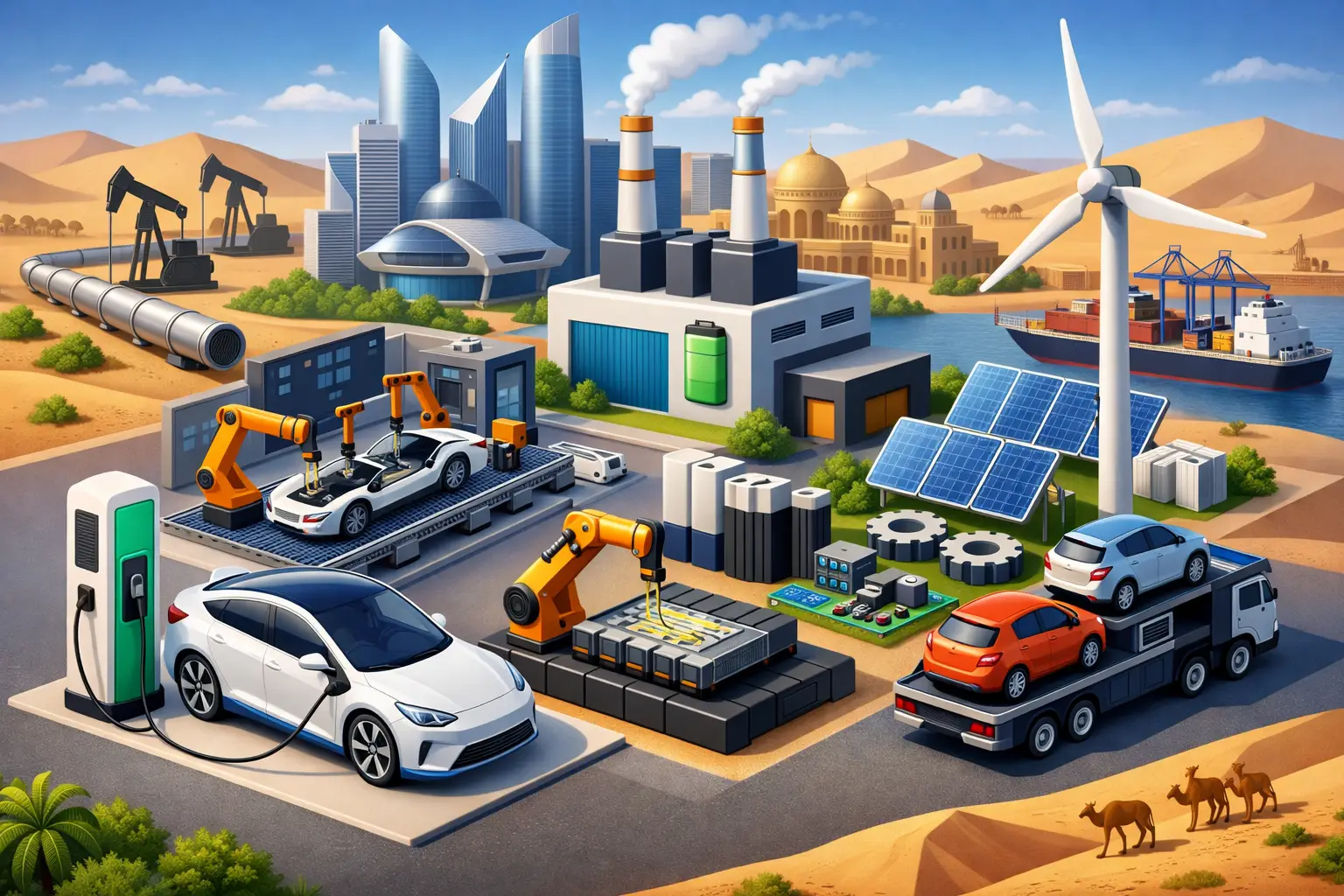
The EV Supplier Ecosystem Middle East is moving from ambition to industrial reality. What used to be a market defined mainly by vehicle imports is becoming a strategic base for battery inputs, power electronics, charging systems, lightweight materials, software integration, and final assembly. For manufacturers and investors, that shift changes the core question. It is no longer whether the region will participate in electric mobility. It is where the supply chain will concentrate, which countries will move fastest, and what kind of industrial platform can support scale without creating new operational friction.
This matters because EV manufacturing is not won by isolated factories. It is won by ecosystems. A vehicle plant without nearby component suppliers, testing capabilities, logistics capacity, workforce housing, and policy support becomes expensive very quickly. The companies that establish an early regional footprint are not just chasing sales growth. They are positioning themselves inside the infrastructure layer of a market that is aligning industrial policy, energy transition goals, and cross-border trade.
Why the EV supplier ecosystem matters now
The Middle East offers a rare mix of demand-side and supply-side momentum. Governments across the Gulf are pushing economic diversification, decarbonization, and advanced manufacturing at the same time. That creates a stronger foundation for EV suppliers than a purely consumer-led story. Policy can accelerate charging rollout, fleet electrification, local content targets, and industrial incentives in parallel.
For suppliers, this reduces one of the biggest risks in new market entry: fragmented signals. In many regions, EV adoption may be rising while manufacturing policy remains unclear, or incentives may support vehicle sales but not local production. In the Middle East, several national strategies are linking mobility, energy, and industrial development more directly. That creates room for a full value chain, not just downstream distribution.
There is also a practical advantage that gets less attention. The region sits at the intersection of Europe, Asia, and Africa. That makes it relevant not only as an end market, but as a production and re-export platform. Suppliers serving GCC assembly, North African demand, and selected European or South Asian corridors can build a more flexible business case than one tied to a single national market.
What actually makes up the EV Supplier Ecosystem Middle East
The phrase can sound broader than it is, so precision matters. The EV supplier base is not limited to battery packs and drivetrains. It includes upstream and midstream players that often determine whether manufacturing at scale is viable.
In the current regional context, the most investable layers include battery materials processing, cell and pack assembly, thermal management systems, wiring harnesses, semiconductors and control units, cast and fabricated structural parts, charging hardware, fleet software, testing services, and logistics support tailored to hazardous materials and high-value components. In parallel, there is growing relevance for adjacent sectors such as hydrogen mobility components, power management systems, and lightweight composite manufacturing.
Not every market in the Middle East will host every layer. That is a critical point for investors. A successful supplier ecosystem does not require every country to replicate the entire chain. It requires strategic clustering. Some locations will be stronger in energy-intensive processes, some in assembly and export logistics, and others in R&D, certification, or software integration.
The region’s structural advantages and where they have limits
The strongest case for the Middle East starts with cost and connectivity. Industrial land can be more competitive than in mature manufacturing hubs. Port infrastructure is strong. Free zone and investor frameworks are generally clearer than in many emerging markets. Energy availability is another differentiator, especially for processes where stable power supply affects yield, uptime, and operating economics.
The second advantage is industrial planning. New manufacturing zones in the region often have the benefit of being built for current needs, not retrofitted around outdated infrastructure. That can support cleaner layouts, modern utilities, ESG alignment, and sector clustering in ways older industrial belts struggle to match.
But the region does face real constraints. Supplier density is still developing. In many categories, manufacturers will need a phased localization strategy rather than expecting deep local sourcing on day one. Specialized technical talent is improving but remains uneven depending on the country and product segment. Demand visibility also varies. Fleet electrification, government procurement, commercial transport, and premium passenger EV adoption are not moving at the same pace across the region.
That means site selection should be based on operational fit, not headlines. A company making charging equipment may prioritize standards alignment, logistics, and access to utilities contractors. A battery systems manufacturer will care more about power reliability, hazmat handling, thermal management capabilities, and room for future expansion.
Where value is likely to concentrate
The early winners in the Middle East EV supply chain are likely to be the businesses that solve bottlenecks rather than chase broad narratives. Charging hardware and energy management systems are obvious examples because they connect vehicle adoption with grid and real estate infrastructure. Power electronics and control systems are another, especially as regional players look beyond passenger cars into buses, commercial fleets, logistics vehicles, and industrial mobility.
Battery pack assembly also has logic in the region, particularly where assembly can be paired with import-efficient logistics, local integration, and access to end users such as fleets or public sector programs. Full cell manufacturing is a bigger bet. It may work in select locations with the right energy, capital, and policy stack, but it is far more demanding than many market overviews suggest.
Commercial vehicle electrification may be one of the most underestimated opportunities. The Gulf’s logistics, construction, municipal, and industrial operations create use cases where fleet economics can justify electrification faster than private consumer markets alone. Suppliers who understand duty cycles, charging needs, and uptime requirements for these segments may find stronger near-term traction than those focused only on passenger EV demand.
What industrial occupiers should look for in a regional base
For executives evaluating entry into the EV Supplier Ecosystem Middle East, the decision should start with ecosystem readiness rather than plot size alone. A factory can be built almost anywhere. A resilient operating base needs more.
First, infrastructure must match process requirements. That means power quality, utility redundancy, transport access, warehousing, and compliance conditions that support advanced manufacturing rather than generic light industry. If a supplier expects to scale from module assembly to more complex integration, the site must accommodate that progression without forcing relocation.
Second, labor strategy cannot be treated as an afterthought. The strongest industrial platforms increasingly combine manufacturing space with residential, healthcare, education, and daily-life infrastructure that improves workforce attraction and retention. This is especially relevant for technically specialized operations that need stable teams over multiple production cycles.
Third, the ecosystem should support adjacency. EV suppliers benefit from proximity to testing facilities, prototyping, clean manufacturing environments, logistics nodes, and sector-specific neighbors. A company may enter with one product line, then expand into power management, charging integration, or regional customization. Industrial environments that support that evolution create better long-term economics.
This is where integrated development models stand out. In Ras Al Khaimah, platforms such as the Erisha Smart Manufacturing Hub reflect a broader shift from industrial real estate to industrial ecosystems – combining advanced manufacturing facilities, logistics capability, workforce-supportive infrastructure, and sector clustering designed for future industries rather than legacy demand.
Why the UAE has strategic weight in this market
Within the broader regional picture, the UAE has distinct advantages for EV suppliers looking for an anchor market. It offers strong trade connectivity, established free zone structures, a policy environment receptive to advanced industry, and a growing focus on sectors linked to clean mobility and electrification.
For companies entering the region, the UAE often works best not simply as a domestic sales market but as a control tower for regional manufacturing and distribution. That distinction matters. The local consumer market alone may not justify every investment thesis. The export logic, operating environment, and ability to coordinate GCC and international flows often do.
That said, not every supplier needs a flagship plant at launch. For some, a modular entry model is smarter: start with assembly, calibration, regional distribution, and technical service, then localize more content as contracts, policy support, and supplier relationships deepen. The right facility strategy should reduce capital risk while preserving expansion optionality.
The next phase of competition
The next competitive battleground will not be who announces the most EV-related projects. It will be who can compress time to production, reduce supply chain complexity, and create conditions for suppliers to scale together. That requires coordinated industrial planning, not scattered incentives.
The Middle East has the capital, policy momentum, and geographic position to become a serious node in global electric mobility supply chains. The question is whether industrial platforms can convert that potential into repeatable operating success for tenants and partners. The regions that do this well will attract more than factories. They will attract engineering capability, long-term investment, and the kind of industrial density that compounds over time.
For manufacturers and investors, the opportunity is not just to enter a growing market. It is to help shape where the future of EV production in this region actually takes hold.
