
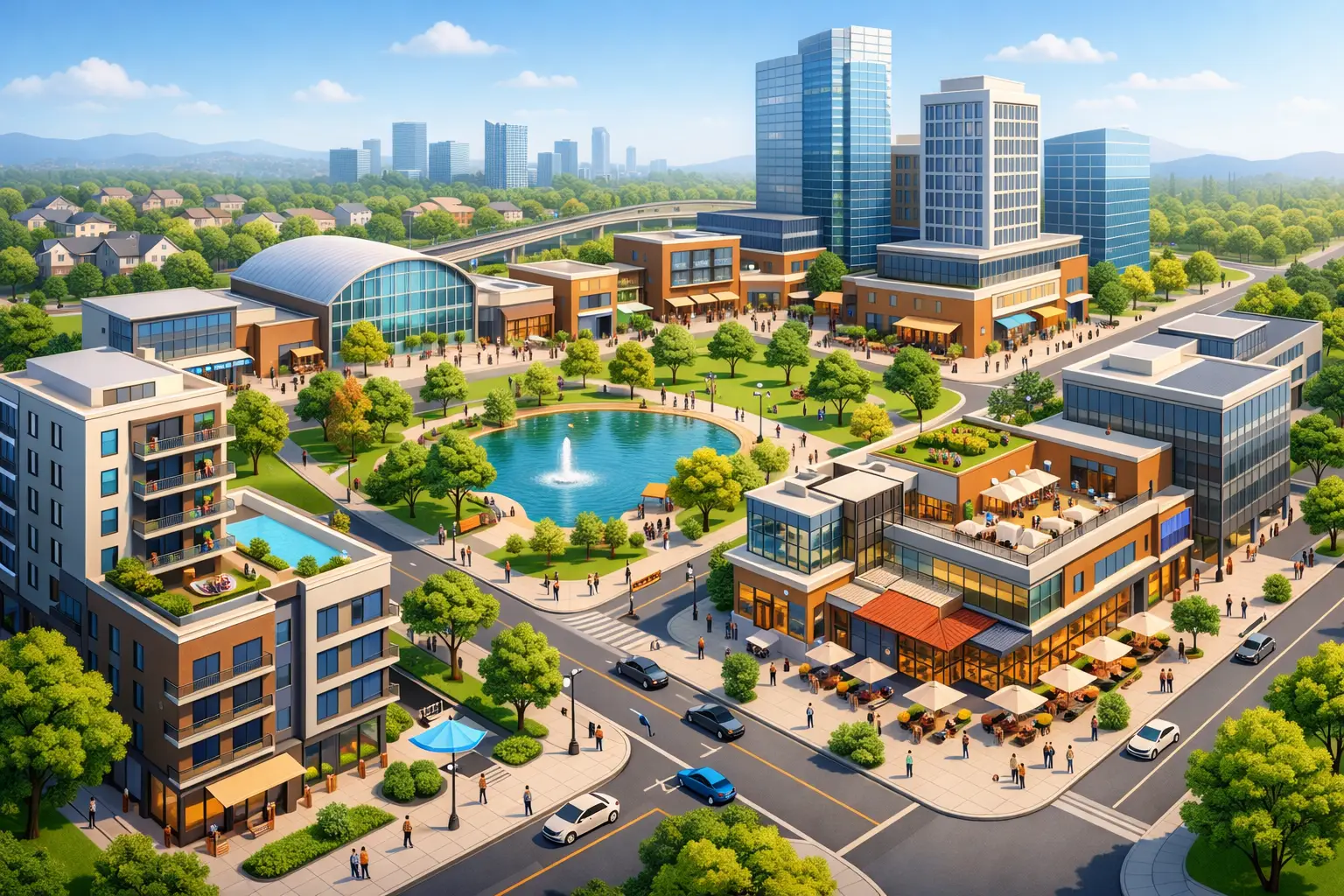
Industrial growth fails in predictable ways. A site may have land but no workforce housing. It may offer factories but lack logistics depth, utility resilience, or room for R&D. It may attract early tenants, then lose momentum because daily life, talent retention, and operational expansion were never designed into the place. That is why a Guide To Mixed Use Master Planning matters – especially for industrial platforms expected to support advanced manufacturing, clean technology, and long-horizon investment.
For serious developers, investors, and occupiers, mixed-use master planning is not a branding exercise. It is the operating logic of a high-performance economic zone. Done well, it aligns industrial production, residential capacity, mobility, social infrastructure, and environmental systems into one coherent framework. Done poorly, it creates land-use conflict, stranded assets, traffic pressure, and a fragmented tenant experience that weakens both returns and competitiveness.
What mixed use master planning actually means
In an industrial context, mixed-use master planning is the deliberate integration of production, logistics, research, workforce living, services, and community infrastructure within a single long-term development strategy. The goal is not to make an industrial district feel like a retail destination. The goal is to create a place where advanced industry can scale without being constrained by the very ecosystem it depends on.
That distinction matters. Conventional industrial parks often optimize for plot sales, warehouse access, and utility connections. A mixed-use industrial master plan looks further ahead. It asks whether the site can support engineers, technicians, suppliers, training institutions, medical services, short-stay business visitors, and future expansion sectors that may not even be active on day one.
For sectors such as EV manufacturing, semiconductors, hydrogen mobility, aerospace-adjacent production, and renewable energy systems, that broader frame is not optional. These industries require specialized buildings, reliable power, compliance-ready environmental systems, talent pipelines, and fast coordination across suppliers and partners. Land alone does not deliver that.
The first principle: start with the economic engine
The strongest mixed-use plans begin with the industrial thesis, not the lifestyle overlay. In other words, planners should first define what kinds of production the district is built to support, what utility loads those sectors require, what logistics patterns they generate, and what kind of workforce they need across construction, commissioning, operations, and growth phases.
This is where many projects go off course. They allocate residential, retail, or hospitality components too early, based on generic real estate assumptions rather than the demand profile of actual target industries. A hub built for light assembly has very different land, power, safety, and labor requirements than one designed for battery systems, cleanroom-capable semiconductor operations, or hydrogen-related manufacturing.
A credible plan therefore starts by identifying the anchor sectors, the likely tenant mix, the range of building typologies required, and the expected phasing of industrial absorption. Only then should supporting uses be calibrated around those realities.
Land use must reduce friction, not create it
A mixed-use district succeeds when every use supports the other uses. That sounds obvious, yet many master plans still separate components in ways that look neat on paper and perform poorly in operation.
Industrial production needs access, truck movement, security buffers, utility corridors, and room for future expansion. Residential and hospitality uses need comfort, safety, and predictability. Education and healthcare assets need accessibility and a stable surrounding environment. The job of master planning is to organize these uses so they coexist without compromising performance.
That usually means creating gradations rather than hard adjacencies. Heavy industrial plots should not sit directly against family housing. Freight routes should bypass community zones. Service retail should be placed where it supports workers and visitors without interfering with logistics. R&D spaces often work best as transition zones between production clusters and broader commercial or institutional uses.
The best plans treat land use as an operational system. Every parcel should answer a practical question: what function does this location serve within the wider industrial ecosystem, and how does its placement improve efficiency, resilience, or value?
Infrastructure is the real master plan
Renderings may attract attention, but infrastructure determines whether a district can compete.
A serious Guide To Mixed Use Master Planning has to center power capacity, water systems, wastewater treatment, telecommunications, internal road hierarchy, stormwater management, and logistics access. For advanced manufacturing, the standard utility package is often not enough. Some occupiers need redundant feeds, higher power density, cleanroom-readiness, special ventilation, hazardous material handling, or process-specific water treatment.
This is where mixed-use planning becomes a strategic advantage rather than a compromise. When infrastructure is designed across the full district, not plot by plot, developers can reduce future retrofit costs and create a stronger value proposition for incoming tenants. Shared systems, if properly engineered, can improve cost efficiency while preserving performance.
There are trade-offs. Oversizing infrastructure too early can damage project economics. Undersizing it can block future tenants and force expensive upgrades. The right answer depends on target sectors, funding structure, and phase sequencing. That is why the infrastructure strategy must be tied to a realistic absorption model, not an optimistic one.
Workforce ecosystems are now core industrial infrastructure
For many manufacturers, labor availability is no longer just an HR issue. It is a site selection issue.
A mixed-use industrial district should account for where workers live, how they commute, what services they need, and how the location supports retention at multiple income and skill levels. Executive housing alone is not a workforce strategy. Neither is isolated labor accommodation without access to education, healthcare, food services, and community amenities.
The new benchmark is a live-work-innovate environment where technical talent can build a career, not just take a job. That is particularly relevant in regions competing to attract global operators and specialized engineering teams. If a site offers advanced industrial facilities but fails to provide a credible daily-life ecosystem, occupiers absorb that weakness through higher turnover, recruitment friction, and relocation difficulty.
This is one reason integrated hubs are gaining momentum. They are not simply more convenient. They are more investable because they support continuity of operations.
ESG cannot sit on the margins
In advanced industrial development, ESG is moving from reporting language to location logic. Investors, multinational occupiers, and strategic partners increasingly need sites that can support emissions reduction, resource efficiency, regulatory alignment, and future disclosure requirements.
In practical terms, this affects energy systems, building orientation, transit planning, waste management, water reuse, materials strategy, and green buffers. It also affects tenant attraction. A district that can support renewable integration, lower transport friction, and more efficient industrial operations enters the market with a sharper competitive edge.
That does not mean every project needs to overengineer sustainability features that tenants will not value. The question is always strategic fit. But in growth sectors tied to electrification, advanced materials, clean mobility, and next-generation manufacturing, ESG readiness is increasingly part of the core infrastructure offer.
Phasing is where ambition becomes credible
The market rarely absorbs a large-scale mixed-use industrial hub all at once. Phasing is what converts a long-term vision into an executable platform.
Strong phasing prioritizes the uses that make the site operational early: primary road access, utilities, initial industrial product, logistics support, and a first layer of workforce-serving amenities. Residential, retail, hospitality, and institutional assets should follow demand signals, but not so late that the district feels incomplete or difficult to inhabit.
This balance is delicate. Build support uses too early and you risk underutilized assets. Build them too late and you weaken tenant acquisition. The right sequence depends on the target market, anchor commitments, and the speed at which the industrial base is expected to scale.
At Rana Group, this ecosystem logic is central to the value proposition behind next-generation manufacturing hubs. The premise is simple: industrial competitiveness strengthens when production capacity is planned alongside the services, talent systems, and community infrastructure that allow it to endure.
What investors and occupiers should evaluate
When assessing a mixed-use master plan, decision-makers should look past the headline concept and test the operating model underneath it. The most useful questions are straightforward. Is the industrial thesis clear? Does the land use plan support that thesis? Are utilities designed for real sector needs? Is there room for expansion? Does the workforce strategy exist beyond marketing language? Are ESG claims reflected in physical systems? Can the phasing plan protect both momentum and capital discipline?
They should also examine what could go wrong. Some mixed-use schemes dilute industrial performance by over-prioritizing non-core uses. Others remain too rigid, leaving no flexibility for new technologies, evolving regulations, or changing tenant requirements. In high-growth sectors, adaptability is not a bonus feature. It is part of long-term asset quality.
The strongest master plans do something rare. They make industrial growth easier over time, not harder. They reduce friction, concentrate capability, and create conditions where manufacturers, investors, researchers, and service providers can operate as part of the same economic engine. That is the real promise of mixed-use master planning – not a nicer industrial park, but a more durable platform for industrial leadership.
