
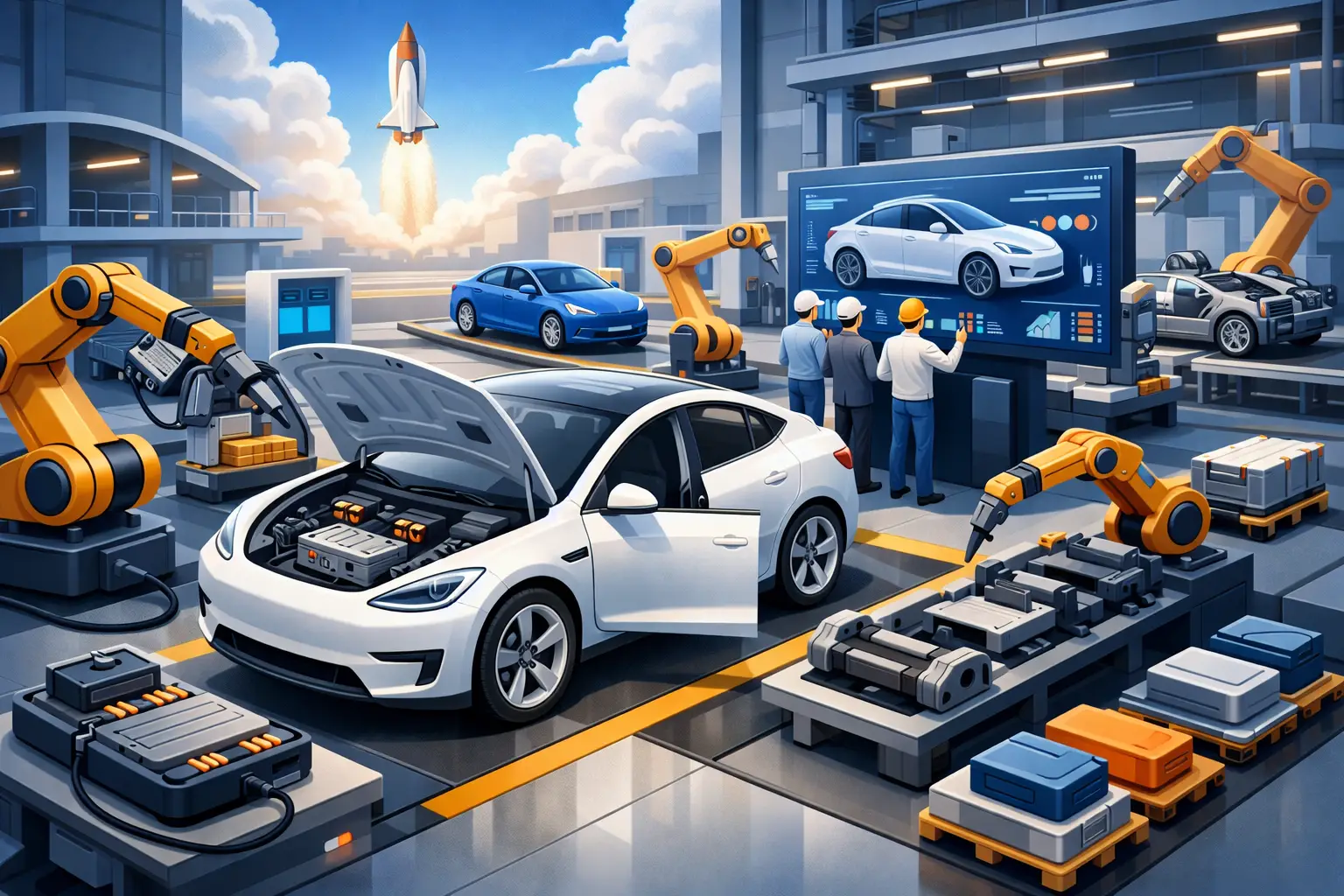
An EV assembly program can lose momentum long before the first vehicle leaves the line. Most setbacks start earlier – in site selection, utility planning, supplier localization, homologation timing, or an operating model that looks efficient on paper but fails under production pressure. That is why How To Launch EV Assembly is not a narrow factory question. It is a full industrial strategy decision.
For manufacturers, investors, and market-entry teams, the real objective is not simply opening an assembly line. It is creating a platform that can scale from pilot runs to commercial output without constant redesign, avoidable cost inflation, or infrastructure bottlenecks. In a market moving this quickly, the winners are not always the first movers. They are the operators who build for execution.
What launching EV assembly actually requires
EV assembly is often described as a downstream manufacturing activity. In reality, it sits at the intersection of product engineering, supply chain design, utilities planning, workforce development, logistics, and regulatory readiness. If one of those systems is weak, the line will feel it immediately.
The launch model also depends on what kind of business is being built. A CKD or SKD operation entering a new market has very different needs from a vertically integrated manufacturer planning body, battery, and power electronics capabilities over time. Some companies need speed to market above all else. Others are optimizing for tariff treatment, regional content requirements, or phased localization.
That distinction matters because assembly should not be designed in isolation. It should be designed as the first operational layer of a broader manufacturing roadmap.
Start with the business case, not the building
The most common early mistake is treating the facility as the first decision. The first decision is the business case. Before committing to land, factory fit-out, or equipment procurement, leadership needs a clear view of target volumes, vehicle mix, launch sequence, sourcing model, and intended sales geography.
A plant sized for optimistic year-five demand can become a cost burden in year one. On the other hand, an underspecified site can limit expansion just as orders accelerate. The right answer is usually a phased model: enough installed capability for launch, enough adjacent capacity for scale, and enough infrastructure flexibility to support future process additions.
This is especially important in EV manufacturing, where production architecture can change quickly. Battery pack assembly, thermal systems integration, software validation, and end-of-line testing can all evolve between product generations. A rigid facility may look cheaper at the start, but it often becomes more expensive when change arrives.
How To Launch EV Assembly with the right location strategy
Location determines more than real estate cost. It influences inbound component flow, export economics, permitting timelines, labor access, utility reliability, ESG performance, and the speed at which future manufacturing stages can be added.
For EV assembly, a viable location usually needs five things working together: industrial-grade power, efficient freight access, investor-friendly regulations, room for phased expansion, and a workforce ecosystem that can support both technicians and management. If even one of those is missing, the site may still function, but at a penalty.
That is why many manufacturers are moving away from isolated industrial footprints and toward integrated manufacturing ecosystems. Assembly operations do not perform well when the factory is ready but housing, healthcare, logistics support, training pipelines, and supplier space are not. Production stability depends on the full environment around the plant.
In growth markets, this becomes a major strategic advantage. A manufacturing base that connects industrial operations with logistics, talent retention, and future sector clustering creates more resilience than a standalone factory ever can.
Design the assembly model around launch speed and future localization
There is no single correct starting point for EV assembly. Some companies begin with imported kits to enter the market quickly, validate demand, and build aftersales capability. Others launch with partial localization from day one because policy incentives, logistics costs, or fleet demand justify a deeper footprint.
The key is to decide what must be local at launch and what can be localized in stages. Final assembly, testing, quality assurance, warehousing, and pre-delivery operations may be enough for phase one. Over time, manufacturers can add battery pack assembly, plastics, interiors, harnessing, light fabrication, and localized subassemblies as volume and supplier confidence increase.
This staged approach protects capital while preserving strategic direction. It also gives the organization time to mature process discipline before layering in additional complexity.
Utilities and technical infrastructure are make-or-break issues
EV assembly is unusually sensitive to infrastructure quality. Stable power supply, environmental controls, compressed air, water systems, IT architecture, fire protection, and testing capability all shape throughput and quality performance. If battery handling or pack integration is part of the scope, safety design and compliance requirements become even more important.
Many launch plans underestimate utilities because the initial assembly process appears lighter than heavy manufacturing. But EV operations rely on high consistency. Voltage fluctuations, weak digital systems, poor layout logic, or limited test infrastructure can slow output and raise defect rates.
A future-ready site should also account for process adjacencies. If a company intends to add electronics assembly, battery work, or cleanroom-dependent processes later, that possibility should influence the base infrastructure from the start. It is far easier to plan for evolution than retrofit under production pressure.
Build the supplier strategy early
An EV assembly line is only as strong as its supply chain. That means launch planning must include supplier mapping far earlier than many new entrants expect. Imported kits can simplify the first stage, but long-term competitiveness depends on reducing logistics friction, managing lead times, and localizing where economics support it.
Supplier strategy should separate critical components from localizable components. Cells, semiconductors, and advanced driveline elements may remain globally sourced for longer. Seats, plastics, brackets, trims, glass, packaging, and some metal parts often present earlier localization opportunities. The decision is not ideological. It is financial and operational.
Manufacturers also need to think in clusters. Suppliers are more likely to commit when they can access shared infrastructure, multiple anchor tenants, logistics efficiency, and a policy environment that supports industrial scaling. This is where a specialized advanced manufacturing hub can materially reduce launch risk.
Compliance, certification, and market access cannot be left to the end
Homologation delays can derail an otherwise well-built launch. EV assembly programs need a compliance path that covers vehicle standards, battery regulations, worker safety, environmental requirements, transport rules, and destination-market certification. If vehicles are intended for regional export, those pathways should be built into the launch calendar from the beginning.
This is not just a legal matter. It affects engineering validation, documentation systems, testing equipment, supplier approvals, and release timing. A company that waits until the factory is nearly ready to address compliance often discovers that the commercial start date was never realistic.
The most effective teams treat compliance as a parallel workstream, not a finishing task.
Workforce planning is an industrial strategy question
EV assembly depends on more than hiring operators. It requires production leaders, quality engineers, maintenance capability, EHS discipline, warehouse control, software-aware diagnostics, and technical training systems that can keep pace with product updates. That is difficult to build in a location where the labor market and social infrastructure are disconnected from the plant.
Retention is just as important as recruitment. If supervisors, technicians, and specialists face long commutes, limited housing options, or weak support services, turnover rises and ramp-up suffers. For that reason, many serious manufacturers now evaluate the surrounding ecosystem as closely as they evaluate the factory shell.
Industrial development groups that combine manufacturing space with residential, healthcare, education, and logistics assets are solving a real operating problem, not adding amenities for appearance. They are improving workforce continuity, which directly affects output stability.
Capital discipline matters as much as industrial ambition
Launching EV assembly requires confidence, but it also demands sequencing. Overbuilding too early is one risk. Underinvesting in the systems that protect quality and uptime is another. The smartest programs allocate capital around the ramp curve: core infrastructure first, process-critical equipment next, expansion modules later.
That approach creates room to respond to demand, supplier readiness, and policy shifts without compromising the launch. It also gives investors a clearer view of milestone-based value creation instead of a single oversized capital event.
In regions positioning themselves as advanced manufacturing gateways, this phased discipline becomes even more compelling. It aligns private capital with industrial policy, accelerates tenant readiness, and creates a stronger case for long-term ecosystem investment.
The real answer to How To Launch EV Assembly
The companies that launch well rarely treat EV assembly as a standalone line installation. They treat it as the first operating expression of a larger industrial platform – one built for logistics efficiency, compliance certainty, workforce resilience, supplier growth, and future manufacturing depth.
That is the difference between entering a market and establishing a position in it. In high-growth regions, where cost structure, connectivity, and industrial policy can materially shape competitiveness, the launch environment becomes part of the production strategy itself. For manufacturers planning their next move, the question is not whether EV assembly is viable. It is whether the chosen ecosystem is ready to carry it forward.
