
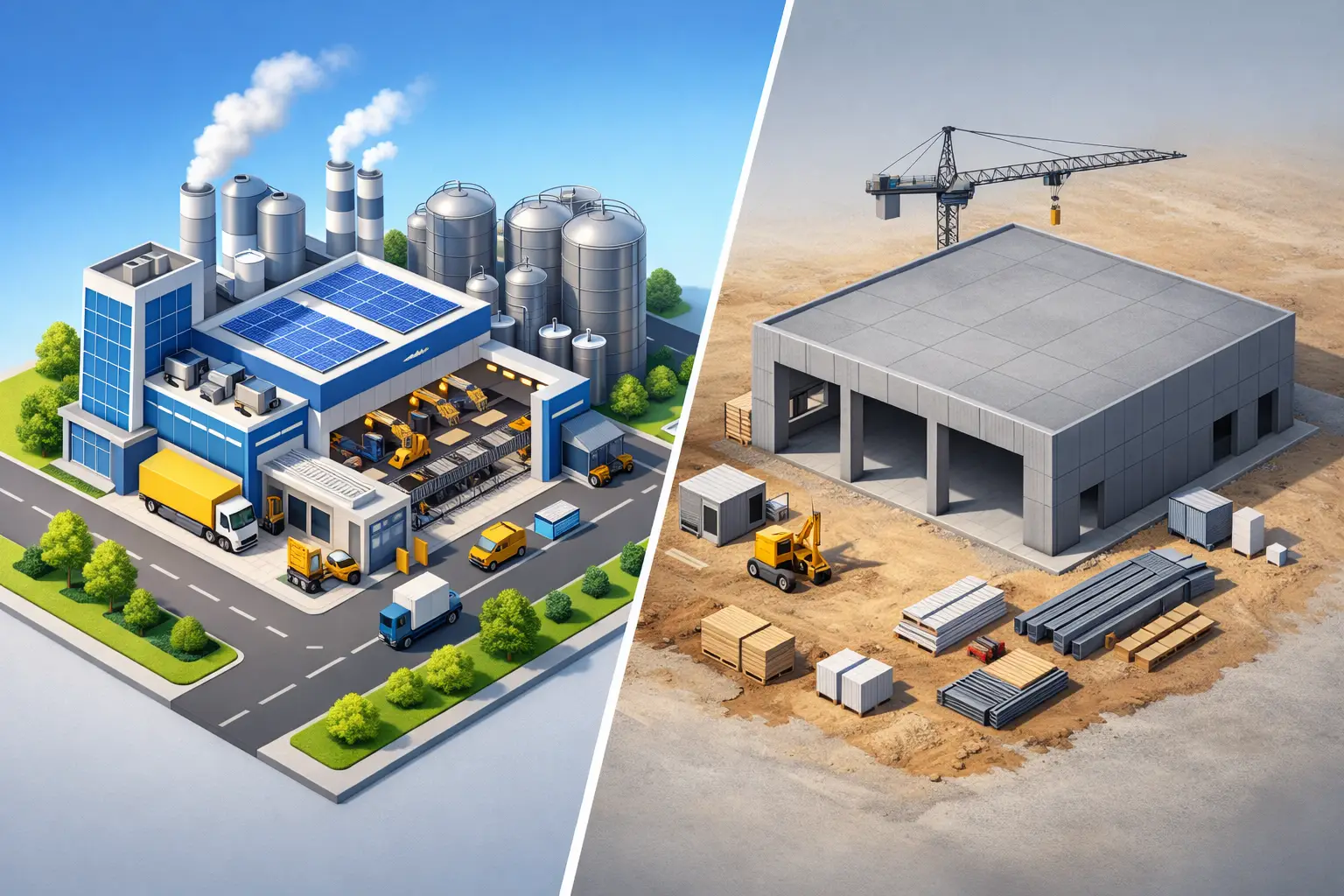
Speed to market is rarely a side issue in manufacturing expansion. It shapes revenue timing, customer commitments, hiring plans, equipment commissioning, and investor confidence. That is why the debate around Turnkey Factories Versus Shell Buildings matters far more than real estate preference. It is a strategic decision about how quickly an operation can move from site selection to production, and how much execution risk a company is prepared to absorb.
For industrial occupiers entering the GCC, scaling an advanced production line, or regionalizing supply chains, the wrong facility model can delay launch by quarters, inflate capital costs, and complicate regulatory approvals. The right model can compress timelines, improve budget visibility, and create a stronger platform for long-term output. There is no universal winner. There is only the option that best matches the manufacturer’s process, capital strategy, and growth horizon.
What separates turnkey factories from shell buildings?
A turnkey factory is delivered as an operationally ready industrial facility built around the occupier’s manufacturing needs. That usually means the core structure, utilities, internal fit-out, loading configuration, technical provisions, office areas, and in some cases specialized environmental or production requirements are planned into the delivery model from the beginning. The tenant arrives with machinery, workforce planning, and commissioning schedules, not a blank sheet of paper.
A shell building is fundamentally different. It provides the envelope – structure, external walls, roof, and often limited core utilities – while leaving substantial interior planning, engineering, fit-out, and systems integration to the occupier. For some manufacturers, that level of control is attractive. For others, it becomes an expensive second project layered on top of the initial lease or acquisition decision.
The practical difference is not cosmetic. It affects who carries design coordination, who manages contractors, how approvals are staged, and when production can actually begin.
Turnkey Factories Versus Shell Buildings on speed and execution
If time is the dominant variable, turnkey tends to have the advantage. A facility designed around predefined industrial requirements removes a large portion of downstream coordination. Electrical loading, floor loading, HVAC strategy, internal circulation, office allocation, fire and life safety interfaces, and utility planning are addressed earlier and in a more integrated way.
That matters most for sectors where revenue depends on a narrow launch window. EV component manufacturing, electronics assembly, renewable energy equipment, precision engineering, and clean-tech production all suffer when occupancy is achieved but operational readiness is still months away. A shell building may look available sooner on paper, yet actual production start can be pushed back by design revisions, contractor procurement, authority approvals, and fit-out dependencies.
That said, speed is not only about construction. It is also about decision complexity. A shell building requires the occupier to define much more, manage much more, and sign off on much more. If the company has a mature in-house project delivery team, that may be manageable. If not, the supposed flexibility of shell can turn into a prolonged execution burden.
Capital deployment is where the choice gets sharper
Many investors initially assume shell buildings are the lower-cost option because the base asset is simpler. That can be true at entry point, but it is often incomplete as a financial comparison. Shell buildings shift a meaningful share of cost into tenant-led fit-out, specialist engineering, approvals, and project management. Those costs are real, and they are often underestimated during early market entry planning.
Turnkey factories typically present a higher all-in facility price, but they also create better visibility on total occupation cost. For expansion leaders and CFOs, predictability matters. Cost certainty supports cleaner investment committee approvals, more accurate production ramp planning, and fewer surprises after the lease is signed or the land is committed.
This becomes even more relevant for multinational manufacturers managing capital across multiple jurisdictions. A turnkey structure can reduce the risk of fragmented procurement, uneven quality control, and duplicated technical work. Instead of treating building delivery and operational setup as separate undertakings, the business can align them under one strategic timeline.
The exception is the company with highly proprietary process architecture. If the facility requires unusual load conditions, bespoke utility routing, extreme temperature control, or a production logic that may evolve rapidly, shell can still make sense. In those cases, paying for maximum design control may protect the operation later.
Compliance, ESG, and sector readiness
For advanced manufacturing, a building is no longer just a box with power and access roads. It is part of a compliance environment. Energy performance, environmental controls, waste handling, worker welfare, logistics flow, and resilience planning increasingly influence investor decisions and customer qualification.
Turnkey factories usually perform better when occupiers need a facility model aligned with ESG expectations from day one. That is because sustainability features, utility efficiency, and operational planning can be embedded early rather than retrofitted later. For industrial tenants serving regulated global supply chains, that can shorten the path to internal approvals and external audits.
Shell buildings, by contrast, can meet strong ESG standards, but the burden of achieving that outcome often shifts to the occupier. The result depends heavily on how disciplined the fit-out program is, how integrated the consultants are, and whether sustainability goals remain protected when budgets tighten.
This is especially important in sectors like semiconductors, hydrogen mobility, electrification, and aerospace-adjacent manufacturing, where process sensitivity and infrastructure reliability are central to business continuity. Facility readiness is not a branding issue in these industries. It is part of operational qualification.
Flexibility is not always where people think it is
Shell buildings are often described as the more flexible option. That is true in one sense: they offer a broader design canvas. But flexibility has two dimensions. One is design freedom before fit-out. The other is business adaptability after operations begin.
A well-conceived turnkey factory can actually provide stronger operational flexibility because essential infrastructure has already been planned to support growth, utility redundancy, workflow efficiency, and future expansion phases. If the facility has been designed with the tenant’s production logic in mind, it can be more useful on day one and more scalable over time than a generic shell that later receives a constrained fit-out.
The question is not whether shell provides more freedom in theory. The question is whether that freedom translates into a better manufacturing outcome. For many occupiers, especially those entering a new region, freedom without delivery discipline introduces more risk than value.
When shell buildings are the better choice
Shell buildings still have a clear role in industrial strategy. They are often the right answer when the occupier has a specialized engineering brief, expects several iterations of process design, or wants to stage capital investment in phases. They also suit companies with established internal construction and facilities teams that prefer direct control over contractor selection and system specification.
They can be effective for light industrial uses, warehousing with custom interior needs, or manufacturers whose equipment profile will change significantly over the next few years. In those cases, a shell can act as a framework rather than a finished operating environment.
But shell is not automatically the more strategic option simply because it appears more customizable. Customization only adds value if the occupier has the time, internal capacity, and technical clarity to manage it well.
When turnkey creates stronger industrial value
Turnkey factories are typically the stronger choice when market entry speed, execution certainty, and operational readiness matter more than absolute design freedom. They are particularly well suited to international manufacturers expanding into high-growth regions, companies working against customer delivery deadlines, and businesses seeking faster revenue activation.
They also support a broader strategic objective that many industrial leaders now prioritize: reducing friction outside the core operation. Manufacturers want to spend management attention on production, quality, labor strategy, certification, and commercial scale-up. They do not want their senior teams consumed by utility routing changes, contractor disputes, and redesign cycles.
That is one reason integrated industrial ecosystems are gaining attention. In environments built around advanced manufacturing from the start, turnkey delivery can sit within a larger framework of logistics access, workforce support, regulatory clarity, and sector clustering. At that point, the factory is not just a building. It is part of an operating platform.
For example, within next-generation industrial hubs such as those being developed by Rana Group, the value proposition extends beyond physical premises. The more important question becomes how fast a manufacturer can establish production inside an ecosystem designed for talent retention, supply chain connectivity, and long-term industrial expansion.
The decision framework executives should use
The best decision usually comes down to five variables: launch speed, capital visibility, technical complexity, internal project management capacity, and long-term production flexibility. If a company scores speed and certainty highest, turnkey is often the superior path. If it scores customization and phased technical control highest, shell may be worth the added responsibility.
What should be avoided is making the decision on headline cost alone. Industrial facilities do not succeed because they were cheaper at signing. They succeed because they reduced time loss, supported compliance, accommodated process requirements, and enabled efficient scale.
For serious manufacturers, the facility model is part of the operating model. That is why this choice deserves board-level attention. The real question is not which building format looks better in a brochure. It is which one gets your production line running, your people working, and your expansion strategy moving at the pace your market demands.
