
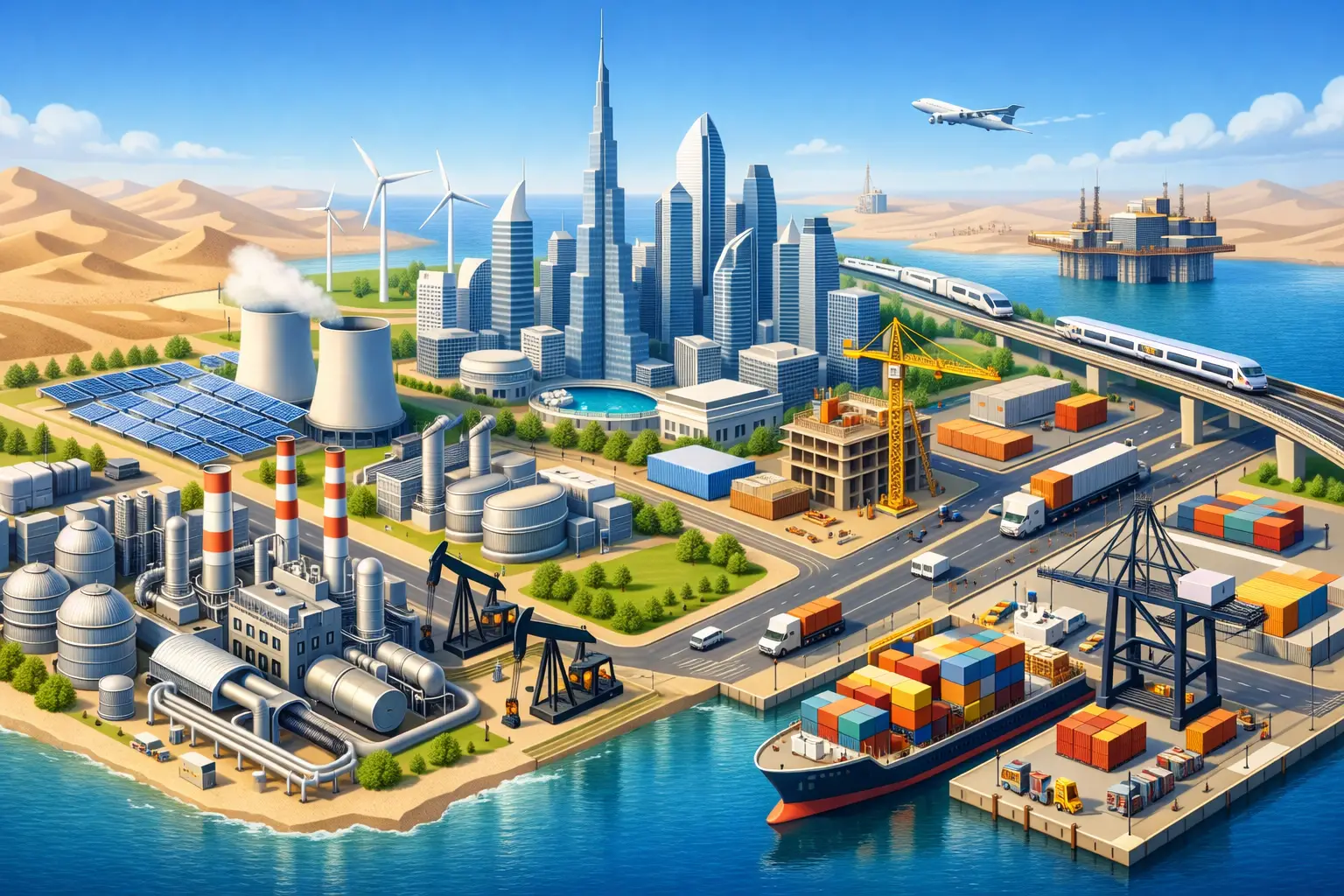
For advanced manufacturers, the real constraint in the UAE is no longer market ambition. It is infrastructure fit. Industrial Infrastructure UAE is being judged by a higher standard now – not just by land availability or warehouse supply, but by whether a location can support precision production, workforce stability, ESG targets, and cross-border speed at the same time.
That shift matters because the sectors driving the next wave of industrial growth are not looking for generic industrial zones. EV supply chains, hydrogen mobility platforms, semiconductor-adjacent operations, advanced materials, aerospace components, and renewable energy manufacturers need infrastructure that is technically prepared, operationally efficient, and commercially scalable. In the UAE, the winners will be the platforms built for that reality.
Why Industrial Infrastructure UAE Is Being Redefined
For years, industrial infrastructure in the region was often measured in basic terms: plot size, utility access, road links, and lease economics. Those metrics still matter, but they are no longer enough for investors making long-horizon decisions.
A serious manufacturing base now depends on a broader operating system. Companies need facilities that can be commissioned faster, utility frameworks that can support specialized loads, logistics assets that shorten movement between factory floor and export route, and a surrounding environment that helps retain technical talent. If any one of those pieces is weak, expansion costs rise quickly.
This is why Industrial Infrastructure UAE is moving away from a single-asset mindset and toward ecosystem thinking. The question is not simply where a company can build. The question is where it can produce efficiently, recruit reliably, meet compliance expectations, and expand without rebuilding its operating model every three years.
The New Benchmark Is Integrated Industrial Ecosystems
The most competitive industrial platforms in the UAE are not functioning like old industrial parks. They are being planned as integrated environments where production, logistics, R&D, services, and workforce life support each other.
That distinction has direct financial value. A manufacturer with access to turnkey factories, modular expansion options, logistics facilities, and sector-specific technical readiness can compress its time to operation. A business operating in a location with nearby housing, healthcare, education, and daily services can reduce workforce friction and improve retention. An investor entering a hub designed around long-term ESG alignment gains a stronger position with partners, regulators, and capital providers.
This is where many industrial developments fall short. They provide space, but not continuity. They solve for the first transaction, not the next decade of industrial growth. For sectors with high capital intensity and demanding production standards, that gap is expensive.
What Advanced Manufacturers Actually Need
Industrial decision-makers are becoming more precise about what qualifies as viable infrastructure. They are not only comparing incentive packages. They are comparing operating conditions.
First, facility readiness matters more than ever. A site that offers only raw land can still work, but it often extends project timelines and increases execution risk. In contrast, turnkey factories, modular industrial units, and cleanroom-ready environments give manufacturers a clearer path from approval to production. That is especially relevant in sectors where speed to market and capital efficiency are tightly linked.
Second, logistics integration is no longer optional. Industrial occupiers need dependable links to ports, regional trade lanes, airports, and major road networks. The UAE remains attractive because it can serve as a gateway to GCC demand, African growth corridors, and wider global markets. But not every site captures that advantage equally. The right location reduces freight complexity and improves resilience when supply chains tighten.
Third, sector compatibility is becoming a major differentiator. A general-use industrial plot may be enough for basic assembly or storage. It is not enough for hydrogen mobility infrastructure, EV component manufacturing, semiconductor support operations, or eVTOL-related production. These sectors need technical specifications, safety planning, utility reliability, and adjacent partners that fit their growth model.
Cost Still Matters, but So Does Cost Structure
One of the most common mistakes in industrial site selection is focusing on headline cost without evaluating operating structure. Lower lease rates can look attractive until utility upgrades, transportation inefficiencies, labor turnover, and retrofit requirements begin to accumulate.
The UAE remains competitive for manufacturers because it offers regulatory clarity, trade connectivity, and investor-friendly frameworks. Still, the real advantage comes from locations that combine those strengths with lower operating friction. That means sites where expansion can happen in phases, infrastructure has already been considered for modern production needs, and the wider environment supports business continuity.
For multinational manufacturers, this is not a minor distinction. Over a ten-year horizon, infrastructure inefficiencies can outweigh early rental savings. The more specialized the operation, the more damaging those hidden costs become.
ESG Compliance Is Now Part of Core Industrial Value
ESG was once treated as an additional layer in industrial planning. That era is over. For many global manufacturers and institutional investors, ESG readiness now sits inside the investment case itself.
Industrial infrastructure must increasingly support energy efficiency, future-facing mobility, sustainable land use, workforce wellbeing, and more transparent operating standards. In the UAE, this aligns with broader national ambitions around economic diversification, industrial capability, and sustainable growth. That policy direction matters because companies do not want to place advanced operations in environments that will look outdated within a few years.
The practical implication is clear. Industrial hubs that are planned with environmental and social performance in mind will attract stronger tenants and better capital. Hubs that ignore this shift may still fill space, but they will struggle to become strategic platforms for next-generation industry.
Ras Al Khaimah and the Rise of Strategic Industrial Geography
Geography still drives industrial performance, but the conversation has become more strategic. Manufacturers are looking for locations that balance cost, access, and room to scale. That is one reason Ras Al Khaimah is drawing attention from serious industrial occupiers.
It offers a compelling combination: competitive operating economics, access to port infrastructure, investor-oriented regulation, and connectivity to regional and international markets. For companies evaluating the UAE as a manufacturing base, that balance can create a stronger long-term platform than higher-cost locations that offer visibility but less flexibility.
A development model such as Erisha Smart Manufacturing Hub reflects where the market is heading. Instead of treating industry as an isolated land use, it frames industrial growth as part of a broader economic ecosystem – one that includes advanced production space, logistics capability, innovation support, and the residential and social infrastructure needed to sustain a skilled workforce. That is a more durable answer to industrial expansion than a conventional park model.
Where Industrial Infrastructure UAE Creates the Most Value
The strongest value creation is happening where infrastructure is aligned with sector strategy. This is especially true in industries with long investment cycles and complex technical requirements.
EV and battery-related manufacturers need scalable facilities, supplier adjacency, and efficient freight movement. Hydrogen mobility companies need infrastructure that can evolve alongside emerging standards and partnerships. Semiconductor-related operations need highly controlled environments and confidence in utility planning. Renewable energy manufacturers need room for production, storage, assembly, and export coordination. Aerospace-adjacent producers need exacting quality environments with dependable logistics and growth capacity.
In each case, the same principle applies: infrastructure performs best when it is purpose-built around industrial reality, not retrofitted after demand appears.
What Investors and Occupiers Should Ask Before Committing
The right question is not whether a site is available. It is whether the infrastructure can support industrial ambition at scale.
Decision-makers should examine how fast a facility can become operational, whether the site can support future phases of expansion, how well logistics are integrated, what kind of technical environment is possible, and whether the surrounding ecosystem will help or hinder workforce retention. They should also assess whether the development is aligned with the sectors shaping the next decade of manufacturing, or whether it is trying to serve every use case without true specialization.
Industrial infrastructure becomes valuable when it reduces friction across the full operating lifecycle. That includes setup, production, hiring, compliance, expansion, and market access. If a platform improves only one of those variables, it may still be useful. If it improves all of them together, it becomes strategic.
The future of Industrial Infrastructure UAE will be defined by that standard. The market does not need more industrial land in the abstract. It needs environments where advanced industry can start faster, operate smarter, and grow with confidence.
