
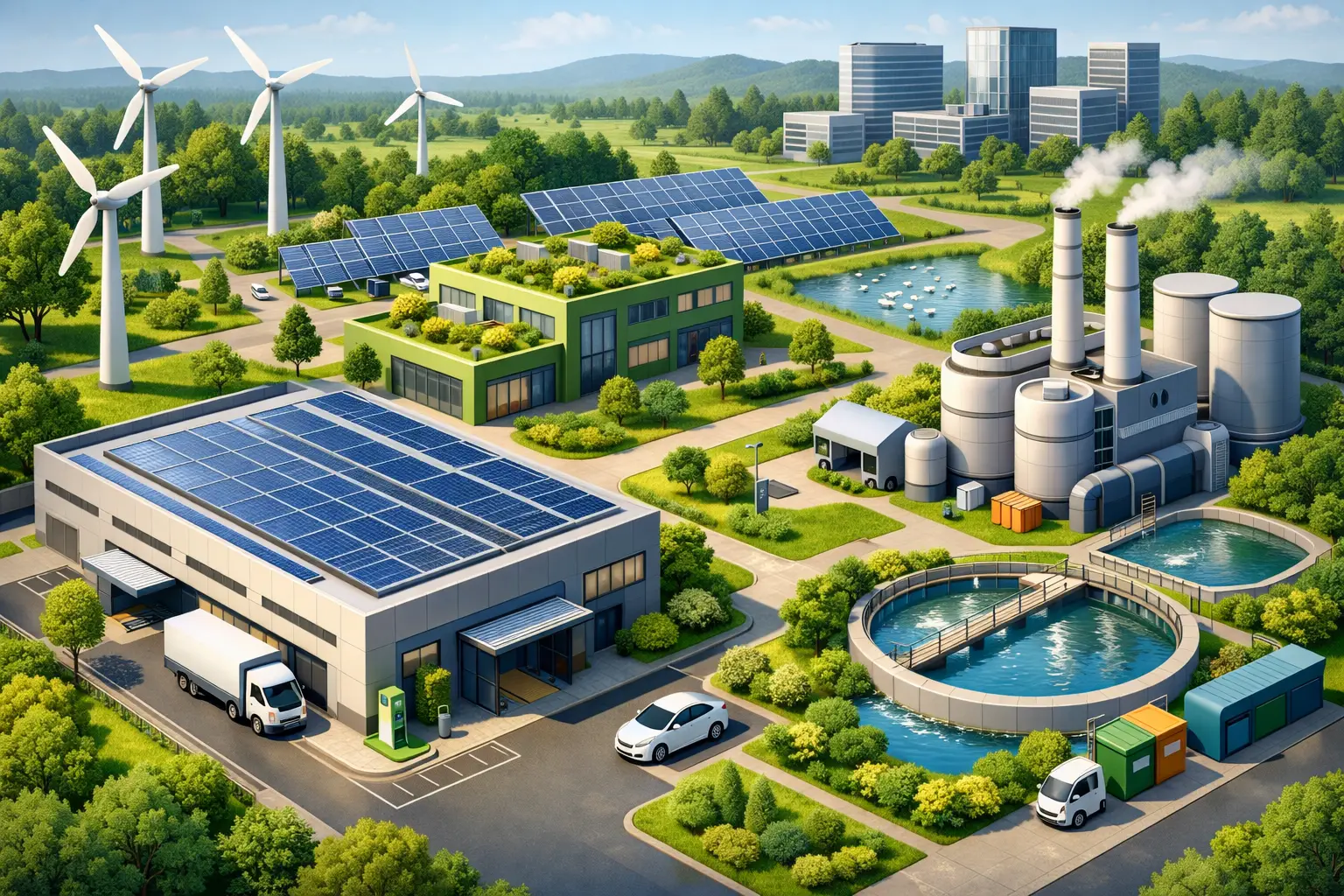
An advanced manufacturer can solve for land, power, and logistics and still fail the expansion test. The weak point is often the operating environment around the plant itself. If the workforce cannot live nearby, if compliance costs rise every year, if utilities are not planned for efficiency, and if investors see long-term ESG exposure, the site becomes a drag on growth. That is why the idea of an esg compliant factory campus matters more now than it did even five years ago. It is no longer a branding layer. It is industrial strategy.
Why the ESG compliant factory campus model is gaining ground
For high-value manufacturing, ESG has moved from reporting language into site-selection criteria. Boards, lenders, customers, and regulators increasingly want proof that industrial growth can scale without creating avoidable environmental liabilities, workforce instability, or governance risk. A single factory can address some of that. A campus model can address far more.
The difference is structural. A conventional industrial park usually focuses on plots, roads, and utilities. An ESG compliant factory campus is planned as an operating system. Energy performance, water management, mobility, worker access, emergency response, waste handling, supplier movement, and community services are considered together rather than as separate afterthoughts. That changes both cost dynamics and resilience over time.
For manufacturers in sectors such as EVs, semiconductors, hydrogen mobility, renewable energy components, and aerospace-adjacent production, that distinction is material. These businesses often run complex equipment, require stable operating conditions, face close customer scrutiny, and compete globally for capital. The physical environment around the factory directly affects uptime, recruitment, brand perception, and financing options.
ESG compliance in industry is practical, not symbolic
The market often talks about ESG in abstract terms, but industrial occupiers do not make decisions in the abstract. They ask practical questions. How much will utility systems cost to operate over ten years? How exposed is the site to future emissions rules? Can the workforce be retained without long and inefficient commutes? Will customers accept this facility as part of a compliant supply chain? Can institutional investors support expansion here without governance concerns?
An ESG compliant campus answers those questions with infrastructure, not slogans.
On the environmental side, that means more than efficient buildings. It includes land planning that reduces transport friction inside the site, utility architecture that supports efficient power and water use, and room for future adaptation as production scales. A facility that works today but cannot integrate cleaner energy systems or tighter waste protocols later may look cheaper at entry and more expensive in year seven.
On the social side, the issue is not philanthropy. It is labor economics and operating continuity. Manufacturers need access to talent, but they also need an environment that supports retention. Housing access, mobility, healthcare, training, education, and day-to-day services influence absenteeism, productivity, and turnover. If those assets sit outside the industrial plan, employers absorb the hidden cost.
On governance, serious occupiers want clarity. They want a structured development environment, transparent compliance expectations, and a framework that can support audits, investor reviews, and long-cycle expansion decisions. Governance quality rarely appears in site renderings, but it sits behind every durable industrial ecosystem.
What separates a campus from a collection of factories
The strongest industrial platforms are built around interdependence. Manufacturing does not happen in isolation. Suppliers move in sequence. Skilled workers need predictable support systems. R&D functions benefit from proximity to production. Logistics works best when the site is designed around flow rather than patched together over time.
That is why the campus model has become more compelling than stand-alone development. A true factory campus can combine production units, logistics capacity, worker-serving amenities, training environments, and sector-specific infrastructure in one master-planned setting. For advanced industries, that can compress decision cycles and reduce the friction that usually appears between launch and scale-up.
There is also a reputational effect. An investor or multinational partner reviewing a campus sees whether the developer understands industrial value creation at ecosystem level. That matters. Sophisticated capital does not only ask whether a building is available. It asks whether the surrounding platform will strengthen or constrain the business over a decade.
The cost case is stronger than many expect
Some executives still hear ESG and assume premium cost. In industrial development, that is often an incomplete view.
Yes, an ESG aligned campus can require more disciplined planning up front. Utility systems, mobility, water strategies, and mixed-use integration are not casual investments. But poorly planned industrial growth creates its own premiums later through higher energy intensity, labor churn, fragmented logistics, duplication of services, and retrofitting costs.
The better question is not whether ESG adds cost. It is where cost sits and how long it stays. A site that lowers transport inefficiency, supports labor retention, reduces future compliance exposure, and improves investor confidence may be financially stronger even if upfront planning is more demanding.
This is especially relevant in regions competing for global industrial capital. Manufacturers expanding into the Middle East are often balancing speed, cost efficiency, and strategic market access. A campus that combines lower operating friction with future-ready compliance can move from being a nice-to-have to a deciding factor.
Why sector specialization matters in an ESG compliant factory campus
Not every manufacturer needs the same infrastructure. Cleanroom-ready semiconductor production has different requirements from EV assembly or hydrogen mobility components. Renewable energy manufacturing has a different logistics and storage profile from aerospace-adjacent precision systems.
That is why generic ESG claims are not enough. The campus has to support the actual operating profile of its target sectors.
A specialized ESG compliant factory campus can plan for heavier power loads, cleaner production environments, sensitive supply chains, testing facilities, and freight movement in ways that a general-purpose site cannot. It can also create clustering effects. When related industries are located within the same ecosystem, suppliers, talent pools, service providers, and innovation partners become easier to align.
That clustering advantage is one of the most underestimated elements in industrial expansion. It does not show up only as convenience. It can affect procurement speed, technical collaboration, workforce development, and customer confidence.
The live-work-innovate model is becoming an industrial advantage
Industrial real estate used to treat residential, education, healthcare, and retail functions as external concerns. That model is under pressure. For advanced manufacturing, the workforce experience is now part of operational performance.
A campus that integrates living, learning, wellness, and industrial work can reduce the distance between labor demand and labor stability. It can also make a location more attractive to skilled domestic and international talent who are comparing not just salaries, but quality of life and professional opportunity.
This is where ecosystem thinking becomes decisive. If an engineer, technician, plant manager, or research partner can operate inside a connected environment rather than a disconnected industrial zone, the employer gains an edge. That edge may show up in hiring speed, lower churn, stronger culture, and greater readiness for shift-based or high-precision operations.
For industrial leaders, this is not soft value. It is execution value.
A strategic example of where this model is headed
This is the logic behind next-generation industrial hubs being developed for advanced manufacturing rather than conventional warehousing or low-spec production. Platforms such as the Erisha Smart Manufacturing Hub reflect a broader market shift toward integrated industrial environments designed for long-horizon growth, sector specialization, and ESG alignment in one place. That matters to occupiers looking beyond immediate occupancy toward long-term competitiveness.
The relevance is especially strong where national economic strategy, logistics access, investor-friendly regulation, and industrial diversification are moving in the same direction. In that setting, the campus is not just a place to operate. It becomes a platform for expansion into regional and global markets.
What decision-makers should look for before committing
The right question is not whether a site calls itself ESG compliant. The right question is whether the campus can support your operating model at scale without pushing hidden risk back onto your balance sheet.
That means examining infrastructure depth, utility planning, sector fit, labor ecosystem design, logistics integration, governance clarity, and room for phased growth. It also means testing how credible the developer is as an ecosystem builder. Many projects can deliver buildings. Far fewer can deliver industrial continuity.
An ESG compliant factory campus should make growth more predictable, not just more marketable. If it does not improve resilience, talent access, cost discipline, and strategic positioning, then the label has limited value.
The manufacturers that lead the next decade will not choose sites based on short-term availability alone. They will choose environments that help them produce efficiently, hire competitively, satisfy capital, and adapt with confidence as standards rise. The future of industry will not be built factory by factory. It will be built campus by campus, with the discipline to make sustainability, performance, and scale work together.
