
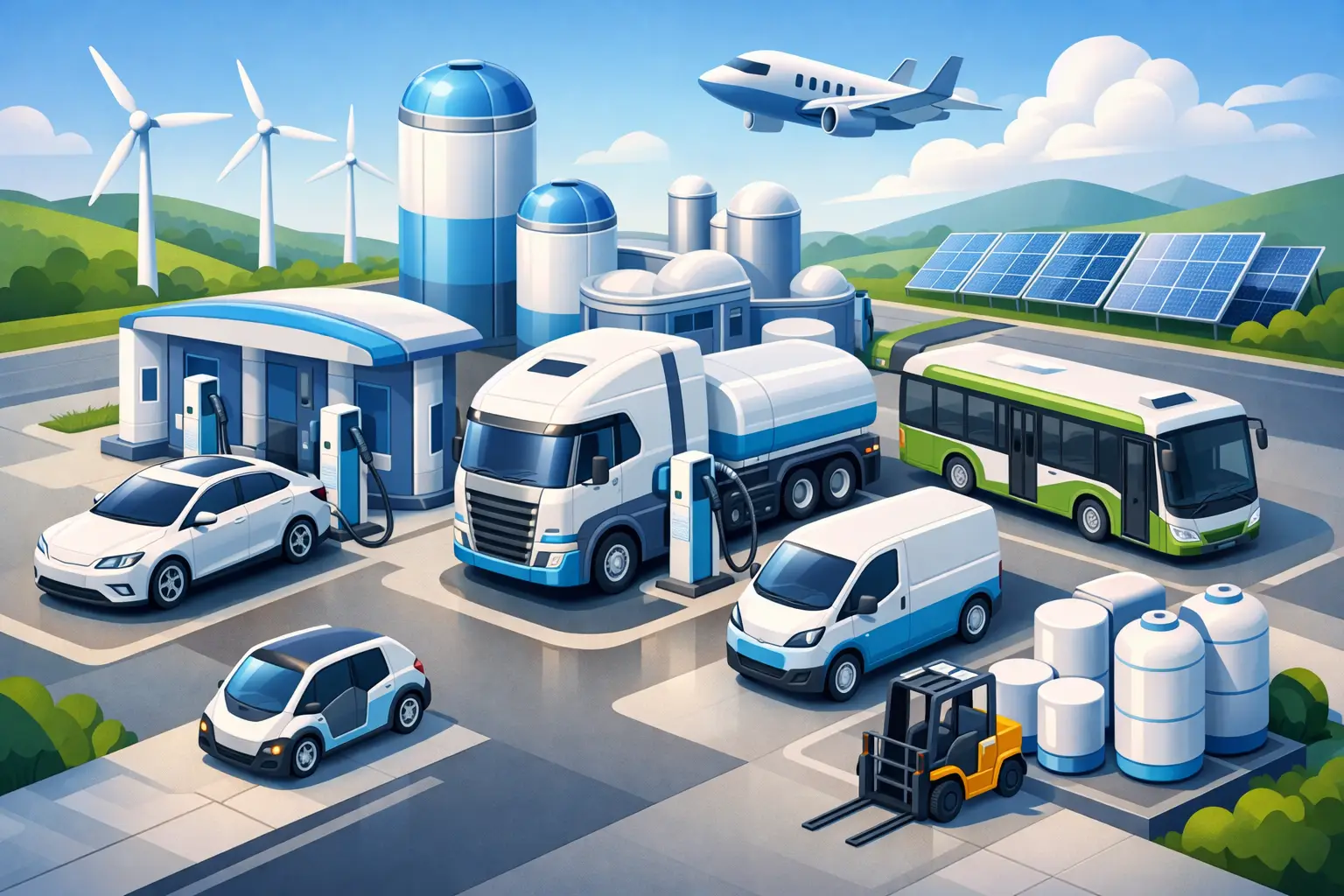
A hydrogen mobility hub case study is rarely about hydrogen alone. The projects that gain momentum are the ones that solve an industrial equation at full scale: energy supply, vehicle demand, logistics access, land readiness, workforce support, and regulatory alignment. Remove one piece, and the economics weaken quickly. Get the system right, and a hub becomes more than infrastructure. It becomes a platform for manufacturing growth, fleet adoption, and regional competitiveness.
That distinction matters for investors, OEMs, and advanced industrial occupiers evaluating where the next wave of clean mobility will actually industrialize. Hydrogen mobility is entering a phase where vision is no longer enough. Capital is looking for sites that can convert policy ambition into operating assets.
What this hydrogen mobility hub case study really shows
The most useful way to approach a hydrogen mobility hub case study is not as a single project profile, but as a model for what makes a hub investable. Across markets, the pattern is consistent. The strongest hydrogen mobility ecosystems are built where production, storage, distribution, vehicle deployment, and adjacent manufacturing can be coordinated instead of fragmented.
A hub fails when it is treated as a fueling station expansion story. It succeeds when it is planned as industrial infrastructure with mobility demand built in. That means the right land parcel is only the starting point. The true advantage comes from ecosystem design – proximity to ports, freight corridors, industrial tenants, utility strategy, and a labor environment capable of supporting both high-value manufacturing and daily operations.
For decision-makers, this shifts the question from “Can we build hydrogen infrastructure here?” to “Can this location support hydrogen mobility as an operating industrial cluster over the next decade?” Those are very different thresholds.
The core components of a bankable hub
A serious hydrogen mobility hub needs demand certainty before it needs headlines. Fleet operators, heavy transport corridors, municipal transit, industrial vehicle users, and commercial logistics networks create the baseline offtake that supports fueling economics. Without that demand anchor, hydrogen infrastructure remains speculative, no matter how advanced the technology stack may be.
The second requirement is co-location. Production and distribution costs matter more in hydrogen than they do in many other clean-tech segments because transport and storage are still operationally sensitive and capital intensive. A hub that integrates production, compression, storage, vehicle servicing, and industrial users in one area can improve utilization rates and reduce system friction.
The third component is industrial adjacency. Hydrogen mobility does not live in isolation from manufacturing. Vehicle assembly, component fabrication, tank systems, power electronics, testing facilities, and maintenance capabilities all benefit from being near one another. This is where mixed-use industrial ecosystems create structural value. They support not just deployment, but the full supply chain behind deployment.
Why location strategy decides the outcome
Hydrogen mobility is often discussed through technology readiness, but location strategy usually decides commercial viability. Land cost, permitting speed, utility access, export potential, and logistics connectivity all shape whether a hub can move from pilot to scale.
For example, a site with port access and direct freight links has a major advantage over an inland location that requires multiple handoffs for equipment and fuel movement. A location with investor-friendly regulation and lower operating costs improves the long-term case for manufacturing tenants. A site that can house workers near the industrial base lowers operational strain and improves talent retention. These are not secondary benefits. They are part of the commercial logic.
This is especially relevant in the Middle East, where national industrial strategies, energy transition targets, and export-led growth agendas are converging. The regions most likely to lead in hydrogen mobility are not simply promoting clean transport. They are building ecosystems that connect production, advanced manufacturing, logistics, and trade.
Demand first, then infrastructure
One of the clearest lessons in any hydrogen mobility hub case study is that infrastructure should follow credible demand pathways. Heavy-duty trucking, buses, port equipment, airport ground support, and industrial fleets tend to be stronger early use cases than passenger mobility. Their routes are more predictable, utilization rates are higher, and refueling can be centralized.
That matters because hydrogen economics improve when assets are heavily used. A station serving a defined commercial fleet has a more stable utilization profile than one built around uncertain open-market demand. Likewise, a hub with nearby industrial users for hydrogen can diversify offtake and improve project resilience.
There is a trade-off here. A narrowly focused hub may achieve faster initial utilization, but a broader multi-user ecosystem is usually better positioned for long-term scale. The right answer depends on market maturity, policy support, and the quality of anchor tenants.
Manufacturing changes the value proposition
The market often talks about hydrogen mobility as a downstream adoption story, yet the larger opportunity is upstream and midstream industrialization. When a hub includes manufacturing capacity for mobility platforms, balance-of-plant systems, storage technology, and related components, it captures more of the value chain and creates stronger reasons for global companies to establish a regional base.
This is where purpose-built industrial environments become strategically important. Companies do not just need a plot of land. They need facilities that can support specialized production requirements, flexible expansion, logistics efficiency, testing capabilities, and ESG-aligned operations. The more integrated the environment, the lower the execution risk.
That is also why ecosystem design has become a competitive differentiator. Industrial occupiers increasingly evaluate whether a location can support executives, engineers, technicians, and supplier networks over time. Live-work infrastructure, healthcare access, training partnerships, and community amenities are no longer soft benefits. In advanced manufacturing, they support continuity.
Policy alignment is necessary, but not sufficient
Hydrogen mobility hubs tend to gain attention when they align with national decarbonization and industrial diversification goals. That alignment is valuable. It can support permitting, incentives, infrastructure investment, and public-private collaboration. But policy support alone does not create a commercially durable hub.
The projects that endure are the ones that combine policy alignment with operational realism. They secure land with expansion potential. They stage development in phases. They attract anchor demand before overbuilding. They place infrastructure where logistics already work. And they treat hydrogen mobility as part of a wider industrial strategy, not a standalone demonstration.
For investors, that discipline matters. A future-facing project still needs present-tense economics.
What investors and occupiers should test
When evaluating a hydrogen mobility opportunity, executives should look beyond the technology narrative. The real questions are practical. Is there a credible demand cluster nearby? Can the site support both fueling and manufacturing activity? Are utilities and transport links sufficient for scale? Is there room for phased growth without relocation risk? Can the surrounding ecosystem support workforce needs and supplier integration?
It is also worth testing whether the project has the right sector mix. A hydrogen hub positioned near EV manufacturing, renewable energy production, logistics assets, and advanced industrial tenants can benefit from shared infrastructure and cross-sector synergies. That kind of clustering improves resilience because the hub is not dependent on a single revenue stream or technology cycle.
For companies entering the Middle East, this is where ecosystem platforms stand out. Developments designed as integrated industrial environments, rather than conventional industrial parks, can reduce fragmentation at the exact moment when speed to market matters most. Rana Group’s vision around ecosystem-led industrial growth reflects this broader shift: the most competitive hubs are being built as complete economic platforms, not isolated real estate products.
The larger lesson from this hydrogen mobility hub case study
The future of hydrogen mobility will not be decided by isolated assets. It will be decided by whether regions can build places where energy, manufacturing, logistics, and talent operate as one system. That is the real lesson from any serious hydrogen mobility hub case study.
For industrial leaders, the opportunity is not simply to participate in a clean transport trend. It is to secure position inside the infrastructure layer of the next manufacturing cycle. The winners will be the hubs that make hydrogen mobility easier to deploy, cheaper to operate, and more attractive to scale.
That is where the next generation of industrial value will be built – not at the edge of the market, but at the center of a well-planned ecosystem where the future works.

[…] park but as a purpose-built environment for next-generation sectors – including EVs, hydrogen mobility, aerospace-adjacent manufacturing, semiconductors, and renewable energy. For a hydrogen truck […]
[…] manufacturers in sectors such as semiconductors, EVs, hydrogen mobility, and aerospace-adjacent production, that design logic matters even more. These sectors rely on […]