
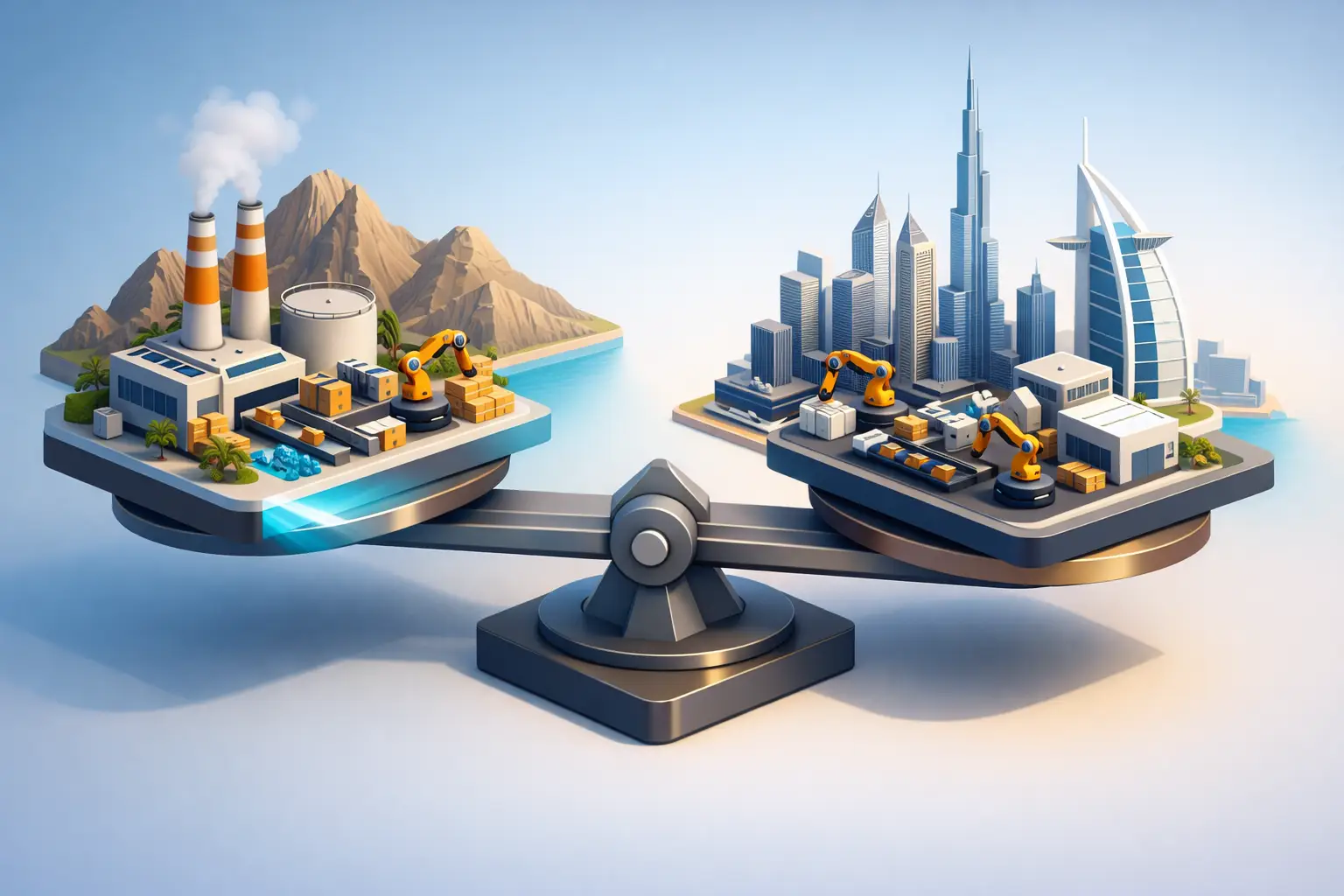
If you are comparing RAK vs Dubai manufacturing, you are not choosing between two versions of the same industrial market. You are choosing between two fundamentally different operating models. Dubai offers brand visibility, commercial density, and established international business networks. Ras Al Khaimah offers a lower-cost industrial base, expansion room, and a clearer path for manufacturers that need production capacity to scale without carrying big-city overhead into every square foot.
For industrial investors and advanced manufacturers, that distinction matters more than image. The right location is the one that protects margins, supports logistics, aligns with workforce needs, and still gives the business room to grow five or ten years from now.
RAK vs Dubai manufacturing: the real decision criteria
Too many location comparisons stop at headline reputation. Manufacturing decisions do not. They are shaped by energy intensity, land efficiency, freight access, permitting, labor accommodation, environmental targets, and the ability to phase expansion without operational disruption.
Dubai remains a powerful base for regional headquarters, trade-led companies, and manufacturers that benefit from immediate proximity to large commercial ecosystems. If the model depends on customer access, showroom functions, or frequent executive movement through a major global city, Dubai has clear advantages.
But manufacturing is not only about address value. It is about operating structure. For companies in EVs, hydrogen mobility, semiconductors, renewable energy, aerospace-adjacent systems, and advanced assembly, the question becomes more practical: where can the business build efficiently, run at competitive cost, and scale with less friction?
That is where RAK enters the discussion with increasing force.
Cost structure changes the manufacturing equation
The clearest difference in RAK vs Dubai manufacturing is cost discipline. Land, lease rates, warehousing, industrial unit pricing, and support overhead are typically more favorable in Ras Al Khaimah than in Dubai. That does not just improve a startup budget. It changes the economics of long-term production.
For manufacturers, lower occupancy cost creates strategic flexibility. It allows more capital to move into automation, line equipment, testing capability, and inventory resilience instead of being absorbed by location premium. In sectors with long payback periods or high capex requirements, that shift can materially improve project viability.
Dubai may still make sense when the higher cost is justified by customer concentration or premium ecosystem access. But if the production model is land-intensive, utility-sensitive, or designed for multi-phase buildout, RAK often presents the stronger operating case.
This is particularly relevant for companies planning regional export manufacturing rather than just local distribution. A lower fixed-cost base can protect competitiveness across market cycles, not just at launch.
Space and industrial planning are not minor details
One of the most underestimated issues in site selection is future expansion. A facility may work on day one and still fail the business by year three if nearby land is constrained, truck movement becomes inefficient, or worker accommodation and support services are disconnected from operations.
Dubai has mature industrial zones, but maturity can also mean tighter land availability, more fragmented expansion options, and premium pricing for well-positioned plots. For some occupiers, that is a manageable trade-off. For others, especially those building specialized production environments, the inability to scale in place creates real risk.
RAK is increasingly attractive because it offers room to think beyond a first facility. Manufacturers can evaluate larger footprints, phased development, logistics integration, and dedicated industrial clusters with fewer constraints. That matters for sectors that require cleanroom readiness, controlled supply chains, hazardous material protocols, or adjacent warehousing and testing functions.
An industrial base should not force a company to outgrow its own site strategy. It should support expansion as a built-in possibility.
Logistics is about network fit, not just map distance
Dubai is often the default choice in logistics discussions because of its global connectivity and strong trade infrastructure. That strength is real. For many businesses, especially those tied to rapid import-export cycles or high-frequency international travel, Dubai can deliver undeniable advantages.
But manufacturing logistics is not judged by airport reputation alone. It is shaped by freight economics, port access, customs efficiency, domestic transport patterns, and the physical relationship between factory, storage, and outbound channels.
RAK offers a compelling proposition for companies that want access to regional and global markets without placing production in one of the UAE’s highest-cost operating environments. For businesses shipping across the GCC, into South Asia, or through broader export corridors, the value lies in balancing connectivity with cost control.
That balance matters even more when logistics volumes increase. A location that is slightly less central in brand perception can become significantly more attractive when the total landed cost of production improves.
Workforce strategy goes beyond labor supply
Manufacturers do not only need workers. They need retention, reliability, and an environment that supports technical operations over time. That includes housing, transport, healthcare access, education options for families, and the broader quality of life that keeps talent stable.
Dubai offers a deep labor market and executive appeal. That makes it a strong fit for headquarters functions, technical sales leadership, and organizations that need to attract globally mobile professionals who prioritize metropolitan living.
Yet industrial operations often require a broader workforce ecosystem, not just urban talent density. If production teams face long commutes, fragmented support services, or high living costs disconnected from wages, productivity can suffer and turnover can rise.
This is where integrated industrial ecosystems become more strategic than conventional industrial zones. A manufacturing location that combines production infrastructure with residential, healthcare, education, retail, and R&D support is better positioned to sustain workforce continuity. That model is especially relevant for advanced industry, where technical teams, engineers, operations staff, and suppliers all need a more stable long-term environment.
ESG and future-industry alignment matter more now
For advanced manufacturers, the location decision is increasingly tied to sustainability reporting, energy strategy, investor expectations, and national industrial alignment. This is no longer a side consideration handled after the lease is signed.
Dubai has made major progress in sustainability and innovation positioning, and many companies will find that ecosystem attractive. But for firms building next-generation industrial capacity, the stronger question is whether the site itself is designed for ESG-aligned manufacturing from the ground up.
RAK has growing relevance here because it can support purpose-built industrial environments rather than retrofitted solutions. That distinction matters for companies in renewable energy systems, hydrogen mobility, EV production, and semiconductor-related manufacturing, where the facility itself becomes part of the operational strategy.
Institutional investors and multinational occupiers are now looking for industrial platforms that align with decarbonization goals, efficient infrastructure planning, and long-term resilience. In practice, that means the winning location is not always the most globally visible one. It is the one designed around the needs of future industry.
When Dubai is the right call
A serious comparison should acknowledge where Dubai leads. If a manufacturer needs a high-profile regional base with strong access to commercial partners, financial services, global talent, and executive mobility, Dubai remains a compelling choice. It can also be the better fit for hybrid businesses that combine light manufacturing, distribution, client engagement, and headquarters operations in one footprint.
Dubai is also useful when speed depends on existing commercial density. Some firms benefit from being close to customers, advisors, integrators, and trade ecosystems that are already concentrated there.
The trade-off is straightforward: those advantages often come at a higher operating cost and with less flexibility for large-footprint industrial scaling.
When RAK becomes the stronger manufacturing platform
RAK tends to outperform when the core requirement is industrial efficiency rather than metropolitan positioning. If the business needs competitive land economics, purpose-built infrastructure, cleaner expansion pathways, and a location strategy built around long-term production, RAK becomes a very serious contender.
This is particularly true for high-value and infrastructure-heavy sectors. Companies in advanced manufacturing need more than a plot and a warehouse. They need an environment that can support specialized utilities, logistics coordination, technical labor planning, and adjacent innovation functions. That is why ecosystem-led developments are gaining traction.
At Rana Group, this is the logic behind building industrial infrastructure as a live-work-innovate platform rather than a standalone park. The market is moving beyond isolated facilities. Manufacturers increasingly want operating environments that connect production capacity with talent support, R&D readiness, and sector-specific clustering.
The better question is not RAK or Dubai – it is what your factory needs to become
The most effective site decisions are not made by asking which emirate is more famous. They are made by asking what kind of manufacturing model the business is trying to build.
If the goal is a visible commercial base with strong urban connectivity, Dubai may justify its premium. If the goal is scalable, future-ready manufacturing with tighter cost control and room to build industrial depth, RAK can offer a stronger platform.
For many advanced manufacturers, the answer will not come from prestige. It will come from whether the site can carry the next phase of growth without becoming the next constraint. That is the standard worth using as you decide where the future of your operation should take shape.

* Strategic Proximity to the Strait of Hormuz: Positioned at the mouth of the Gulf, significantly reducing sea transit time.
* Direct Access to Open Waters: Seamless connection to the Sea of Oman and the Indian Ocean for global trade.
* Global Market Gateway: Faster maritime routes to major markets in East Asia, India, and Africa.
* Lower Logistics Costs: Reduced shipping distances and fuel consumption compared to inner-Gulf ports.
* Home to Saqr Port: The largest bulk handling port in the Middle East, ideal for raw material imports.
* Industrial Hub Design: Dedicated zones for heavy and medium manufacturing with unrestricted 24/7 heavy vehicle access.
* Operational Cost Efficiency: Significantly lower land lease, utility, and labor housing costs compared to Dubai.